Build an actor–reviewer loop under test
Write a flow with two roles: an actor that works on a goal, and a reviewer that answers with a typed verdict. The flow loops until the reviewer approves. You write the test first with scripted agents, then run the flow on real ones.
What you need
hmzinstalled, and one coding agent signed in. This page uses Claude Code. See Coding agents.- uv, to run the tests.
- A project in git. This page uses
~/shop.
1. Make a place for the flow
Create a directory for the flow under .hmz/flows/ and one for its tests:
cd ~/shop
mkdir -p .hmz/flows/review_loop .hmz/tests
The directory name sets the flow's name. You run it as @local/review_loop.
2. Declare the roles and the verdict
Save this stub flow as .hmz/flows/review_loop/__init__.py. It declares the loop's types and takes a single turn.
# .hmz/flows/review_loop/__init__.py
import pydantic

from hmz.flows import (
    Agent,
    AgentCollection,
    EnvCollection,
    FlowContext,
    FlowParams,
    GoalCommandAgentMixin,
    LocalEnv,
    Permission,
    flow,
)


class Verdict(pydantic.BaseModel):
    """What the reviewer decides."""

    approved: bool = pydantic.Field(description="True only if the goal is met.")
    notes: str = pydantic.Field(description="What to fix, said to the actor as it is.")


class Actor(Agent, GoalCommandAgentMixin):
    """Does the work."""


class Reviewer(Agent):
    """Reads the work and changes nothing."""

    _permission = Permission("read-only")


class Agents(AgentCollection):
    actor: Actor
    reviewer: Reviewer


class Envs(EnvCollection):
    workspace: LocalEnv


class Params(FlowParams):
    rounds: int = 3


@flow(agents=Agents, envs=Envs, params=Params)
async def review_loop(
    task: str, *, agents: Agents, envs: Envs, params: Params, ctx: FlowContext
) -> bool:
    """An actor works on a goal until a reviewer approves it."""
    actor = agents["actor"]
    await actor.run(f"/goal {task}", session=await actor.spawn(), env=envs["workspace"])
return False| Class | Role in the flow |
|---|---|
Verdict | Defines the reviewer's response. Each field's description goes to the agent with the schema, as the instruction for that field. |
Actor | Includes GoalCommandAgentMixin so the flow can send /goal. The agent works until it judges the goal met. |
Reviewer | Uses the read-only permission to read the project without changing it. |
Params | Defines the rounds setting with a default of 3. |
3. Write the test first
Save this test file as .hmz/tests/test_review_loop.py:
# .hmz/tests/test_review_loop.py
from hmz.sdk import fakes


async def test_notes_go_back_until_approved() -> None:
    actor = fakes.FakeAgentDriver()
    reviewer = fakes.FakeAgentDriver(
        reply=[
            {"approved": False, "notes": "cover the empty cart"},
            {"approved": True, "notes": ""},
        ]
    )

    approved = await fakes.run_fake(
        "review_loop", "add a coupon", agents={"actor": actor, "reviewer": reviewer}
    )

    assert approved is True
    assert actor.prompts == ["/goal add a coupon", "cover the empty cart"]
    assert len(reviewer.sessions) == 2


async def test_it_gives_up_after_its_rounds() -> None:
    reviewer = fakes.FakeAgentDriver(reply={"approved": False, "notes": "not yet"})

    approved = await fakes.run_fake(
        "review_loop",
        "add a coupon",
        agents={"reviewer": reviewer},
        params={"rounds": 2},
    )

    assert approved is False
    assert len(reviewer.prompts) == 2
run_fake runs the flow with a FakeAgentDriver in each role, which answers from a script at once.
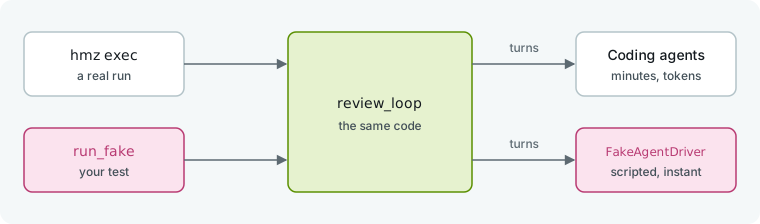
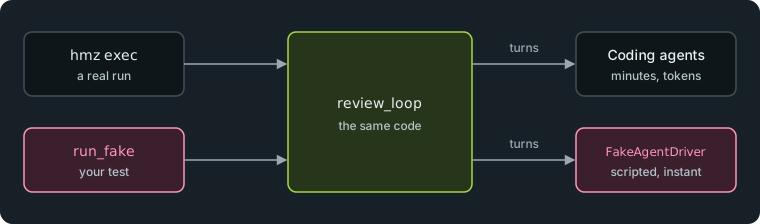
A list in reply gives one answer per turn, and a mapping is parsed as the Verdict. Any role you omit gets a fake that answers ok. On each fake, prompts records every prompt received and sessions records every session opened.
The first test checks that reviewer notes become the actor's next prompt and that each review opens a new session. The second test checks that the flow stops after rounds rounds.
4. Watch the test fail
Run the tests from the project root:
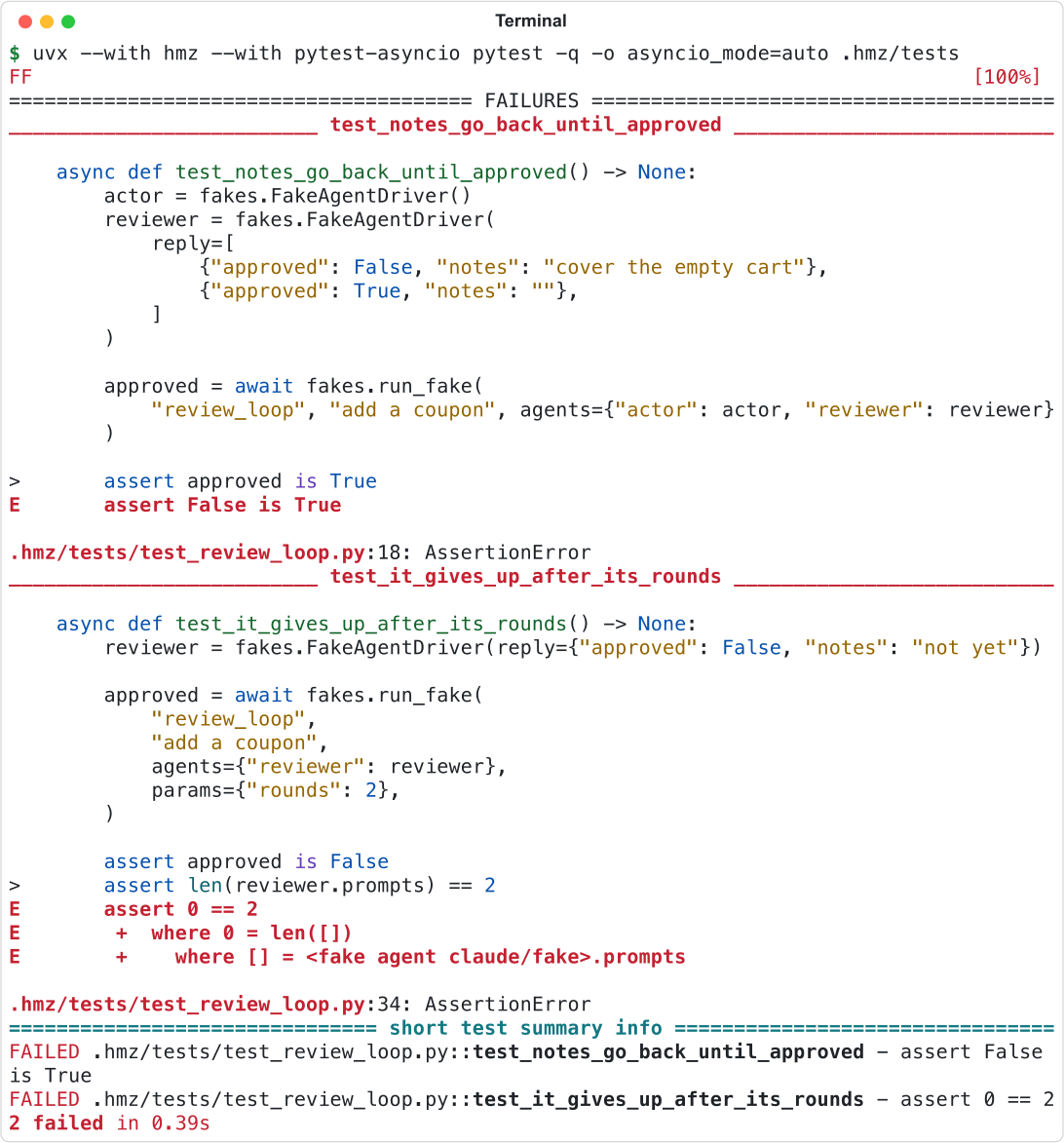
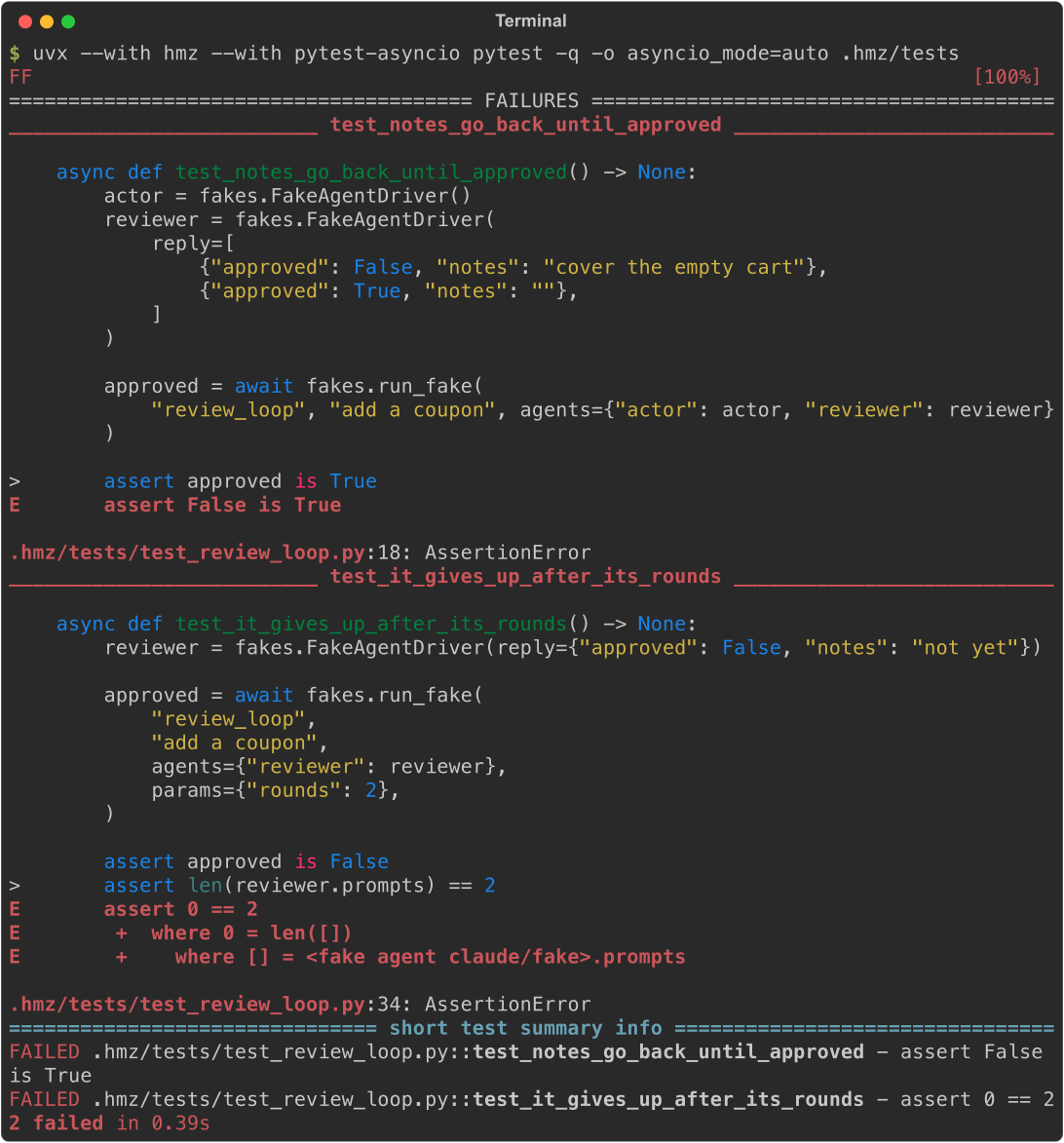
uvx --with hmz --with pytest-asyncio pytest -q -o asyncio_mode=auto .hmz/testsuvx runs pytest with hmz and pytest-asyncio without installing them in your project. Both tests fail because the stub flow never calls the reviewer.
5. Write the loop
Replace the function at the end of .hmz/flows/review_loop/__init__.py with the full loop:
@flow(agents=Agents, envs=Envs, params=Params)
async def review_loop(
    task: str, *, agents: Agents, envs: Envs, params: Params, ctx: FlowContext
) -> bool:
    """An actor works on a goal until a reviewer approves it."""
    actor, reviewer = agents["actor"], agents["reviewer"]
    workspace = envs["workspace"]
    work = await actor.spawn()
    prompt = f"/goal {task}"
    for _ in range(params.rounds):
        await actor.run(prompt, session=work, env=workspace)
        verdict = await reviewer.run(
            f"Review the change in this repository. The goal: {task}",
            session=await reviewer.spawn(),
            env=workspace,
            output_schema=Verdict,
        )
        if verdict.approved:
            return True
        prompt = verdict.notes
    return False
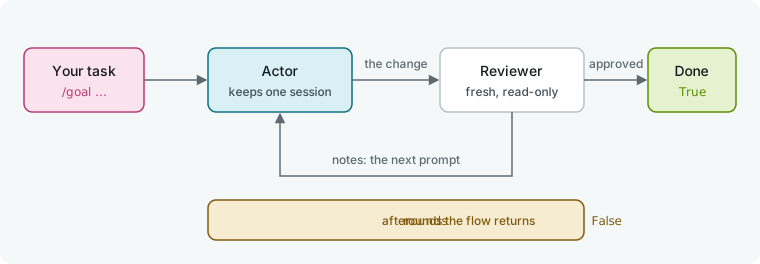
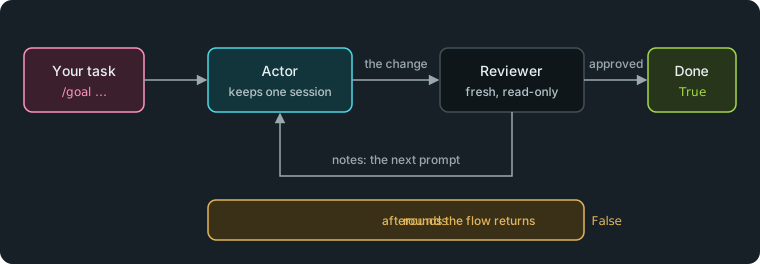
The actor's spawn stays outside the loop so it keeps one session and remembers every round. The reviewer's spawn sits inside the loop so each review starts fresh. Passing output_schema=Verdict makes run return a Verdict instance. If verdict.approved is false, verdict.notes becomes the actor's next prompt. If the loop finishes params.rounds rounds without approval, it returns False.
6. Run the tests again
Run the pytest command again. Both tests pass in about a second without starting an agent.
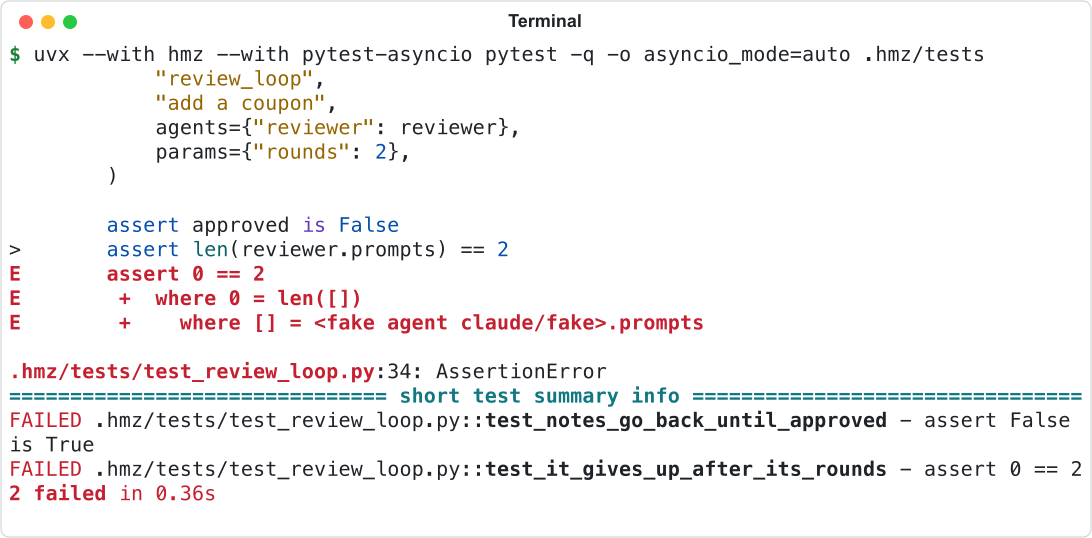
Before the loop, and after it.
7. Run it on real agents
Run the flow with -a to assign each role an agent and -p to set the required budget:
hmz exec -f @local/review_loop \
    -a actor=claude/claude-haiku-4-5 -a reviewer=claude/claude-haiku-4-5 \
    -p budget.output_tokens=20000 "Add a coupon code to checkout"
The actor edits the project, and the reviewer responds with JSON that run parses as a Verdict. When a verdict is not approved, the actor receives the notes and tries again.
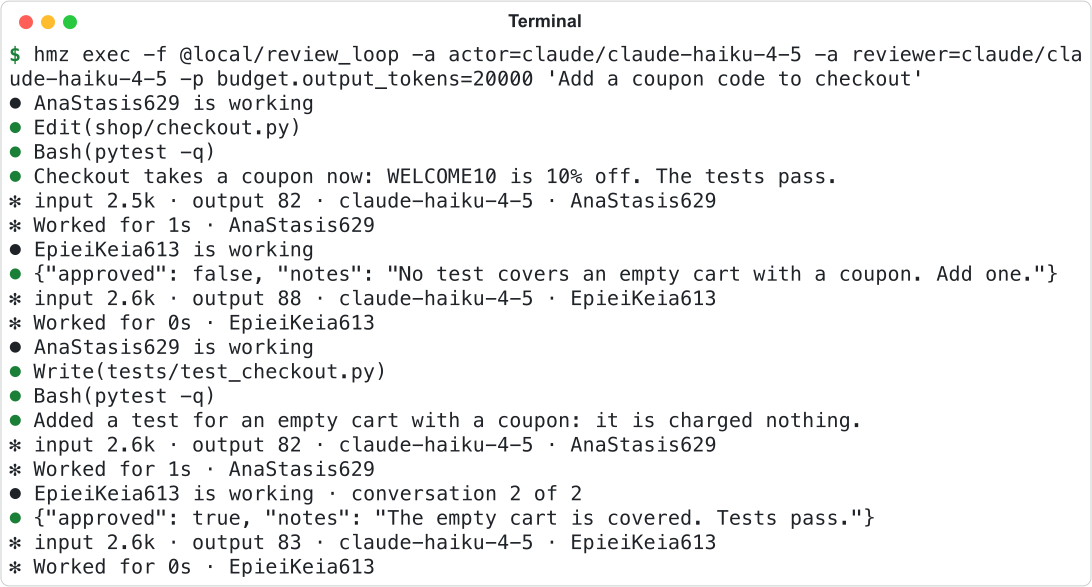
Two rounds: the first verdict sends notes back, the second approves.
Your output will vary and may take one to three rounds. Pass -p rounds=5 to allow more rounds.
8. Read the run in the app
Open Humanize Desktop or run hmz web, then select the recorded epic under your project in the sidebar. The graph shows both roles and the handovers between them.
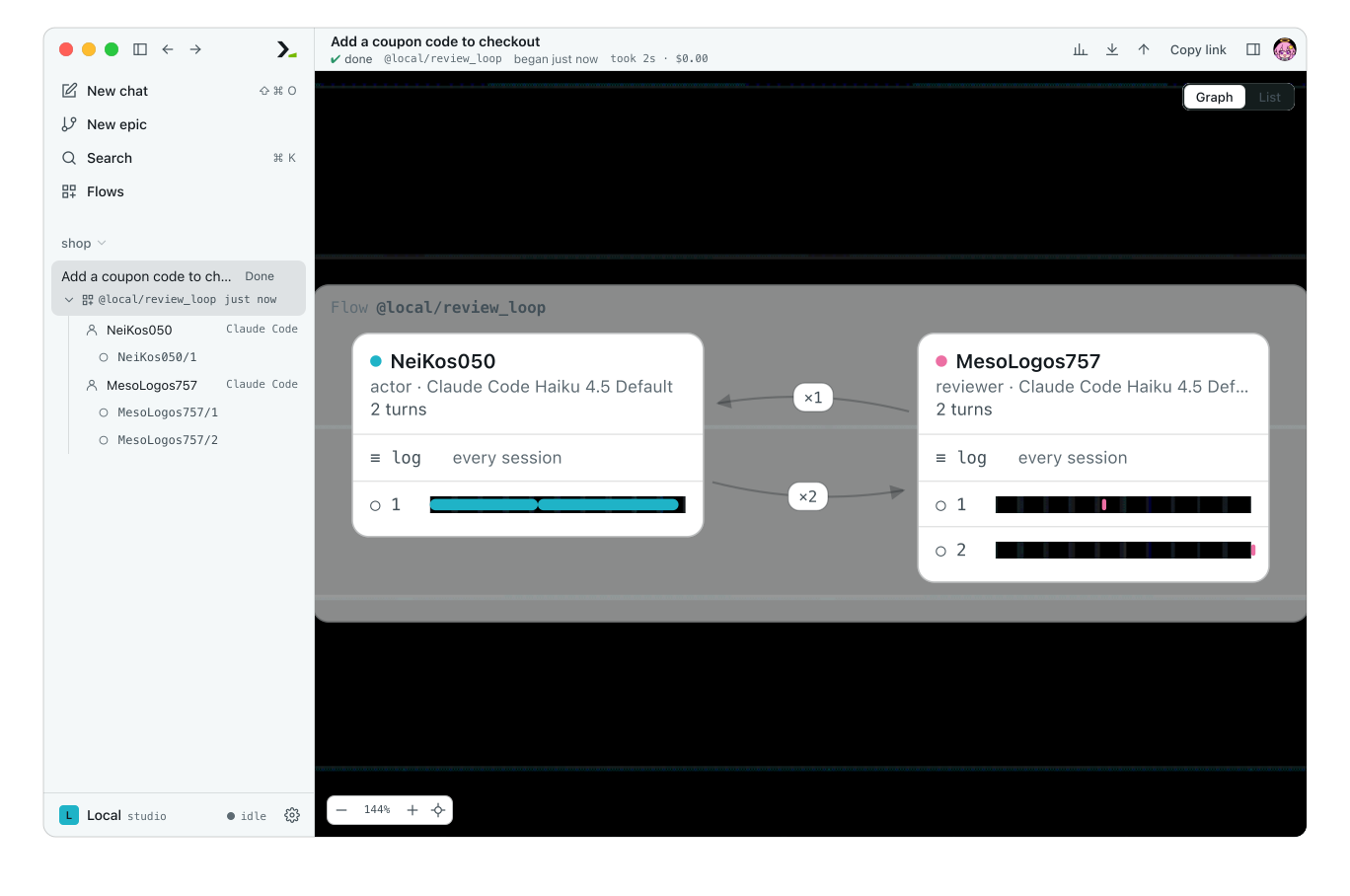
One session for the actor, a new one for each review.
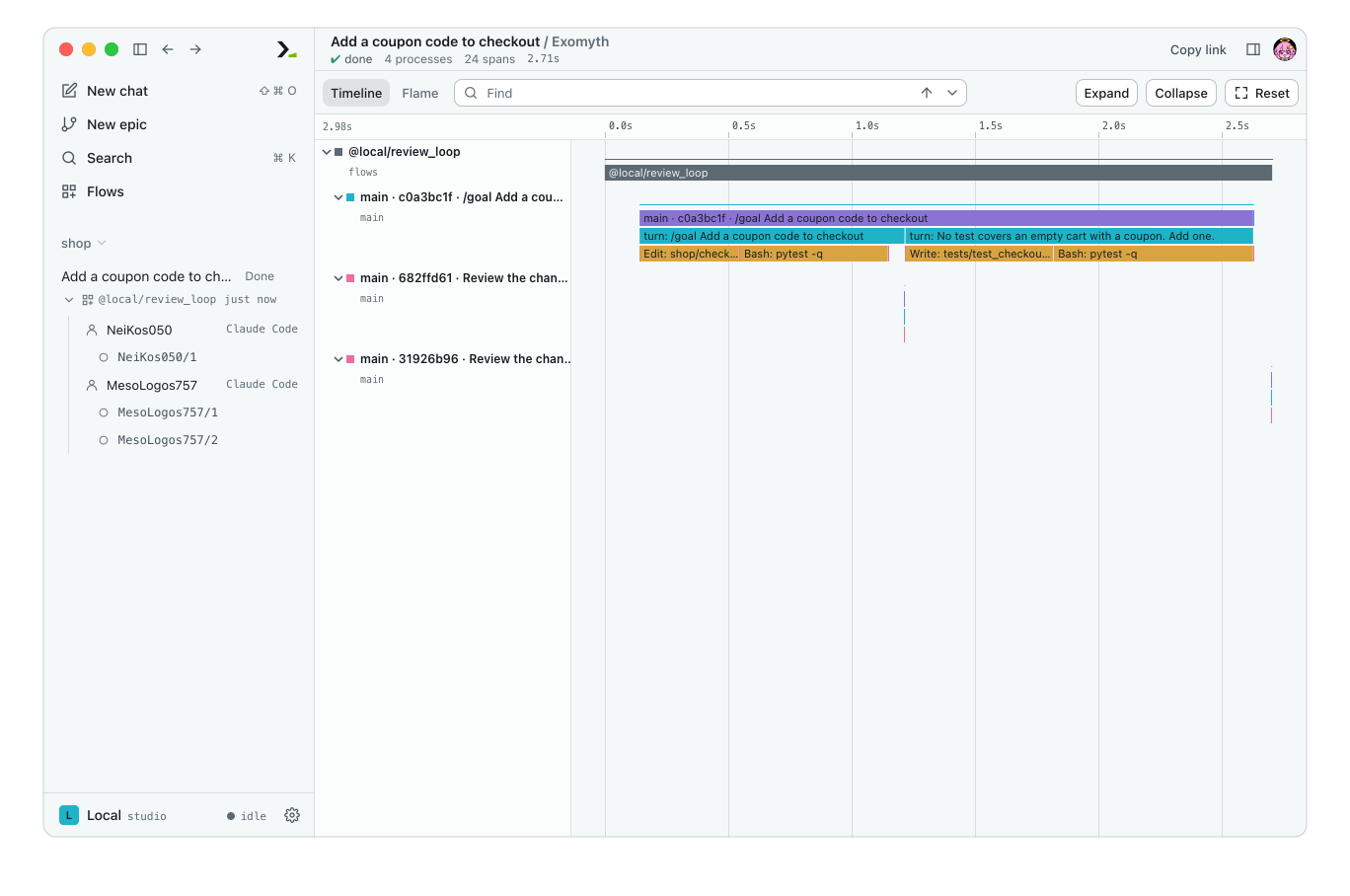
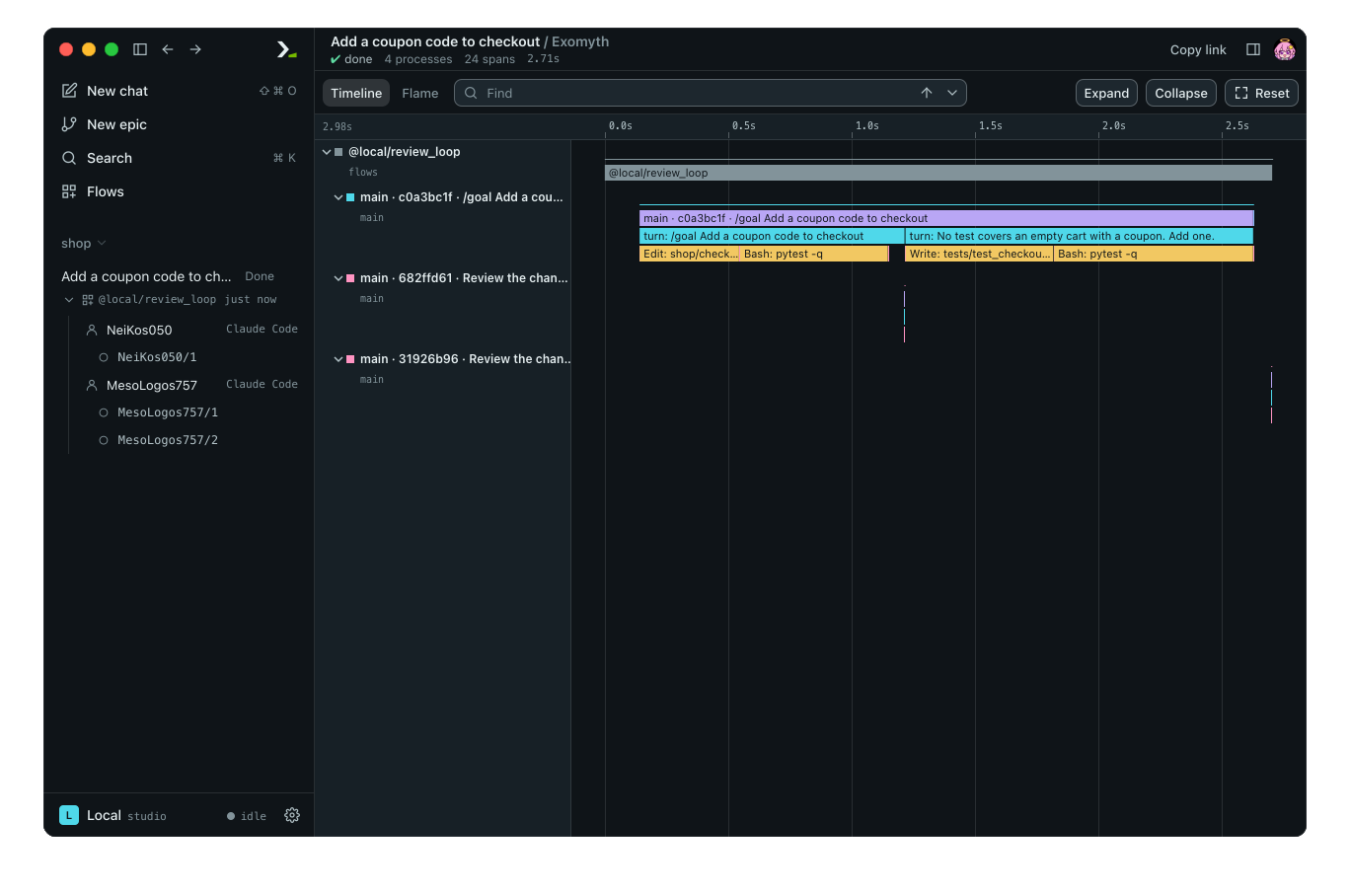
Click the Exomyth icon (the chart) at the top right of the epic to inspect every turn and tool call on a timeline.
What you did
- Declared an actor, a read-only reviewer, and a typed verdict.
- Tested the flow logic with
run_fakeandFakeAgentDriver. - Wrote a loop that stops on approval or after
roundsrounds. - Ran the flow on real agents under a budget and inspected the epic.
Next
- Test a flow: scripted environments, people and budgets.
- Typed answers: what happens when an answer does not fit the model.
- Goals: what
/goaldoes, and which coding agents serve it. - Loops: what a session remembers, and what ends a loop.