Loops
Write a for or while loop around run. Flows are async Python, so there is no separate loop API. You choose what a round remembers, what ends the loop, and what happens when a turn fails.
Write a loop
Run an agent in a loop until your check passes. In this flow, each round spawns a fresh session, runs the coder, and then runs the project's tests to check the exit status.
# .hmz/flows/until_green/__init__.py
from hmz.flows import (
    Agent,
    AgentCollection,
    EnvCollection,
    FlowContext,
    FlowParams,
    HarnessError,
    LocalEnv,
    ShellEnvMixin,
    flow,
)

TESTS = ["python", "-m", "pytest", "-q"]


class Agents(AgentCollection):
    coder: Agent


class Workspace(LocalEnv, ShellEnvMixin):
    """The project, and a shell in it."""


class Envs(EnvCollection):
    workspace: Workspace


class Params(FlowParams):
    rounds: int = 5


@flow(agents=Agents, envs=Envs, params=Params)
async def until_green(
    task: str, *, agents: Agents, envs: Envs, params: Params, ctx: FlowContext
) -> bool:
    """Work on the task, round after round, until the tests pass."""
    coder, workspace = agents["coder"], envs["workspace"]
    prompt = task
    for _ in range(params.rounds):
        session = await coder.spawn()  # a fresh conversation every round
        try:
            await coder.run(prompt, session=session, env=workspace)
        except HarnessError:
            prompt = f"{task}\n\nThe last turn failed. Check what is already there."
            continue
        status, out, _ = await workspace.exec(TESTS)
        if status == 0:
            return True
        prompt = f"{task}\n\nThe tests still fail:\n{out[-2000:]}"
    return False
Pass a budget when you run it. hmz exec requires one.
hmz exec -f @local/until_green -a coder=claude/claude-haiku-4-5 \
    -p budget.output_tokens=20000 "Add a discount code to checkout"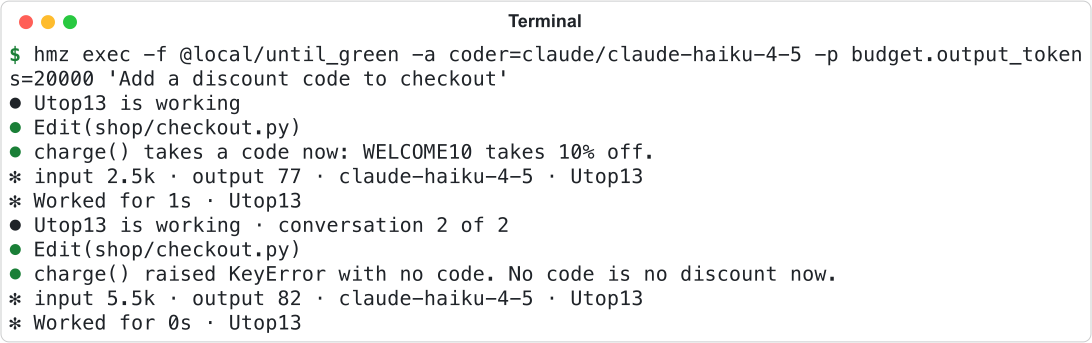
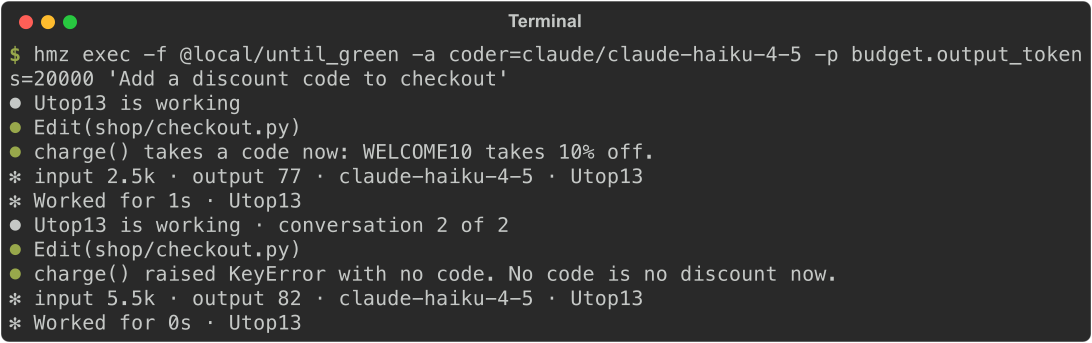
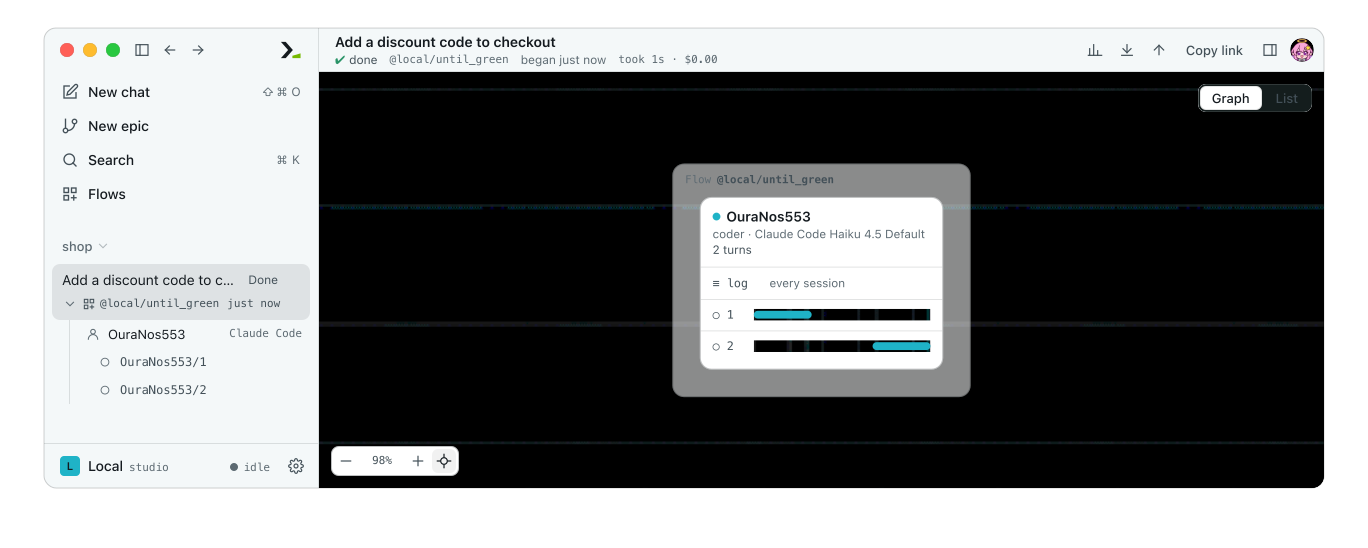
Two rounds. The tests failed after the first and passed after the second.
Choose what a round remembers
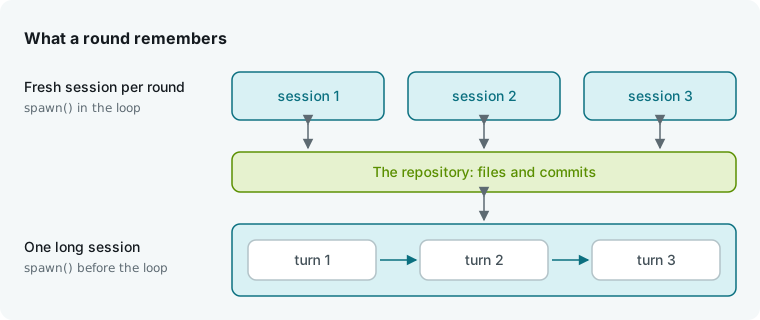
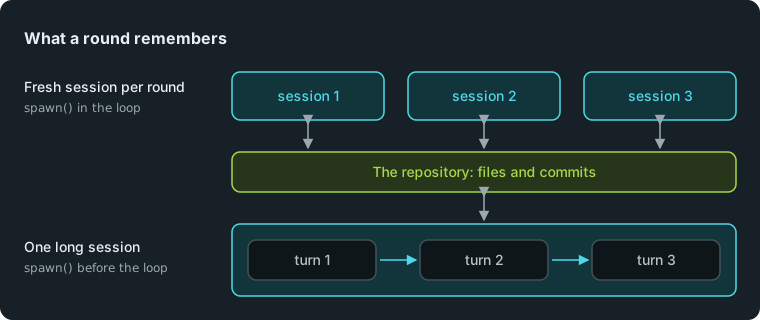
Place spawn inside or outside the loop to control memory.
# Fresh session per round: the agent starts from the prompt and the repository.
for _ in range(params.rounds):
    session = await coder.spawn()
    await coder.run(prompt, session=session, env=workspace)

# One long session: every round is one more turn of the same conversation.
session = await coder.spawn()
for _ in range(params.rounds):
await coder.run(prompt, session=session, env=workspace)| Fresh session per round | One long session | |
|---|---|---|
| Each round starts from | the prompt and the repository | everything said and done so far |
| Use it when | earlier attempts would mislead the next one | each round builds on what the last one learned |
| Cost | every round reads the project again | the conversation grows with every round |
| In the official flowverse | ralph_loop | stateful_ralph, continue_loop |
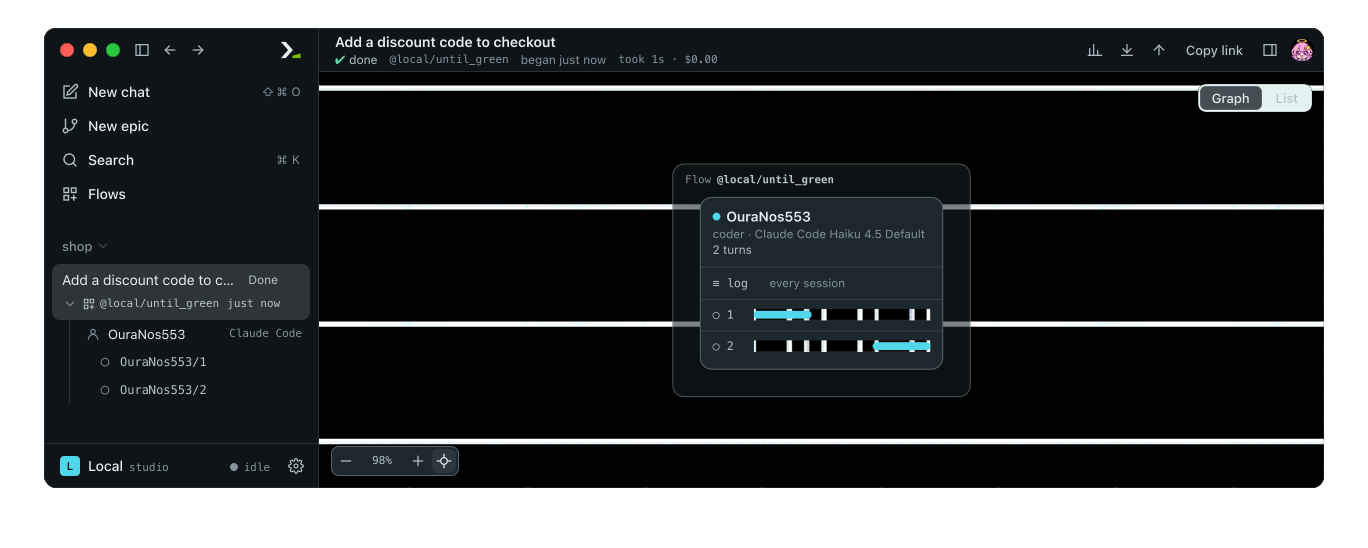
In Humanize Desktop, a fresh-session loop shows one session per round:
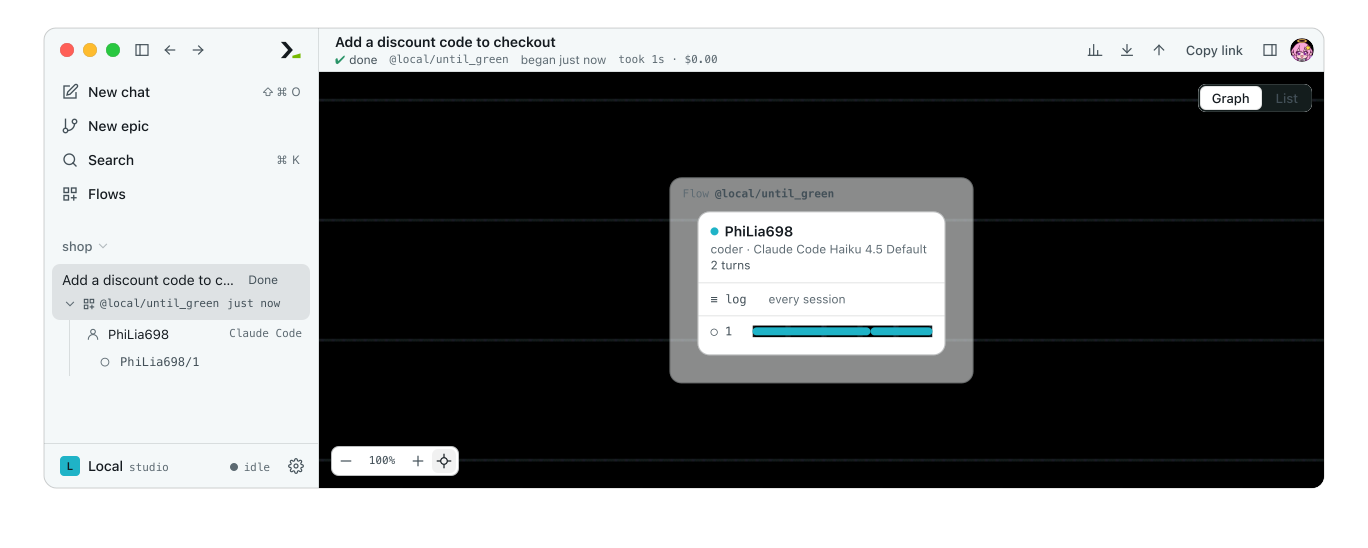
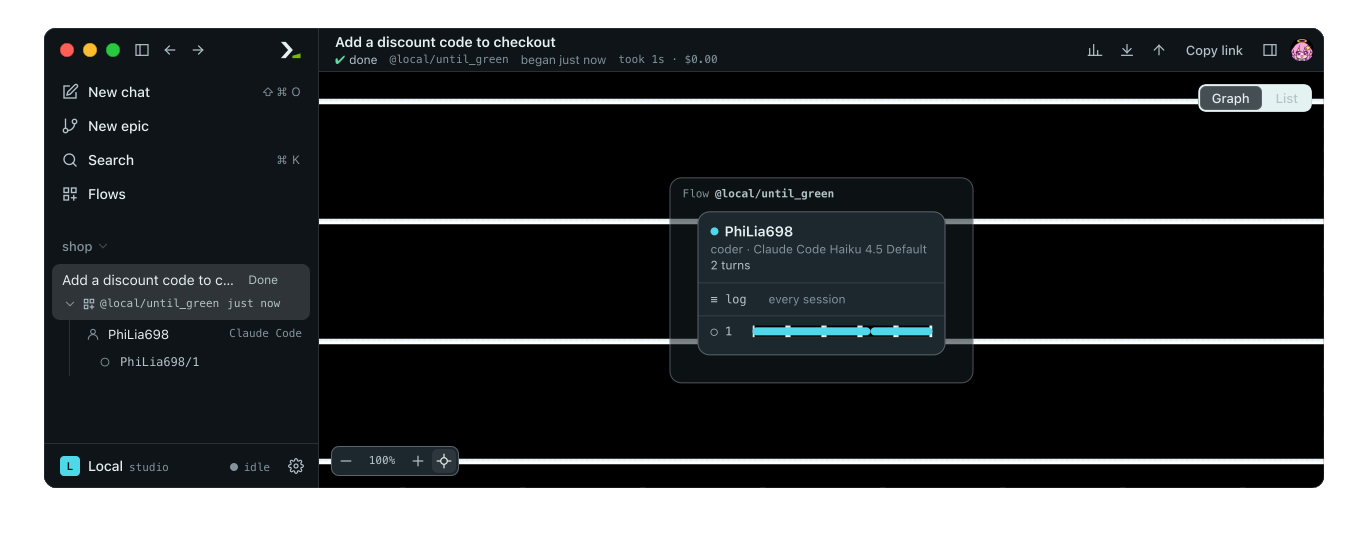
Moving spawn above the loop shows one session with two turns:
Sessions close automatically when nothing references them, so a fresh-session loop keeps only the current session open.
Pass context between fresh sessions in one of four ways:
| Memory | How |
|---|---|
| The repository | The agent's files and commits stay on disk for the next round. |
| The prompt | Put output from the last round into the next prompt, as until_green does with test results. |
| A notes file | Tell the agent to maintain and read a file such as NOTES.md. |
ctx.state | In a resumable flow, store values here to survive stops and resumes. See Resumable flows. |
A counter in a local variable starts again from zero when a run resumes. Keep state that must survive a stop in ctx.state.
Decide when to stop
Give your loop more than one exit condition.
| What ends it | How |
|---|---|
| A check of your own | return or break on a command's exit status: status, out, err = await workspace.exec(TESTS). See Environment roles. |
| A round limit | for _ in range(params.rounds). Let the user override it with -p rounds=3. See Params. |
| A verdict | Ask an agent for a typed answer and branch on a field. See Typed answers. |
| The budget | Always active. Reaching a limit makes the next run raise BudgetExceeded, ending the flow and marking the epic stopped rather than failed. Check ctx.usage and ctx.budget to exit early. See Budgets in a flow. |
| A failed turn | run raises HarnessError. If uncaught, the flow ends and the epic fails. |
| The person | Stopping the epic cancels the flow at its current await. |
| The agent | Delegate the loop to the harness's goal command so the agent decides when it is done. See Goals. |
A while True loop such as ralph_loop relies entirely on the budget to stop. Give it a budget you are willing to spend in full.
To extend a single turn instead of starting a new one, use a stop hook. See Hooks.
Keep going after a failed turn
Catch HarnessError around run to lose only the current round when a turn fails, as until_green does.
run raises HarnessError if the harness dies, hits rate limits, or loses its connection, after Humanize has already exhausted automatic retries and the fallbacks in the agent's nous.
Catch HarnessError, not Exception
BudgetExceeded is not a HarnessError, so it passes through and ends the loop. except Exception catches it too. A spent budget raises again on every later turn, so a while True loop written that way spins without end.
See Sessions and turns for every error a turn can raise.
Handle a stalled turn
Humanize automatically stops silent turns so your loop never hangs forever.
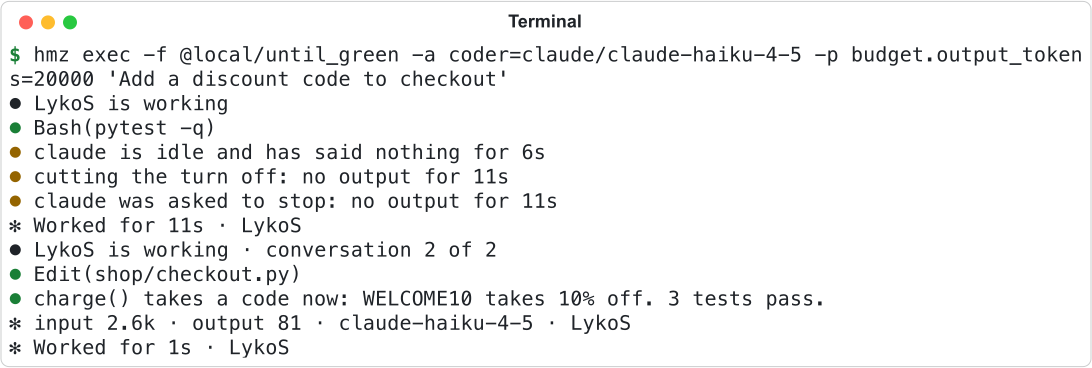
A stalled turn ended by the watchdog, and the loop taking its next round. The window was set to 5 seconds for this picture.
- Output from the harness resets the watchdog window (900 seconds by default, or 360 seconds for the
dshharness). - When the window expires, Humanize checks CPU usage. If the harness or a child process is using the CPU, it gets up to 4 more windows, leaving long test suites alone.
- Otherwise, or once those windows are used up, Humanize posts a notice and then takes one step per window until the turn ends: it interrupts the turn, terminates the harness process tree, and finally kills anything left.
- Each step posts a notice naming the harness wherever you watch the epic.
- The turn fails and
runraisesHarnessUnrecoverable(aHarnessErrorsubclass) whose message containsthe watchdog stopped this turn. A loop catchingHarnessErrormoves to the next round.
The watchdog pauses while a turn waits on a person for a permission request, a question, or a pausing hook.
| Setting | Effect |
|---|---|
HUMANIZE_WATCHDOG=120 | Sets the window to 120 seconds for every harness. |
HUMANIZE_WATCHDOG=0 | Disables the watchdog (0 or negative). |
Set this variable in the environment of the daemon holding the epic. A daemon that is already running does not pick it up from the hmz exec command line. See The daemon.
Test a loop
Test your loop with a scripted agent and a fake workspace without spending tokens.
# tests/test_until_green.py
from hmz.sdk import fakes


async def test_it_stops_at_the_first_green_run() -> None:
    results = iter([(1, "1 failed", ""), (0, "2 passed", "")])
    coder = fakes.FakeAgentDriver()
    workspace = fakes.FakeEnvDriver(run=lambda argv, env: next(results))

    done = await fakes.run_fake(
        "until_green", "add a coupon", agents={"coder": coder}, local=workspace
    )

    assert done is True
    assert len(coder.sessions) == 2  # a fresh session each round
    assert coder.prompts[1].endswith("1 failed")
See Test a flow.
Good to know
- Trust your own check, such as a command's exit status, rather than the agent's claim that it is done.
- A single long session grows each round; exceeding the model's context window raises
HarnessUnrecoverable, which retries cannot fix. - A session runs one turn at a time. To run rounds in parallel, see Concurrent turns.
- A fresh-session loop needs no saved state to resume; running it again continues from the repository.
- Find ready-made loops in the catalogue of official flows. Humanize ships none built in.
- To watch rounds live, see Watch a run.