Test a flow
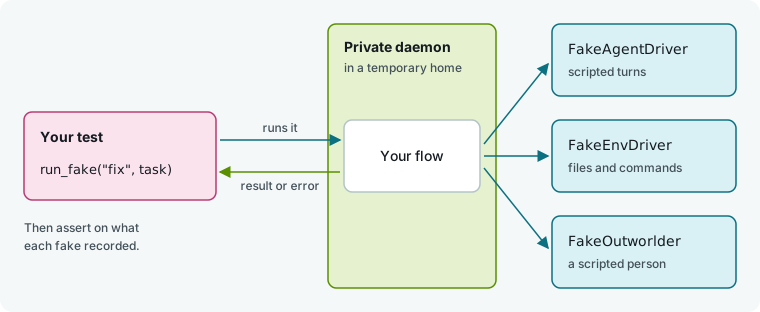
Use hmz.sdk.fakes to run your flow with stand-ins: a scripted agent, an in-memory environment, and a scripted person. No coding agent starts, no machine is touched, and no token is spent.
Write a test
Here is a flow where a coder works until the tests pass (at most rounds times), then asks a person whether to ship.
# .hmz/flows/fix/__init__.py
from pydantic import BaseModel

from hmz.flows import (
    Agent,
    AgentCollection,
    EnvCollection,
    FilesEnvMixin,
    FlowContext,
    FlowParams,
    LocalEnv,
    Outworlder,
    ShellEnvMixin,
    flow,
)


class Verdict(BaseModel):
    ship: bool = False


class Agents(AgentCollection):
    coder: Agent
    human: Outworlder


class Workspace(LocalEnv, ShellEnvMixin, FilesEnvMixin): ...


class Envs(EnvCollection):
    workspace: Workspace


class Params(FlowParams):
    rounds: int = 3


@flow(agents=Agents, envs=Envs, params=Params)
async def fix(
    task: str, *, agents: Agents, envs: Envs, params: Params, ctx: FlowContext
) -> str:
    """A coder works until the tests pass, then a person decides whether to ship."""
    coder, human, workspace = agents["coder"], agents["human"], envs["workspace"]
    session = await coder.spawn()
    prompt = task
    for _ in range(params.rounds):
        await coder.run(prompt, session=session, env=workspace)
        status, out, _ = await workspace.exec(["pytest", "-q"])
        if status == 0:
            break
        prompt = f"The tests fail: {out}"
    else:
        return "gave up"
    await workspace.write("NOTES.md", f"{task}: tests pass\n".encode())
    verdict = await human.run(
        "Ship it?", session=await human.spawn(), output_schema=Verdict
    )
    return "shipped" if verdict.ship else "held"
Script all three roles, run the flow with run_fake, and assert on the return value and what each fake recorded.
# tests/test_fix.py
import pytest

from hmz.flows import ParamsError
from hmz.sdk import fakes


async def test_it_ships_once_the_tests_pass() -> None:
    results = iter([(1, "1 failed", ""), (0, "5 passed", "")])
    coder = fakes.FakeAgentDriver(reply=["Added the code.", "Fixed the total."])
    workspace = fakes.FakeEnvDriver(
        {"shop/checkout.py": "TOTAL = 0\n"},
        run=lambda command, env: next(results) if command[0] == "pytest" else None,
    )
    human = fakes.FakeOutworlder(reply={"ship": True})

    result = await fakes.run_fake(
        "fix",
        "add a discount code to checkout",
        agents={"coder": coder},
        local=workspace,
        outworlder=human,
    )

    assert result == "shipped"
    assert coder.prompts == [
        "add a discount code to checkout",
        "The tests fail: 1 failed",
    ]
    assert workspace.commands == [("pytest", "-q"), ("pytest", "-q")]
    assert workspace.text("NOTES.md").endswith("tests pass\n")
    assert human.asked == ["Ship it?"]


async def test_it_gives_up_after_its_rounds() -> None:
    workspace = fakes.FakeEnvDriver(run={("pytest", "-q"): (1, "1 failed", "")})

    result = await fakes.run_fake("fix", "x", local=workspace, params={"rounds": 2})

    assert result == "gave up"
    assert len(workspace.commands) == 2


async def test_nobody_there_means_held() -> None:
    workspace = fakes.FakeEnvDriver(run={("pytest", "-q"): (0, "5 passed", "")})

    assert await fakes.run_fake("fix", "x", local=workspace) == "held"


async def test_wrong_params_are_refused_before_anything_runs() -> None:
    coder = fakes.FakeAgentDriver()

    with pytest.raises(ParamsError):
        await fakes.run_fake("fix", "x", agents={"coder": coder}, params={"rounds": "many"})

    assert coder.sessions == []
run_fake is a coroutine. Install pytest-asyncio to run async def tests:
# pyproject.toml
[tool.pytest.ini_options]
asyncio_mode = "auto"
Without pytest-asyncio, wrap the call in asyncio.run:
# tests/test_sync.py
import asyncio

from hmz.sdk import fakes


def test_nobody_there_means_held() -> None:
    workspace = fakes.FakeEnvDriver(run={("pytest", "-q"): (0, "5 passed", "")})

    assert asyncio.run(fakes.run_fake("fix", "x", local=workspace)) == "held"
Run pytest from the workspace root:
pytest --no-header -v tests/test_fix.py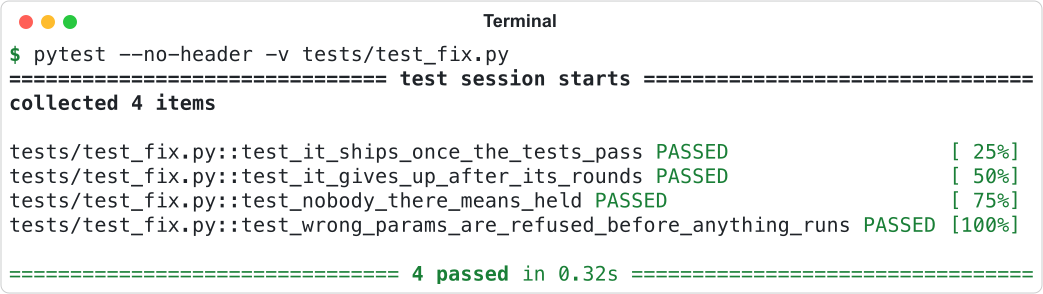
Four runs of the flow, in under a second.
What run_fake takes
Call run_fake(flow, task="", *, agents, envs, params, budget, outworlder, local, journal, resume) to get the flow's return value or raise its exception.
| Argument | What you pass | If you leave it out |
|---|---|---|
flow | A flow's name or ref (looked up from the current directory as hmz exec -f does), a path to the flow's directory, or a Flow object from load | required |
task | The task text | "" |
agents | By role: a FakeAgentDriver, or its reply. For an Outworlder role: a FakeOutworlder, or its reply | Each required role gets a fake of the requested harness (or claude) that answers ok |
envs | By role: a FakeEnvDriver, or a dict of starting files | Each required role gets an empty fake at /<role>, sized as the role requires |
params | A mapping, or an instance of the flow's params class | The defaults |
budget | A Budget | Unlimited |
outworlder | A FakeOutworlder for the Outworlder roles | The person is away |
local | A FakeEnvDriver for the LocalEnv roles | An empty fake at /here |
journal, resume | The journal file of a resumable flow, and whether to resume its run. See Resumable flows | No journal of your own |
Omitted optional roles (NotRequired) stay empty.
run_fake validates the flow before anything runs. It raises RequirementError if a fake in agents or envs does not meet what its role declares or if you name an undeclared role, and ParamsError if parameters fail validation. A local fake that lacks a mixin its role needs raises hmz.sdk.Refused instead.
Script an agent
Pass reply to FakeAgentDriver(harness="claude", *, reply=None, ...) to control how the agent answers each turn:
- A list: one answer per turn, in order. Once exhausted, it returns the default answer.
- One answer: returned for every turn.
- A sync or async function
reply(prompt, *, session, output_schema): returns the answer, orNonefor the default. None: the default answer (ok, or the turn'soutput_schemabuilt from its defaults). If the schema has a field without a default, the turn raisesOutputSchemaError.
An answer can be text, a mapping, a pydantic model, or JSON text. Turns with an output_schema validate the answer against that schema. See Typed answers.
| Option | Default | Meaning |
|---|---|---|
harness | "claude" | The harness to emulate, including its mixins, session forking, and moving |
model, effort, provider | "fake", "", "" | Reported model, effort, and account |
capabilities | the harness's | Custom mixins to serve |
cost, output_tokens, seconds | 0.0, 1, 0.0 | Reported USD, tokens, and seconds spent per answer. Nothing waits. Budgets track cost and tokens. See Budgets in a flow |
forks | the harness's | Whether it can fork a session. See Branch a conversation |
names_late | False | Delay assigning a session id until the first turn starts, matching real CLIs |
name | a random codename | The agent's name |
A scripted agent fires the same hooks as a real one: session start on a session's first turn, prompt submit and stop on every turn, and session end on close. A blocking stop hook sends its reason as the next prompt in the same turn, up to 100 times.
Reach for tools from a reply
Use the FakeSession passed to a reply function to act mid-turn like a real agent.
| Call | What it does | Returns |
|---|---|---|
await session.tool(name, input) | Fires the pre-tool-use hook, then the permission-request hook if supported | Whether the tool would run |
await session.use(name, input) | Calls one of the flow's tools | Tool output |
await session.run_cli(argv) | Runs one of the flow's command lines | (status, stdout, stderr) |
await session.ask(question, options) | Fires the ask-user hook. Raises UnsupportedOperation if unsupported by the harness | The answer, or None |
await session.notify(message) | Fires the notification hook | nothing |
await session.subagent(name, task="", said="") | Fires subagent start and stop hooks if supported | said, or the blocking stop hook's reason |
await session.until_steered() | Holds the turn open until the flow steers it. An interrupt raises SessionError, and the turn's hard deadline raises DurationExceeded | The steering text |
# tests/test_reach.py
from hmz.sdk import fakes


async def careful(prompt: str, *, session: fakes.FakeSession, output_schema: object) -> str:
    await session.tool("Bash", {"command": "pytest -q"})
    return "Fixed the total." if prompt.startswith("The tests fail") else "Added the code."


async def test_one_session_takes_every_round() -> None:
    results = iter([(1, "1 failed", ""), (0, "5 passed", "")])
    coder = fakes.FakeAgentDriver("codex", reply=careful, output_tokens=400)
    workspace = fakes.FakeEnvDriver(run=lambda command, env: next(results))

    await fakes.run_fake("fix", "add a discount code", agents={"coder": coder}, local=workspace)

    (session,) = coder.sessions
    assert session.tools == [("Bash", {"command": "pytest -q"}, True)] * 2
    assert session.usage.output_tokens == 800
    assert session.closed
See Hooks and Tools the agent can call for more examples.
Fake an environment
FakeEnvDriver(files=None, *, run=None, ...) holds a working directory in a dictionary. Reads, writes, listings, worktrees, temporary clones, scratch directories, and snapshots operate on copies of that dictionary.
Pass run to script command execution:
- A dict mapping commands to
(status, stdout, stderr). A command is a tuple of words, or a string for a script. - A sync or async function
run(command, env). ReturnNoneto fall back to the defaults.
By default, the environment handles true, :, false, echo, cat, ls, sleep (which really waits), and git rev-parse --is-inside-work-tree. Any other command or unscripted string exits with status 127.
| Option | Default | Meaning |
|---|---|---|
files | none | Starting files relative to the workdir. Text is stored as UTF-8 |
workdir | "/work" | Path on the fake machine |
backend, provider | "local", "" | Reported machine kind and provider |
capabilities | every mixin | Environment mixins served |
cpu_count, memory | 8, 64 GiB | Reported CPUs and memory in bytes |
gpu_count, gpu_memory | 0, 0 | Reported GPUs and memory per GPU in bytes |
refs | ("HEAD", "main") | Git refs known to worktrees and rewinds |
repo | True | Whether the workdir is a git repository |
Any terminal opened by the flow is a FakePty that echoes input. Typing ctrl+d ends it with status 0, and killing it ends it with status 137.
Script the person
Use FakeOutworlder(reply=None, *, away=False) to answer questions sent to Outworlder roles. reply takes the same forms as FakeAgentDriver's, where a mapping populates the requested schema. A function is called as reply(prompt, *, output_schema): it gets no session, and output_schema is the question's JSON Schema as a dict, or None for a plain-text question.
Pass it to outworlder=, or pass the reply directly in agents (ignored when outworlder= is also given):
result = await fakes.run_fake("fix", "x", local=workspace, agents={"human": {"ship": True}})Use FakeOutworlder(away=True), or leave outworlder out, to simulate an unavailable person: nothing is asked, and asked stays empty. See The person as an agent.
Assert on what happened
Inspect your fakes after the run finishes.
| On | Read | It holds |
|---|---|---|
FakeAgentDriver | prompts | Every prompt across all sessions, in order |
sessions | Every FakeSession opened | |
live, peak, closed | Currently open sessions, peak concurrent sessions, and close count | |
FakeSession | prompts | Every prompt received, including added hook context and stop hook reasons |
requests | Every turn requested, with limits and schema | |
tools | Every session.tool call as (name, input, allowed) | |
steered | Every steer as (text, queued) | |
placement, placements | Current location, and history of where it was opened or moved | |
permission, skills, offered, shelved | Permission, skills, tools, and command lines provided by the flow | |
forked_from, carried_on | Parent session if forked, and prior conversation continued | |
turns, usage, closed | Turn count, resource usage, and whether it is closed | |
id, named | Session id (None until the first turn with names_late), and whether a turn has reached the agent | |
driver | The FakeAgentDriver that opened it | |
FakeEnvDriver | files, text(path) | Workdir files as bytes, and a helper to read a file as text |
commands | Every command executed in the workdir | |
machine | All files on the fake machine by absolute path, including copies and worktrees | |
clones, scratches | IDs of remaining temporary clones and scratch directories | |
ptys, closed | Opened terminals (argv, typed, sizes, status), and close count | |
FakeOutworlder | asked | Every question prompt |
asks | Full question records: schema, context, face, and session | |
shown | Every context shown as (session, context) | |
faces | Every face used to open a session |
Good to know
run_fakeruns your flow in a private, in-process daemon with a temporary home directory, cleaning it up on return. It never touches your machine's daemon or epics.- Flow names resolve from the current directory. Run pytest from the workspace root, or pass a path.
- Unscripted commands exit with status 127. If your flow loops on a command's status, script that command in
run. secondsonly affects reported usage. Adurationbudget measures wall-clock time, and scripted answers return instantly.- Fakes test your flow's logic, not how a real model responds to your prompts. Run the flow with a real agent before shipping.
- Pass the same fakes to
Hmz.runwhen you need to inspect run events. See The Python SDK. hmz.sdk.fakesexports the type aliasesAnswer,Reply,Command, andHandlerfor typing your test helpers.