Branch a conversation
Call await agent.fork(session) to create a new session that keeps the original conversation and branches off on its own. Use it to try several approaches after an expensive step, such as reading a codebase.
Fork a session
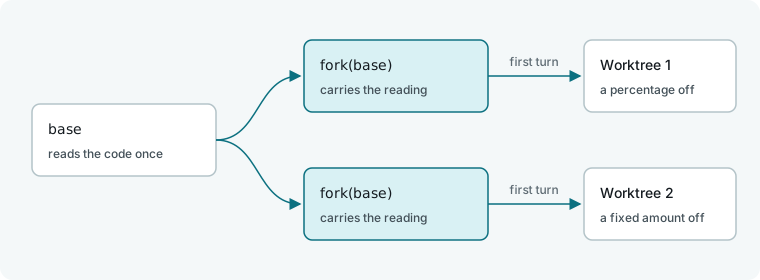
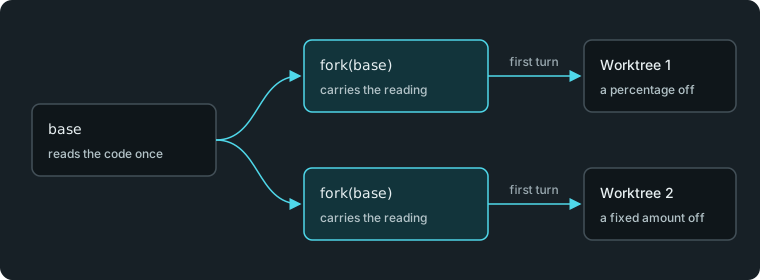
This flow has a coder read the code once, then forks the session twice. Both forks run at the same time, each trying a different approach in its own git worktree.
# .hmz/flows/two_ways/__init__.py
import asyncio

from hmz.flows import (
    Agent,
    AgentCollection,
    EnvCollection,
    FlowContext,
    FlowParams,
    GitWorktreeEnvMixin,
    LocalEnv,
    flow,
)

WAYS = ("as a percentage off the total", "as a fixed amount off the total")


class Agents(AgentCollection):
    coder: Agent


class Workspace(LocalEnv, GitWorktreeEnvMixin):
    """The project. The flow may add worktrees of it."""


class Envs(EnvCollection):
    workspace: Workspace


@flow(agents=Agents, envs=Envs, params=FlowParams)
async def two_ways(
    task: str, *, agents: Agents, envs: Envs, params: FlowParams, ctx: FlowContext
) -> list[str]:
    """Read the code once, then try the task two ways, each in its own worktree."""
    coder, workspace = agents["coder"], envs["workspace"]
    base = await coder.spawn()
    await coder.run(
        f"Read the code this needs. Change nothing yet.\n\n{task}",
        session=base,
        env=workspace,
    )

    async def attempt(way: str) -> str:
        tree = await workspace.derive_worktree()
        branch = await coder.fork(base)
        return await coder.run(f"Now do it {way}.", session=branch, env=tree)

    return await asyncio.gather(*(attempt(way) for way in WAYS))
fork returns a new session of the same agent. The original session is unchanged, and forks never see each other's turns. The session you fork must have taken at least one turn.
Calling fork sends nothing on its own. The fork is cut on its first turn, and that turn's env sets where the fork works. Each fork inherits the conversation history, effort, skills and tools, and tracks its own usage.
Call derive_worktree to give each attempt its own checkout so they do not overwrite each other's files. See Worktrees, clones and scratch.
Run the flow in a git repository with at least one commit:
hmz exec -f @local/two_ways -a coder=claude/claude-haiku-4-5 \
    -p budget.output_tokens=20000 "Add a discount code to checkout"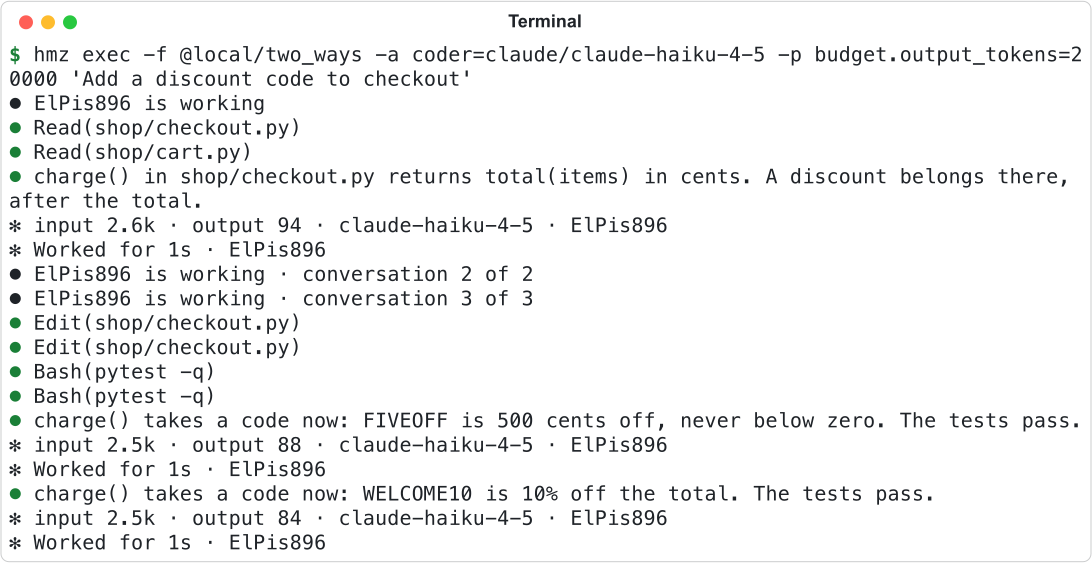
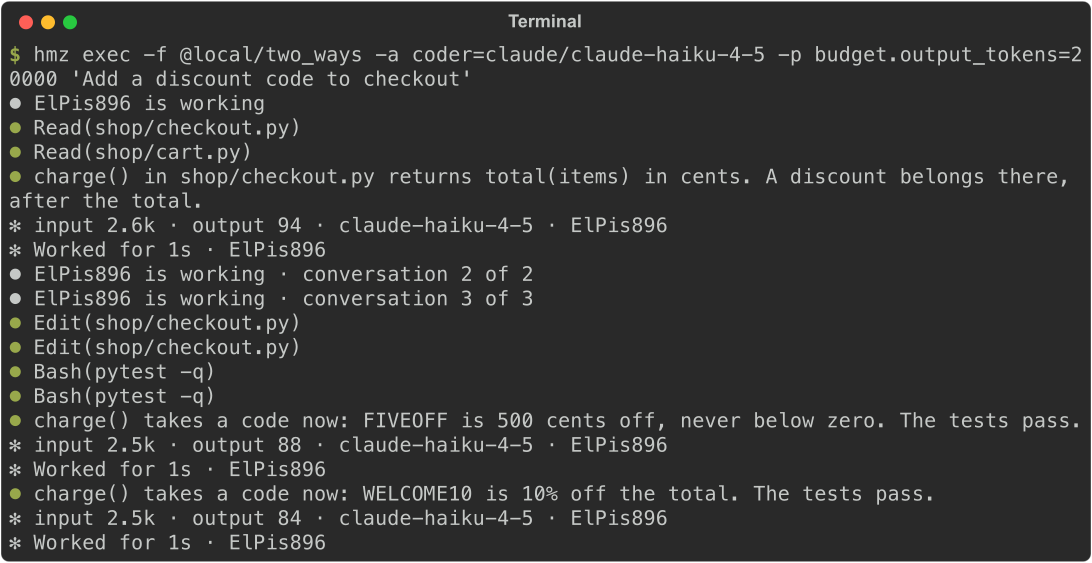
One reading, followed by conversations 2 and 3 running at once as the two forks.
In Humanize Desktop, the epic lists three sessions under the agent. Select a fork to see the inherited reading followed by its own turn.
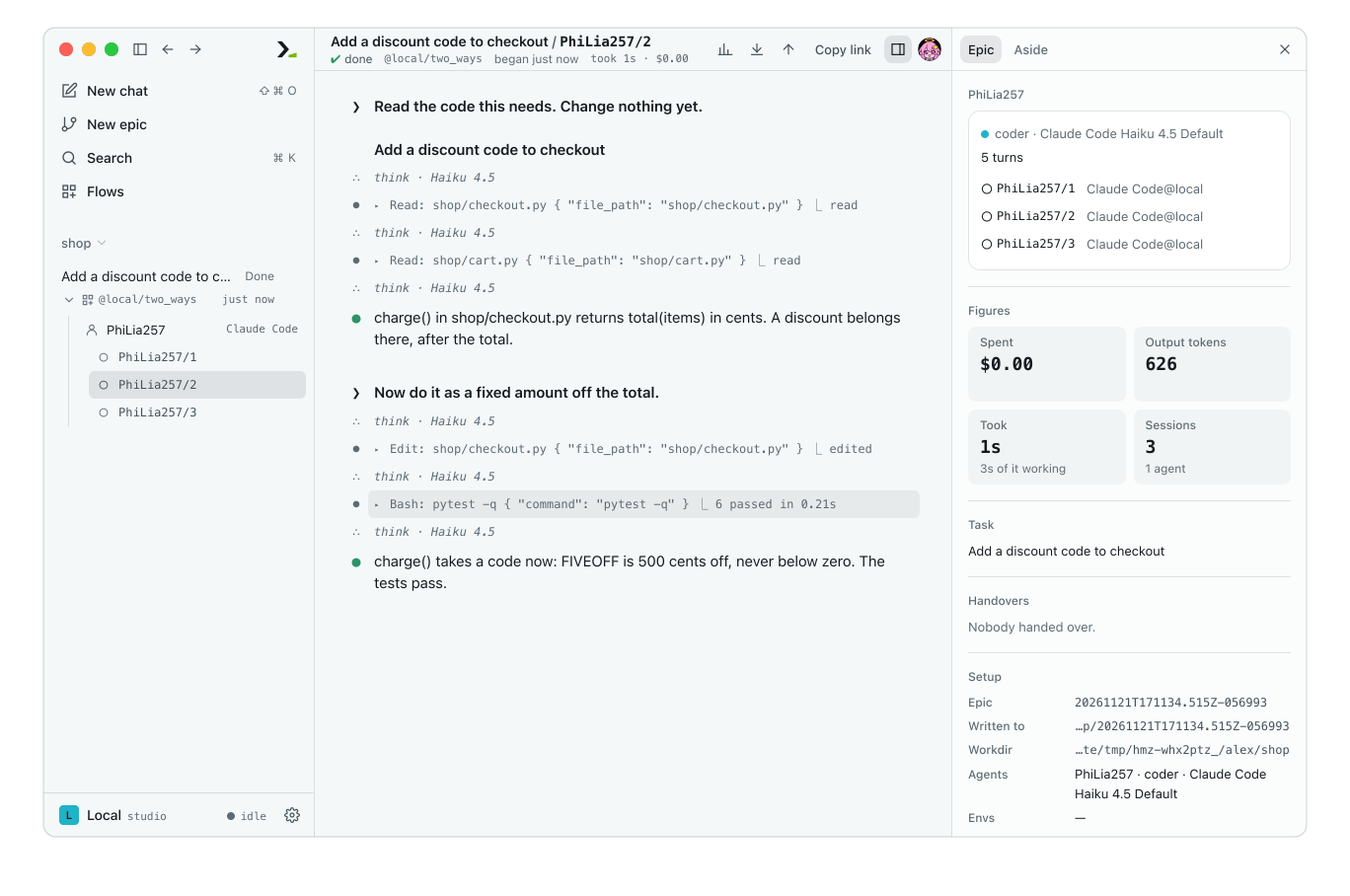
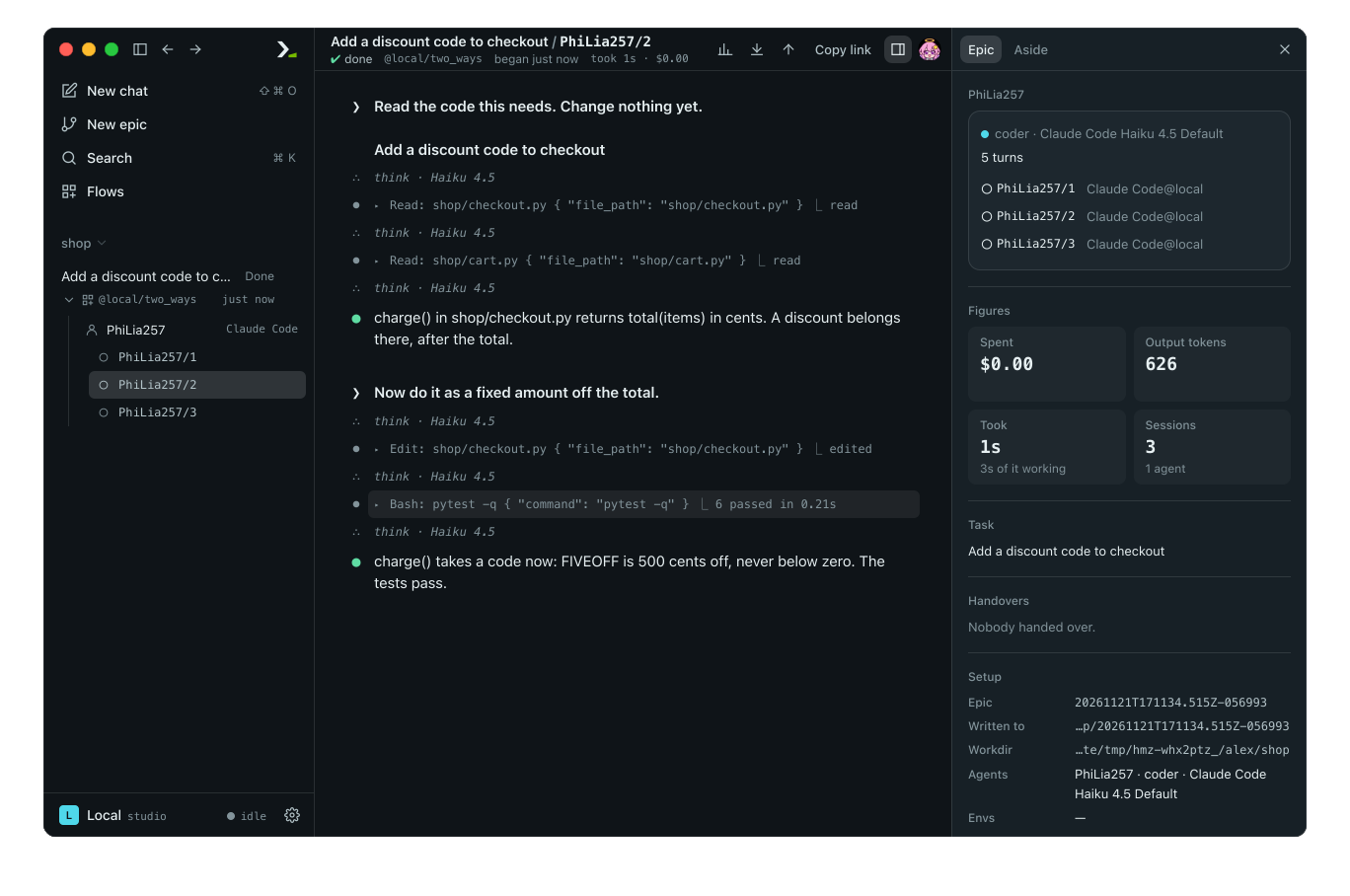
A fork's thread starts with the turns it was forked from.
Fork in the same directory
If your branches only answer questions and write no files, run their first turns in the original session's environment. More harnesses support forking in the same directory.
careful = await coder.fork(base)
quick = await coder.fork(base)
plans = await asyncio.gather(
    coder.run("How would you fix it carefully?", session=careful, env=workspace),
    coder.run("How would you fix it quickly?", session=quick, env=workspace),
)
Check harness support
Every agent has fork without needing a mixin. What a fork can do depends on the harness filling the role.
| Harness | Forks |
|---|---|
claude, codex, kimi, litellm | Into any directory on the same machine. |
pi, omp, grok, opencode, mimo, qwen, acp | Only into the directory the session last worked in. An acp CLI forks only if it offers forking. |
cursor-agent, mcode, agy, dsh | Not at all. |
No harness forks onto another machine.
Handle a refused fork
Humanize raises an error either when you call fork or on the fork's first run.
| Raised by | Error | When |
|---|---|---|
fork | SessionError | The session is not this agent's, is closed, or has taken no turn. |
fork | UnsupportedOperation | The agent is an outworlder. |
The fork's first run | UnsupportedOperation | The harness does not fork, the turn's env is on another machine, or it is another directory on a harness that forks only in place. |
The fork's first run | SessionError | The session it was forked from has taken a turn since the fork, or the harness could not cut the fork. |
The fork's first run | HarnessUnrecoverable | The harness is grok and the role offers fake tools. |
Catch UnsupportedOperation and spawn a fresh session to keep a flow running on harnesses that cannot fork. The fresh session starts without the conversation history.
from hmz.flows import UnsupportedOperation

branch = await coder.fork(base)
try:
    answer = await coder.run(prompt, session=branch, env=tree)
except UnsupportedOperation:
    answer = await coder.run(prompt, session=await coder.spawn(), env=tree)
Test a branching flow
A fake agent records the parent of each forked session. FakeAgentDriver forks like its target harness; pass forks=False to simulate a harness that cannot fork. See Test a flow.
# tests/test_two_ways.py
import asyncio

from hmz.sdk import fakes


def test_both_ways_carry_the_reading() -> None:
    coder = fakes.FakeAgentDriver()
    asyncio.run(fakes.run_fake("two_ways", "Add a discount", agents={"coder": coder}))

    reading, *branches = coder.sessions
    assert [branch.forked_from for branch in branches] == [reading, reading]
    assert len(reading.prompts) == 1  # the parent took no further turn
    assert all(branch.prompts[0] == reading.prompts[0] for branch in branches)
Good to know
- Run a fork's first turn before the parent session takes another turn, or the fork's first turn raises
SessionError. Callforkagain to branch from the newer point. Turns in a fork never advance the parent session. - You can fork a fork after it takes at least one turn.
- A
litellmagent has no directory. Passenv=Nonefor its turns and its forks' turns. forkcopies a conversation.derivenarrows an agent's permissions and holds no conversation. See Agent roles.forkbranches from a session in the current run. To branch from an earlier run, save the session in a resumable flow's state. See Resumable flows.- To move a session to another directory without branching, pass a different
envto its next turn. See Machines and moving sessions.