Resumable flows
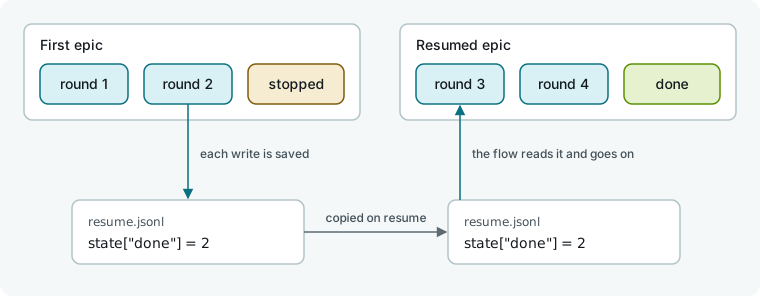
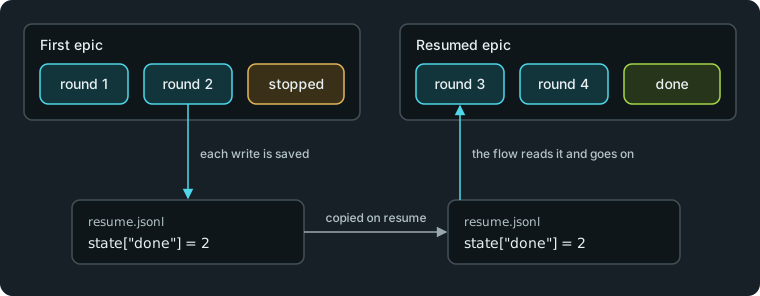
A resumable flow saves its progress while it runs. When an epic stops, runs out of budget, or is killed, a new epic picks up from the saved state instead of starting over.
Make a flow resumable
Pass resumable=True to @flow. Your flow receives ctx.state, a mapping saved to disk. Read ctx.state at the start to find where to continue, and write to it after each step you do not want to repeat.
This flow runs for four rounds, saving the round count and the conversation after each turn.
# .hmz/flows/in_rounds/__init__.py
from hmz.flows import (
    Agent,
    AgentCollection,
    EnvCollection,
    FlowContext,
    FlowParams,
    LocalEnv,
    flow,
)


class Agents(AgentCollection):
    coder: Agent


class Envs(EnvCollection):
    workspace: LocalEnv


class Params(FlowParams):
    rounds: int = 4


@flow(agents=Agents, envs=Envs, params=Params, resumable=True)
async def in_rounds(
    task: str, *, agents: Agents, envs: Envs, params: Params, ctx: FlowContext
) -> int:
    """Work on the task in rounds, picking up at the round it stopped in."""
    coder, workspace = agents["coder"], envs["workspace"]
    state = ctx.state
    assert state is not None  # a resumable flow always has one
    done = state["done"] if "done" in state else 0
    session = state["session"] if "session" in state else await coder.spawn()
    for n in range(done + 1, params.rounds + 1):
        prompt = f"{task}\n\nThis is round {n} of {params.rounds}."
        await coder.run(prompt, session=session, env=workspace)
        state["session"] = session  # the conversation as it stands now
        state["done"] = n  # on disk before this line returns
    return params.rounds
Humanize saves only what you write to ctx.state. On a first run, ctx.state is empty. On a resumed run, it holds what the earlier epic saved, and ctx.resumed is True.
| Operation | What it does |
|---|---|
key in state | Checks whether key is saved. |
state[key] | Returns the saved value, or raises KeyError. |
state[key] = value | Saves value to disk before the line returns. |
del state[key] | Removes key, or raises KeyError. |
Keys must be strings. Values must be JSON-serializable or sessions; anything else raises StateNotSerializable and leaves the state unchanged.
Resume a run
In the app and the terminal
Click Resume on the epic's page, or type /resume in hmz while the flow is on the screen. Both are offered only when an epic can be resumed. See Resume a run.
From the command line
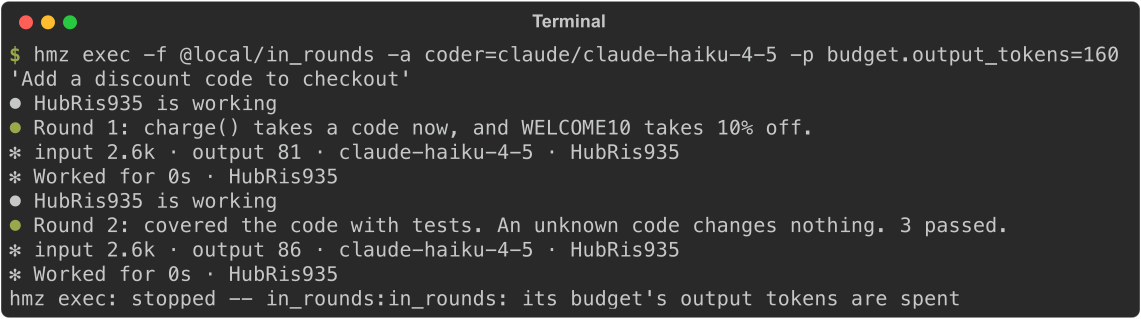
- Run the flow. Here, a small budget stops the epic after two rounds:
hmz exec -f @local/in_rounds -a coder=claude/claude-haiku-4-5 \
    -p budget.output_tokens=160 "Add a discount code to checkout"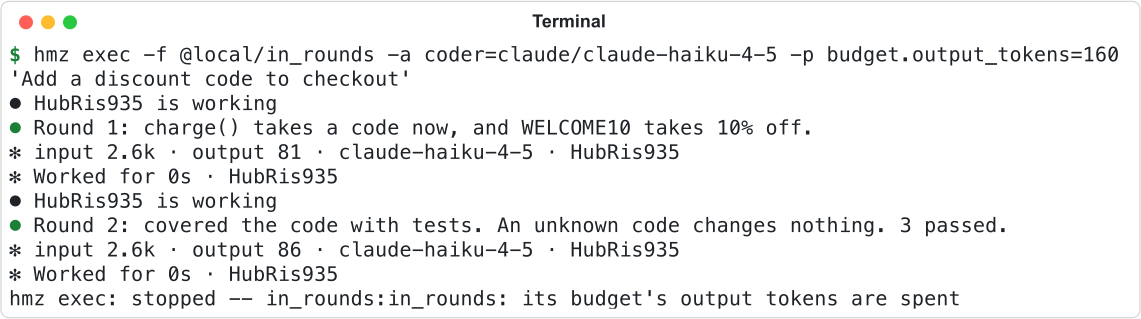
- Run it again with
--resume. A new epic starts from the saved state and continues at round 3:
hmz exec -f @local/in_rounds --resume -a coder=claude/claude-haiku-4-5 \
    -p budget.output_tokens=20000 "Add a discount code to checkout"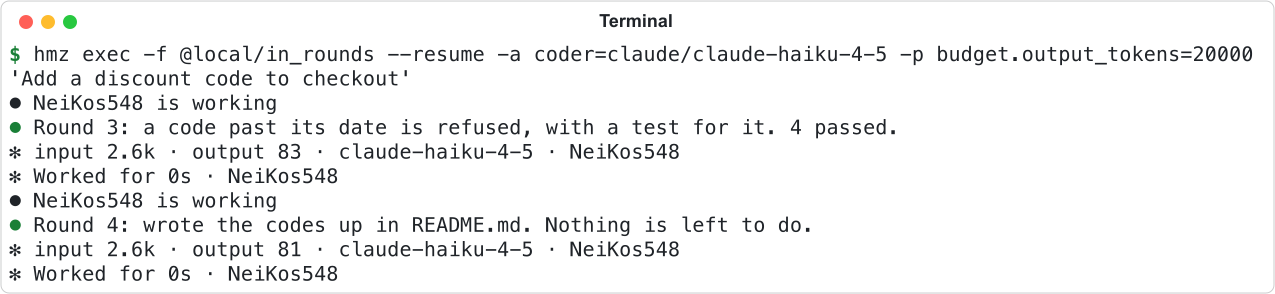
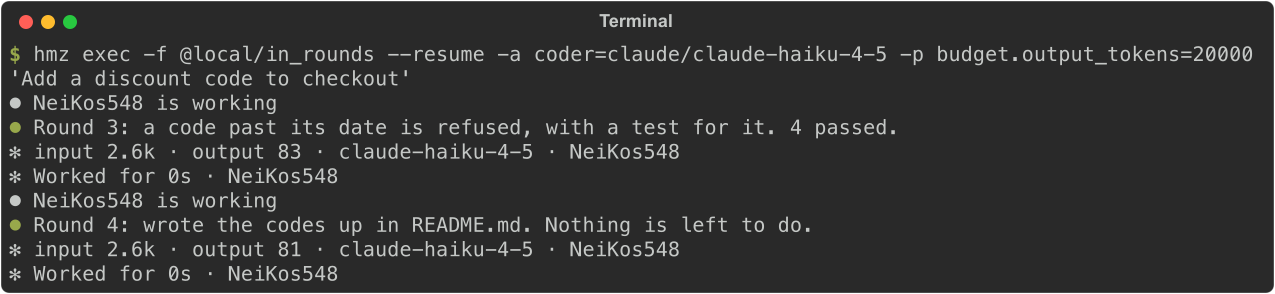
--resume picks up the newest epic of this flow in the current directory that saved progress and is not running. If the flow is not resumable, the command fails with <flow> does not support resuming, so there is no run to resume. If no such epic exists, it fails with <flow> has no run to resume here: none saved any progress.
Save a conversation
Write a session to ctx.state—alone or inside a list or dict—to save the conversation at that moment. Reading the key back returns a new session that continues the conversation, so the agent remembers earlier turns. Any session not saved in ctx.state starts fresh.
In in_rounds, state["session"] = session saves the coder's conversation. In the resumed epic, the session holds all four rounds: two carried over and two new.
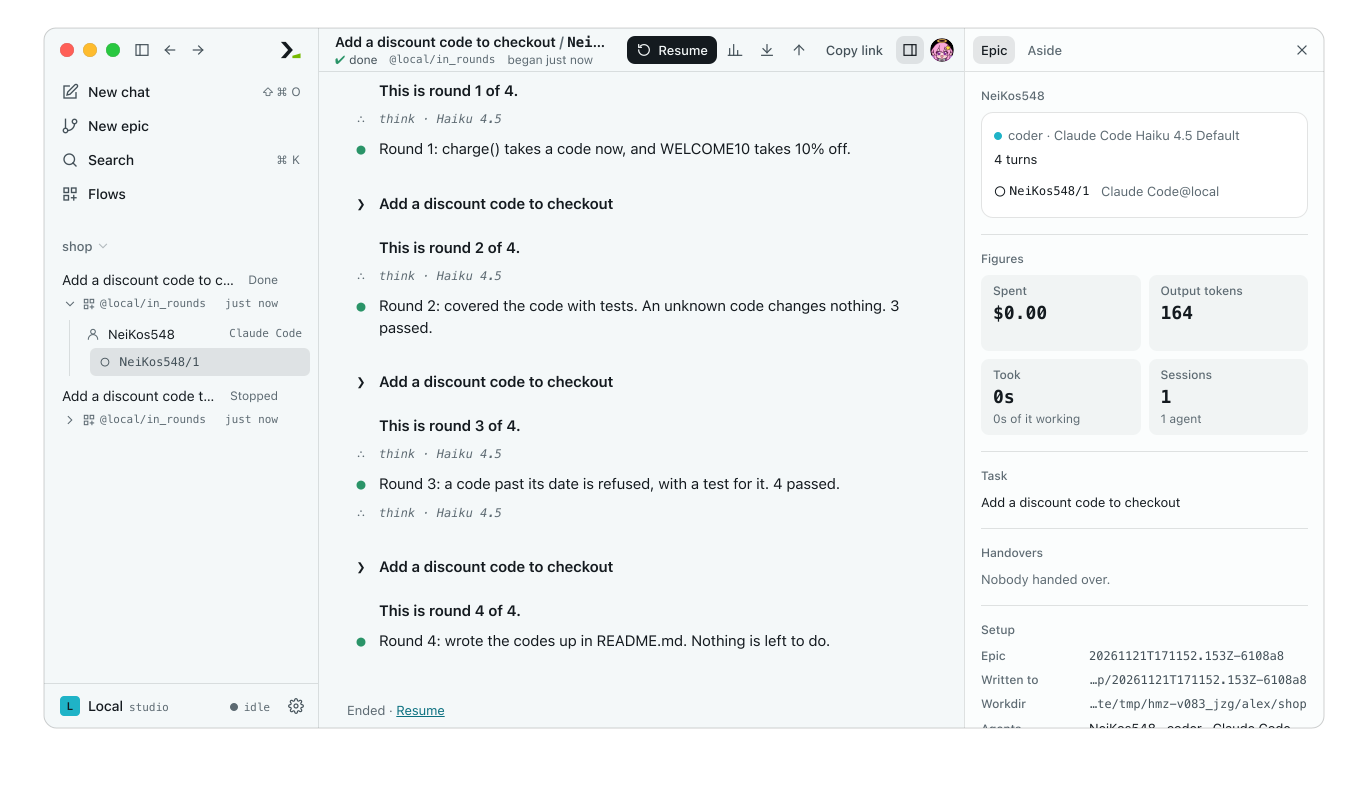
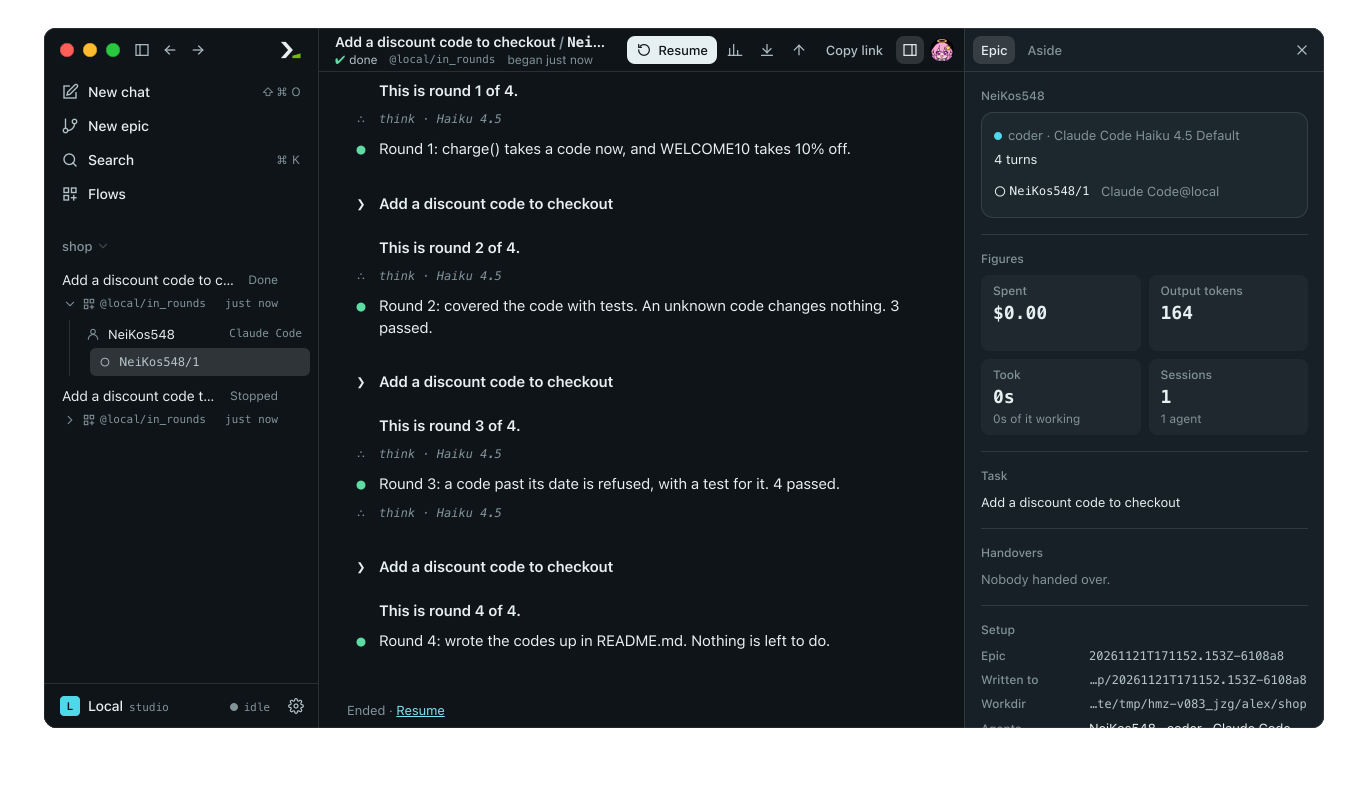
The resumed epic's one session: 4 turns, two of them from the epic it picked up.
Writing a session raises StateNotSerializable if the session:
- has taken no turn, is in the middle of a turn, or is closed;
- belongs to another flow call, or to an outworlder;
- runs on a harness that cannot fork a conversation, or that stores conversations in a database (
opencode,mimo); - took its last turn with the harness running on another machine: on a runtime whose Harness runs on is Inside the environment or another runtime.
Keep the same harness for the role when you resume. Running the first turn of a saved session on a different harness raises UnsupportedOperation.
Inspect the journal
Humanize writes state changes to resume.jsonl in the epic's directory, with one JSON line per flow call and its end, state write or delete, session, and temporary directory.
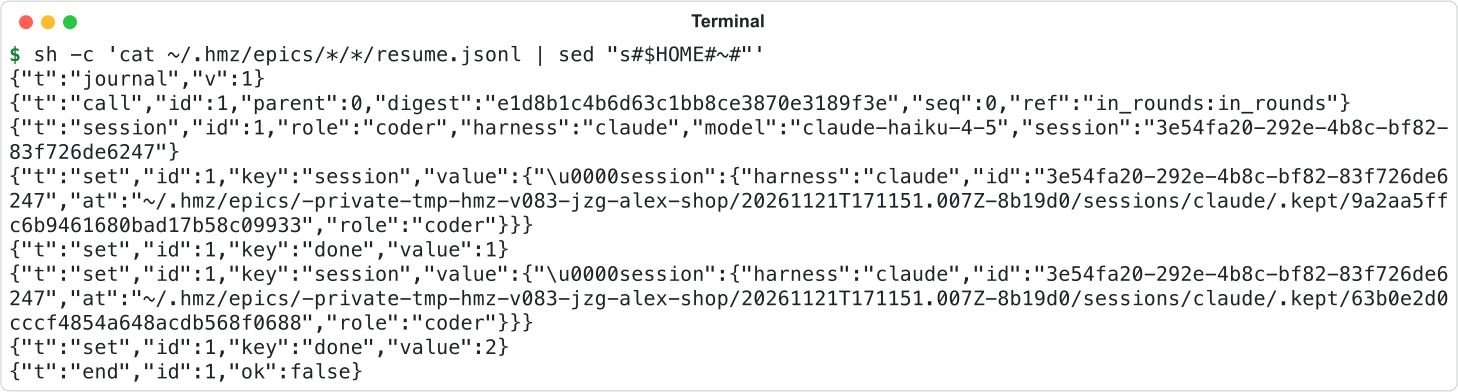
A resumed epic starts with a compacted copy of the journal and appends to it. The original journal is never modified, so you can resume the same epic multiple times. See Files on disk.
Resume subflows
The flow at the top always picks up the earlier epic's state, even if you change the task, agents, or params on resume. When a resumed flow calls another flow, Humanize matches the call to one from the earlier epic. Two calls match when they have the identical caller, flow, task, agents (same harness, account, model, effort, permission, and skills), environments (derived the same way from the same place), and params. Multiple identical calls are matched in the order they were made. Unmatched calls start with an empty state.
Each flow call has its own state, and a subflow must set resumable=True to use it.
Humanize keeps the temporary clones and scratch directories of a resumable epic when it ends. Deriving one with the same id in the resumed epic returns the same directory. See Worktrees, clones and scratch.
Resume from Python
Pass resume=True to Hmz().run to pick up the newest epic, or pass an epic's directory to pick up a specific one. Use Hmz().epics to inspect saved state without running the flow.
# carry_on.py
from hmz.sdk import Hmz

hmz = Hmz()
epic = hmz.epics.resumed("@local/in_rounds")
print("picks up:", epic.name)
print("rounds done:", hmz.epics.state(epic)["done"])

run = hmz.run(
    "@local/in_rounds",
    "Add a discount code to checkout",
    agents={"coder": "claude/claude-haiku-4-5"},
    budget={"output_tokens": 20000},
    resume=True,
)
print("returned:", run.run())

| Call | Returns |
|---|---|
hmz.flows.resumes(name) | Whether the flow is resumable. |
hmz.epics.resumed(flow) | The epic --resume would pick up, or None. |
hmz.epics.picks_up(epic) | Whether that epic can be picked up. |
hmz.epics.state(epic) | The state the epic's flow kept, as a dict. |
See The Python SDK.
Test a resumable flow
Pass a journal path and resume to run_fake. Run the flow once so it fails partway through, then run it again with resume=True on the same journal.
# test_in_rounds.py
from pathlib import Path

import pytest

from hmz.sdk import fakes


async def test_in_rounds_picks_up_at_round_three(tmp_path: Path) -> None:
    asked: list[str] = []

    def coder(prompt: str, **_: object) -> str:
        asked.append(prompt.splitlines()[-1])
        if len(asked) == 3:
            raise RuntimeError("killed")  # the first run dies in round 3
        return "ok"

    async def run(*, resume: bool) -> int:
        return await fakes.run_fake(
            "./.hmz/flows/in_rounds",
            "add a coupon",
            agents={"coder": coder},
            journal=tmp_path / "resume.jsonl",
            resume=resume,
        )

    with pytest.raises(RuntimeError):
        await run(resume=False)
    assert await run(resume=True) == 4
    assert asked[3:] == ["This is round 3 of 4.", "This is round 4 of 4."]
An async def test needs pytest-asyncio with asyncio_mode = "auto". See Test a flow.
Good to know
- A resumed epic is a new epic with its own name, budget, and sessions. Spend from the earlier epic does not carry over.
- State writes are on disk when the line returns. Write after a step completes, not before, so a crash in between does not skip the step.
- Reading a key returns a copy. Mutating a list or dict in place does not update the state; assign it back to the key.
- Values round-trip through JSON on both first and resumed runs: tuples become lists, and dict keys become strings.
- Each session write copies the conversation into the epic. In a long loop, write the session only when needed.
- Finished epics can also be resumed. If a completed flow should start over instead, delete its keys before returning.
- In a non-resumable flow,
ctx.stateisNone. - If the top-level flow is not resumable, any resumable subflow it calls keeps its state in memory for that epic only.
- A resumed epic runs the current flow code on disk. Keep old state keys compatible when you edit a flow.