Agent roles
A flow declares roles instead of naming coding agents or models. The person who runs the flow assigns an agent to each role. A role's type defines what the flow can do with that agent and which harnesses can fill it.
Declare the roles
Subclass AgentCollection with one key per role. Type each role as Agent or a subclass that requests extra capabilities.
# .hmz/flows/careful/__init__.py
from typing import NotRequired

from hmz.flows import (
    Agent,
    AgentCollection,
    EnvCollection,
    FlowContext,
    FlowParams,
    GoalCommandAgentMixin,
    LocalEnv,
    Permission,
    flow,
)


class Coder(Agent, GoalCommandAgentMixin):
    """Pursues the task as a goal of its harness."""


class Agents(AgentCollection):
    coder: Coder
    reviewer: NotRequired[Agent]


class Envs(EnvCollection):
    workspace: LocalEnv


@flow(agents=Agents, envs=Envs, params=FlowParams)
async def careful(
    task: str, *, agents: Agents, envs: Envs, params: FlowParams, ctx: FlowContext
) -> str:
    """A coder pursues the task; a reviewer, if given, reads the change."""
    coder, workspace = agents["coder"], envs["workspace"]
    said = await coder.run(f"/goal {task}", session=await coder.spawn(), env=workspace)
    reviewer = agents.get("reviewer")
    if reviewer is None:
        return said
    reader = reviewer.derive(permission=Permission(preset="read-only"))
    return await reader.run(
        "Review the change in this repository.",
        session=await reader.spawn(),
        env=workspace,
    )
coder is required; a run without an agent for it is refused before starting. reviewer is wrapped in NotRequired[...], so you can omit it. When omitted, its key is missing from agents, so read it with agents.get. A role typed Outworlder represents the person; Humanize fills it automatically, and nobody can assign an agent to it (see The person as an agent).
Run the flow with one -a flag per role:
hmz exec -f @local/careful -a coder=claude/claude-haiku-4-5 \
    -a reviewer=claude/claude-opus-4-1 -p budget.output_tokens=20000 \
    "Add a discount code to checkout"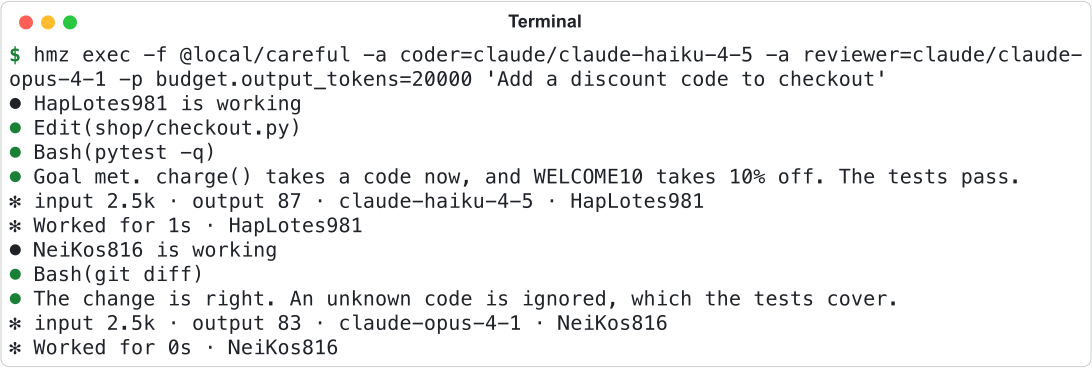
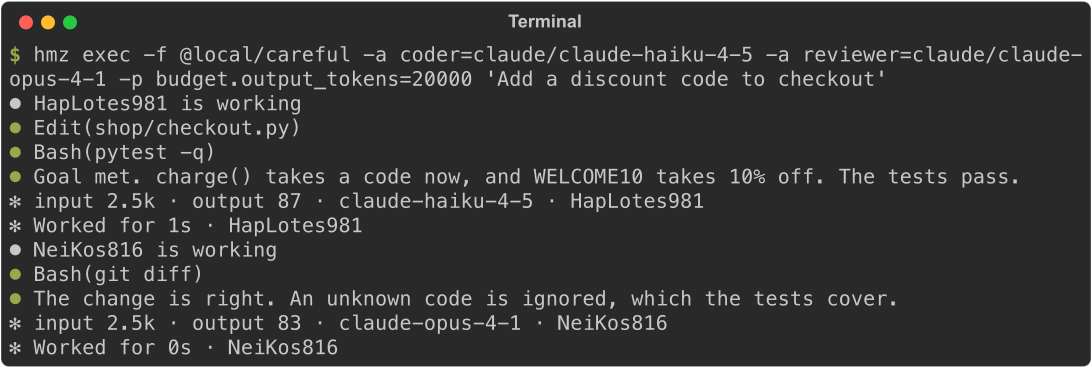
Each role takes its turn as the agent given for it.
Ask for a capability
Add a mixin to a role type for anything the flow does beyond spawn, run, fork, derive and the universal hooks.
| Mixin | Lets the flow |
|---|---|
GoalCommandAgentMixin | run a prompt that starts with /goal. See Goals |
LoopCommandAgentMixin | run a prompt that starts with /loop. See Goals |
SteeringAgentMixin | call steer to say something into a running turn. See Sessions and turns |
PermissionRequestHookAgentMixin | call on_permission_request. See Hooks |
SubagentStartHookAgentMixin | call on_subagent_start |
SubagentStopHookAgentMixin | call on_subagent_stop |
AskUserHookAgentMixin | call on_ask_user |
FakeToolAgentMixin | set _tools on the role. See Tools the agent can call |
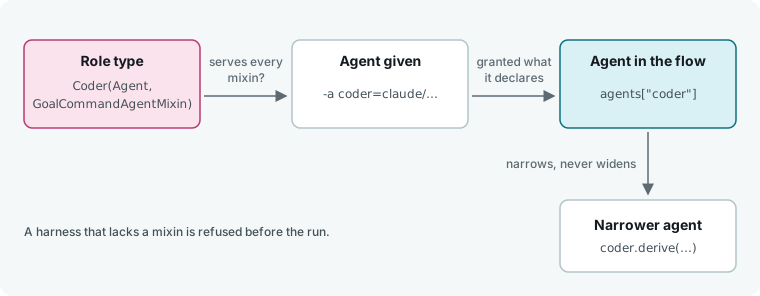
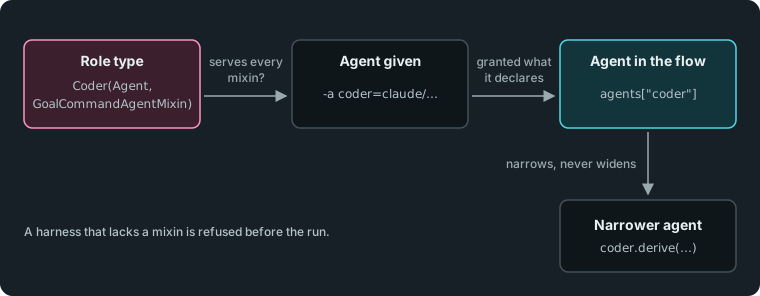
Mixins enforce a contract on both sides. Only a harness that supports every mixin on a role can fill it; any other is refused before the run starts:


The flow receives only the capabilities its role declares. Calling an undeclared capability raises CapabilityNotGranted, even if the underlying harness supports it. Here Coder is declared as class Coder(Agent) and still runs /goal:


Check harness support
Each harness has its own role type and supports specific mixins. The first column shows the harness name passed to -a.
| Harness | Role type | Goal | Loop | Steering | Permission request | Subagent start and stop | Ask user | Fake tools |
|---|---|---|---|---|---|---|---|---|
claude | ClaudeCodeAgent | ✓ | ✓ | ✓ | ✓ | ✓ | ✓ | ✓ |
codex | CodexAgent | ✓ | ✓ | ✓ | ✓ | ✓ | ✓ | |
kimi | KimiCodeAgent | ✓ | ✓ | ✓ | ✓ | |||
pi | PiAgent | ✓ | ✓ | ✓ | ||||
omp | OhMyPiAgent | ✓ | ✓ | ✓ | ||||
dsh | DeepSeekHarnessAgent | ✓ | ✓ | |||||
opencode | OpenCodeAgent | ✓ | ||||||
mimo | MiMoCodeAgent | ✓ | ||||||
qwen | QwenCodeAgent | ✓ | ||||||
grok | GrokBuildAgent | ✓ | ||||||
agy | AntigravityAgent | ✓ | ||||||
cursor-agent | CursorAgent | ✓ | ||||||
mcode | MiniMaxCodeAgent | ✓ | ||||||
litellm | LiteLLMAgent | |||||||
acp | Agent |
acp represents any custom CLI added by a user; give it to -a by the name it was added under, not as acp. It supports no mixins and fills only plain Agent roles. See Coding agents for the products behind these names, and Agents and harnesses for the full matrix.
Pin a role to one harness
Type a role with a specific harness class to require that harness and grant all its mixins:
from hmz.flows import ClaudeCodeAgent, Permission


class Coder(ClaudeCodeAgent):
    _permission = Permission(network=False)
Passing any other harness for this role is refused before the run starts. In a subflow, a mismatch raises HarnessMismatch (see Call another flow).
Prefer Agent with mixins so any compatible harness can fill the role. HARNESS_AGENTS maps each HarnessKind to its role type.
Configure role defaults
Set four class variables on a role type to configure its sessions.
| Class variable | Default | Sets |
|---|---|---|
_permission | Permission(): change the working directory, read the rest of the machine, use the network | What the agent may touch. See Skills and permissions |
_skills | () | The skills its sessions are given. See Skills and permissions |
_tools | () | Functions of the flow offered as tools. Needs FakeToolAgentMixin |
_clis | () | Command lines of the flow put on the agent's PATH. Needs no mixin. Not for litellm |
Inspect the assigned agent
Read these properties on an agent to see what fills its role:
| Property | Value |
|---|---|
role | The role's key in the AgentCollection |
harness | A HarnessKind, such as HarnessKind.CLAUDE. Its value is the -a name, or acp for a custom CLI |
model | The model, as it was given |
effort | The effort in the harness's own words. "" when none was given or it was auto |
provider | The account its turns run as. "" for the sign-in the CLI already has |
Use a bare model
Type a role as LiteLLMAgent, or pass -a judge=litellm/MODEL to a plain Agent role, to call a model directly. Each turn runs one chat completion over the session history without a CLI, tools, shell, or files. Use this for roles that only judge text.
class Agents(AgentCollection):
    coder: Agent
    judge: LiteLLMAgent


# In the flow function:
judge = agents["judge"]
verdict = await judge.run(
    f"Does this summary say the task is done?\n\n{said}",
    session=await judge.spawn(),
)
Omit env on its turns; passing an environment raises UnsupportedOperation. The person running the flow must install the LiteLLM extra (see Gateways, LiteLLM and custom CLIs).
Narrow an agent
Call derive to return a copy of the agent with narrower permissions, fewer skills, or both. The original agent is unchanged.
reader = coder.derive(permission=Permission(preset="read-only"), skills=())Pass permission=None to keep the current permission, and skills=None to keep all current skills. Requesting more than the agent was granted raises CapabilityNotGranted, because derive never widens access. Passing a permission that is not a Permission instance raises TypeError.
The derived agent shares sessions and hooks with the original, and retains the role's tools and command lines. A session spawned by one can take turns with the other.
Assign roles when running a flow
In the app
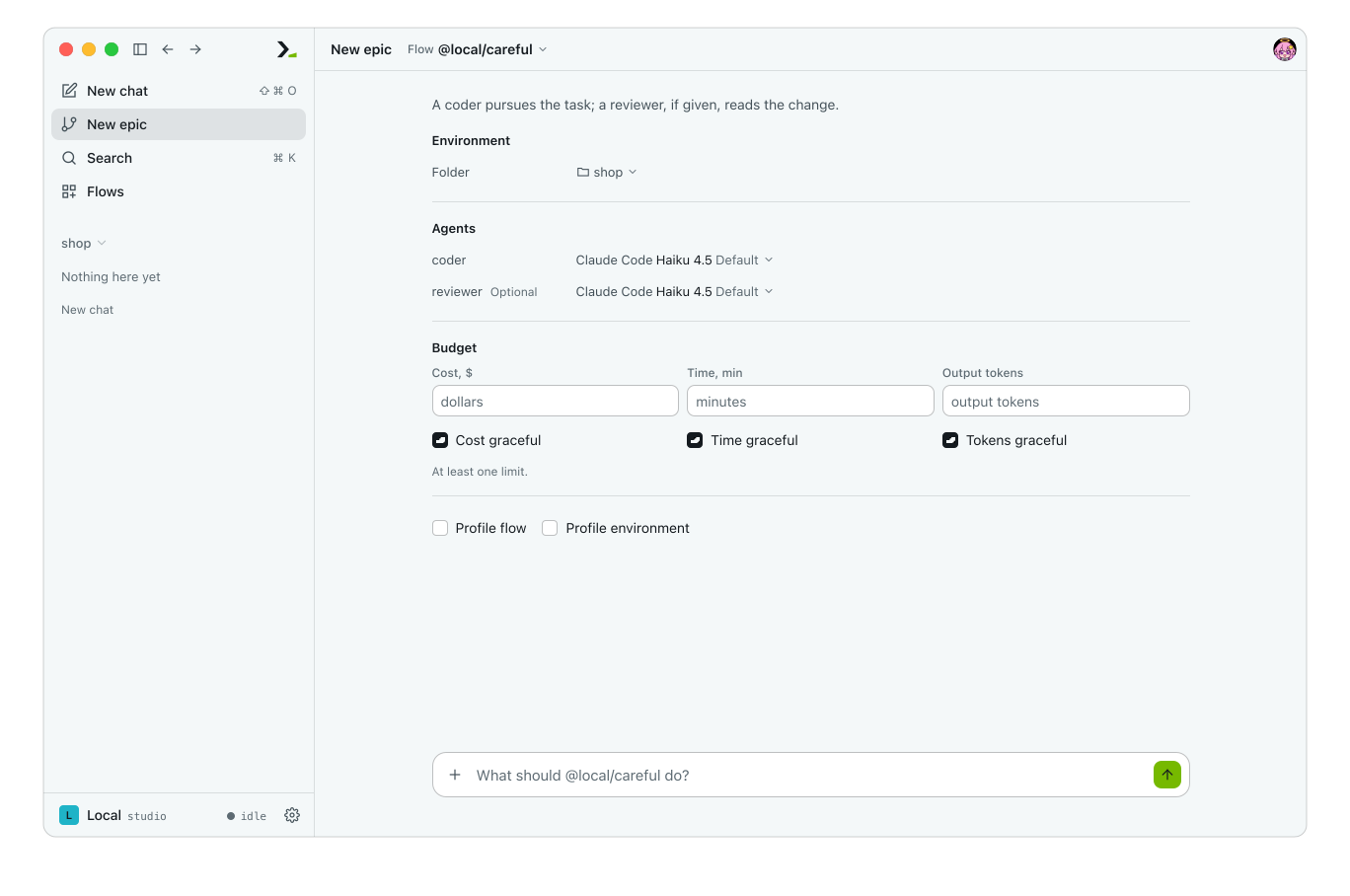
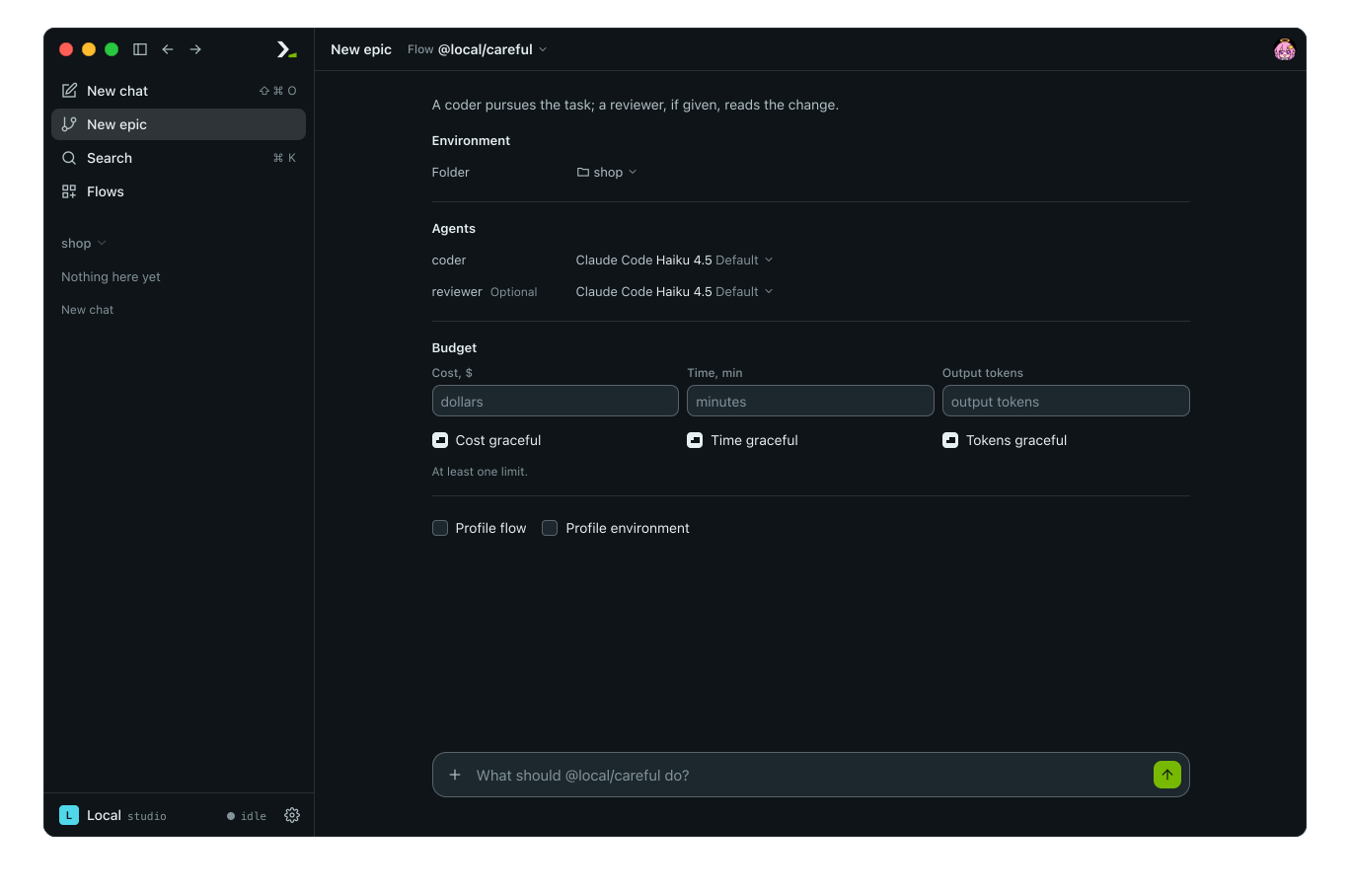
Open New epic and pick the flow in the Flow menu at the top to see one row per role under Agents. Optional roles are marked Optional. Each row lists only the harnesses that can fill the role. See Start an epic.
In the terminal
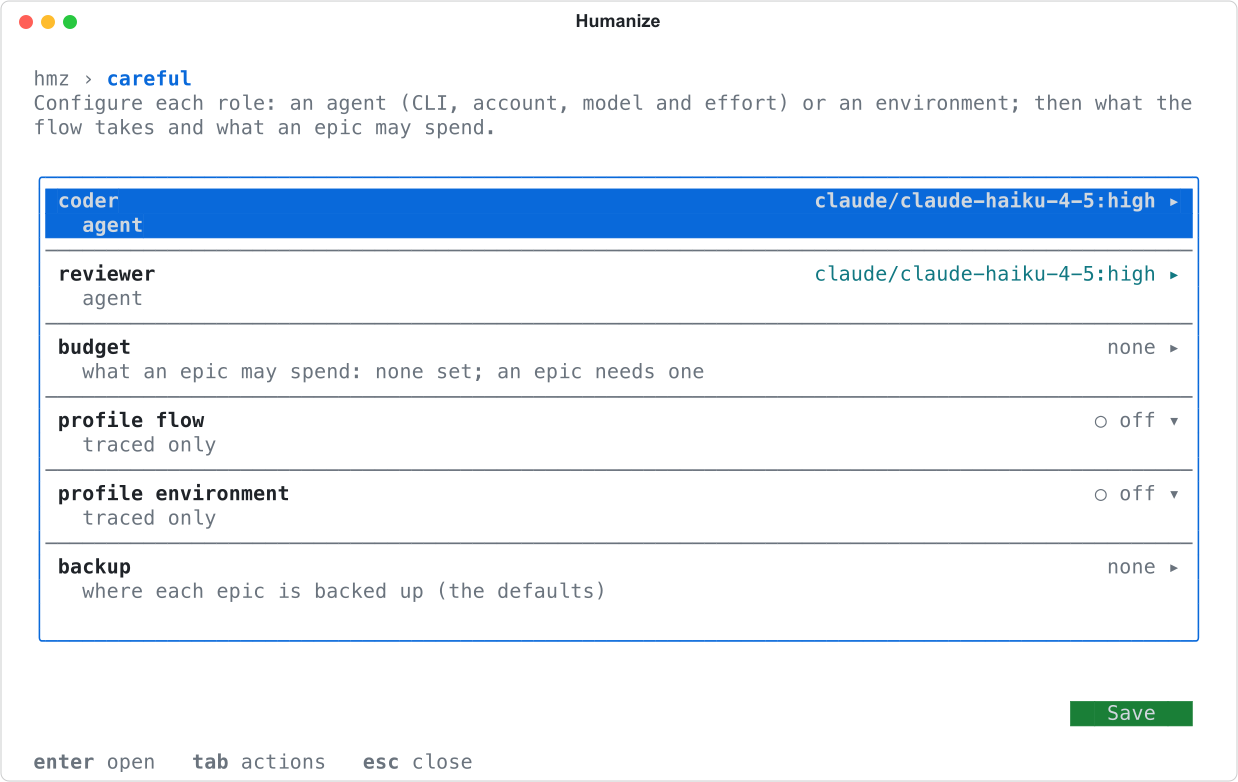
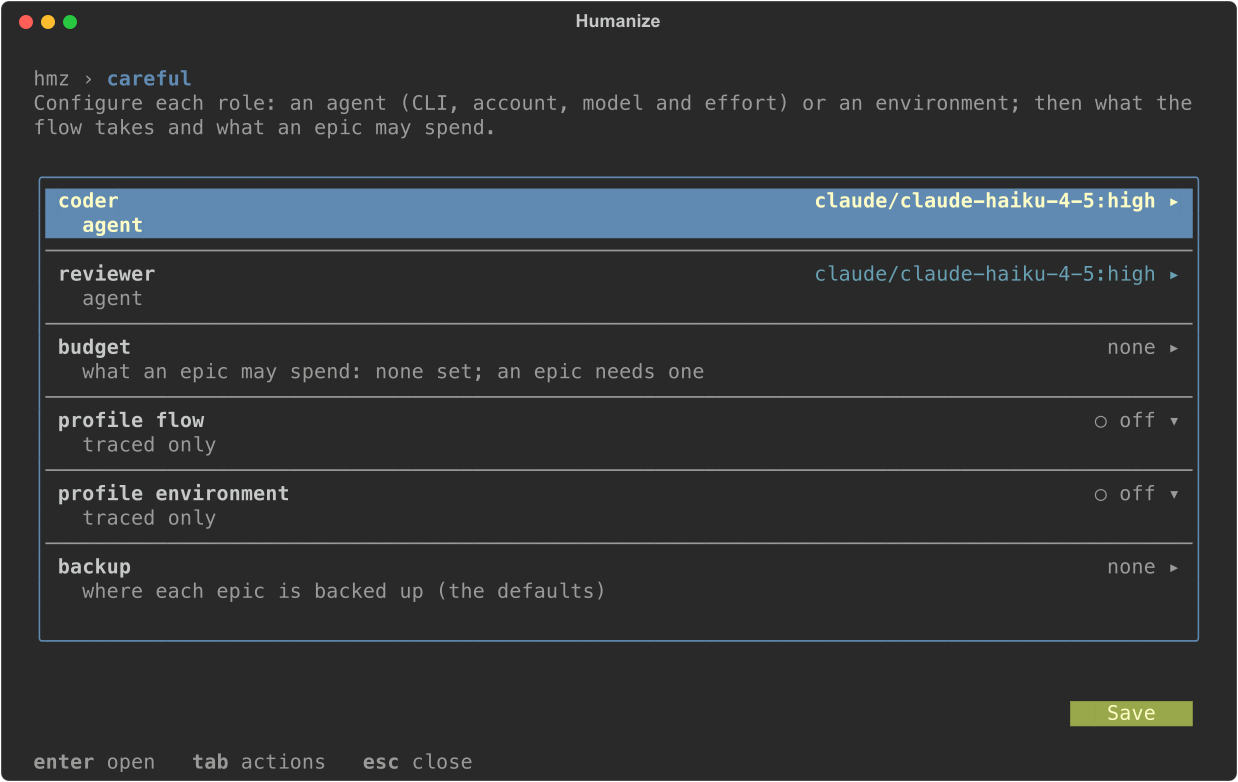
Run /flow careful to open the flow setup with one row per role.
From the command line
Pass one -a ROLE=CLI/MODEL:EFFORT flag per role. Omitting a required role refuses the run: @local/careful needs an agent for 'coder'.
Good to know
- A role type cannot inherit from two harnesses,
Outworlderaccepts no harness or mixin, and setting_toolsrequiresFakeToolAgentMixin. Violating any of these raisesFlowDefinitionErrorwhen Humanize loads the flow. So does a class variable of the wrong type, a tool or command line named twice, an environment's mixin on an agent role, or_clison anOutworlderorLiteLLMAgentrole. - A
grokagent on a role with_toolsraisesHarnessUnrecoverableon turns withoutput_schema, on the first turn of a fork, whennetwork=False, or when its permission lets it write nowhere. - A
litellmagent is refused for any role that sets_clisbecause it has no shell. - In tests,
run_fakefills any unassigned required role with a scripted agent matching the requested harness, defaulting to Claude Code. Unassigned optional roles remain omitted. See Test a flow.