Context, errors and cleanup
Each flow receives ctx, which tracks what the call can spend and has spent. Failures arrive as standard Python exceptions and stops arrive as cancellations, so try, except, and finally work as they do in any coroutine.
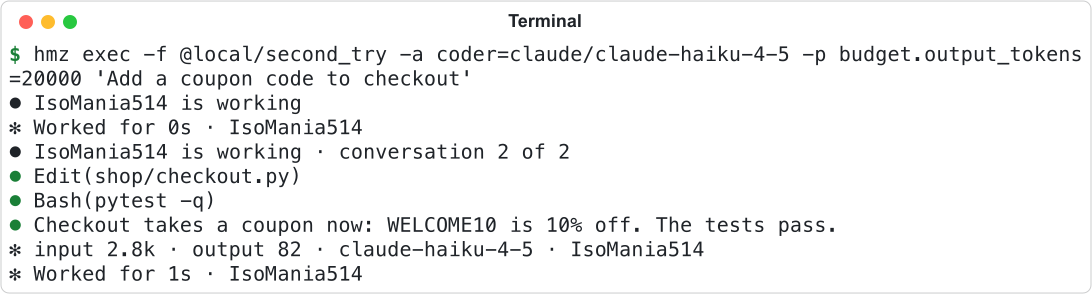
A turn fails, the flow catches the error, and a second conversation finishes the task.
Read the flow context
Read ctx to inspect the current FlowContext. Each flow call gets its own context, and its fields update live each time you read them.
| Name | Type | What it is |
|---|---|---|
ctx.budget | Budget | The limits for this call, taking the tighter of its own limits and its caller's: duration, cost, output_tokens, and graceful. Unset limits are None; with no budget at all, cost is inf. |
ctx.usage | Usage | Total usage for this call and its child calls so far: duration (a timedelta, the time agents spent in turns), cost (USD), and output_tokens. |
ctx.flow | Flow | Metadata for the running flow: description, resumable, expected_agents, expected_envs, and expected_params. |
ctx.resumed | bool | True if this call resumes an earlier run. |
ctx.state | FlowState or None | State kept across runs for a resumable flow, or None if the flow is not resumable. |
ctx.budget holds the total limits, not the remaining budget. Subtract ctx.usage to find the cost or tokens that remain:
left = ctx.budget.cost - ctx.usage.cost if ctx.budget.cost is not None else NoneHooks receive the same context at params.ctx. See Budgets in a flow for budgets and Resumable flows for ctx.state.
Catch an error
Catch FlowException or one of its subclasses to handle errors from the flow API. The hierarchy splits into three branches based on where the failure happened.
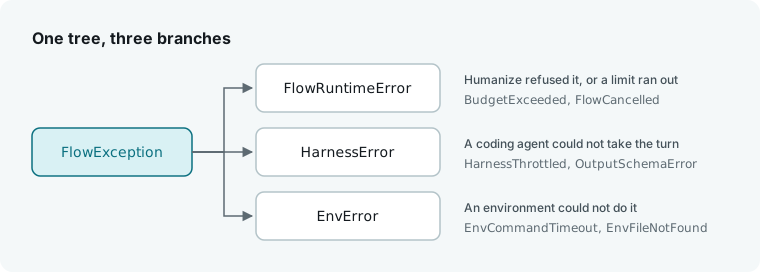
Catch a leaf class for a specific failure, a branch for a category, or FlowException for everything. This flow gives the coder a second try in a new session when the harness fails:
# .hmz/flows/second_try/__init__.py
from hmz.flows import (
    Agent,
    AgentCollection,
    EnvCollection,
    FlowContext,
    FlowParams,
    HarnessError,
    LocalEnv,
    flow,
)


class Agents(AgentCollection):
    coder: Agent


class Envs(EnvCollection):
    workspace: LocalEnv


@flow(agents=Agents, envs=Envs, params=FlowParams)
async def second_try(
    task: str, *, agents: Agents, envs: Envs, params: FlowParams, ctx: FlowContext
) -> str:
    """A coder does the task, and tries once more if its harness fails."""
    coder, workspace = agents["coder"], envs["workspace"]
    try:
        answer = await coder.run(task, session=await coder.spawn(), env=workspace)
    except HarnessError as error:
        again = f"The last try failed: {error}. Try again. {task}"
        answer = await coder.run(again, session=await coder.spawn(), env=workspace)
    return f"{answer} ({ctx.usage.output_tokens} output tokens)"
Here is the full exception tree, including the Python builtins that leaf classes inherit from:
FlowException
├── FlowRuntimeError
│   ├── FlowNotFound
│   ├── FlowRefError (ValueError)
│   ├── FlowDefinitionError
│   ├── FlowLoadConflict
│   ├── RequirementError
│   │   ├── MissingRole
│   │   ├── CapabilityMissing
│   │   ├── PermissionTooNarrow
│   │   ├── ResourceUnmet
│   │   └── HarnessMismatch
│   ├── CapabilityNotGranted
│   ├── ParamsError (ValueError)
│   ├── FlowDepthExceeded (RecursionError)
│   ├── BudgetExceeded
│   │   ├── DurationExceeded (TimeoutError)
│   │   ├── CostExceeded
│   │   └── OutputTokensExceeded
│   ├── FlowCancelled
│   ├── StateNotSerializable (TypeError)
│   └── OutworlderAway
├── HarnessError
│   ├── HarnessNotInstalled
│   ├── HarnessContended
│   ├── HarnessThrottled
│   ├── HarnessRefused
│   ├── ModelUnavailable
│   ├── HarnessMissing
│   ├── HarnessSandboxed
│   ├── HarnessKilled
│   ├── HarnessDropped
│   ├── HarnessUnrecoverable
│   ├── OutputSchemaError (ValueError)
│   ├── SessionError
│   └── UnsupportedOperation
└── EnvError
    ├── EnvUnavailable
    ├── EnvConnectionError (ConnectionError)
    ├── EnvCommandTimeout (TimeoutError)
    ├── EnvFileNotFound (FileNotFoundError)
    ├── EnvPermissionDenied (PermissionError)
    ├── WorktreeError
    ├── TempCloneBusy
    ├── ScratchError
    └── RewindError
Python builtins catch matching leaf classes: except TimeoutError catches both EnvCommandTimeout and DurationExceeded. Child flows raise their exceptions directly into the calling flow without wrapping. Bugs in your own code keep their normal Python types, so a KeyError stays a KeyError rather than becoming a FlowException.
BudgetExceeded is sticky. Once a flow spends its budget, every later turn raises BudgetExceeded again. The flow can continue only when a single turn exceeds its own budget (error.own is True).
See the Flow API reference for a description of each class.
See how a flow ends
How the flow function exits determines the epic's final state and the exit code of hmz exec.
| The flow | The epic ends | hmz exec |
|---|---|---|
| returns | Done | exits 0 |
raises BudgetExceeded | Budget spent | writes hmz exec: stopped -- <reason>, exits 0 |
| is stopped from outside | Stopped | after ctrl+c, exits 128 plus the signal number |
raises another FlowException | Failed | writes the exception, exits 1 |
| raises anything else | Crashed | writes the traceback, exits 1 |
| is refused before it starts | Refused | writes hmz exec: error: <reason>, exits 2 |
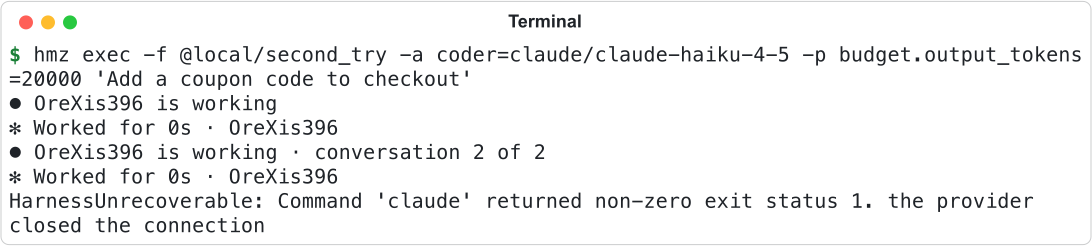
Both tries fail, so the second error leaves the flow and fails the epic.
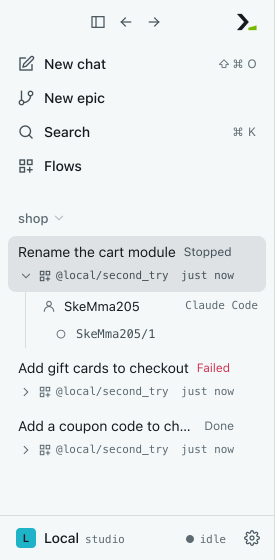
Three of these endings in the app.
Clean up when a run stops
Use a try/finally block to run cleanup code when someone stops an epic via Stop in the app, /stop in the terminal, ctrl+c in hmz exec, or run.stop() in the SDK.
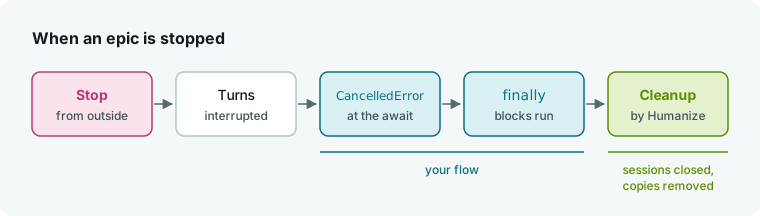
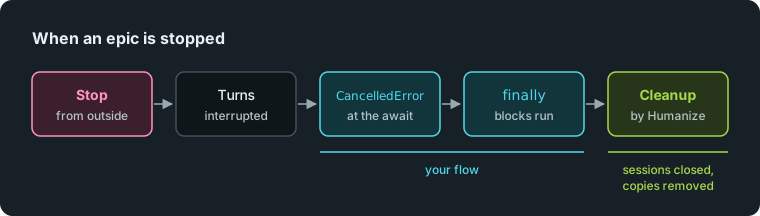
- Humanize interrupts every active turn.
- The flow receives
asyncio.CancelledErrorat its currentawait. - Your
finallyblocks run while environments remain available. - Humanize closes all sessions and removes temporary clones and scratch directories created by the flow.
This flow writes a status file in the workspace and updates it on exit:
# .hmz/flows/tidy/__init__.py
import asyncio

from hmz.flows import (
    Agent,
    AgentCollection,
    EnvCollection,
    FilesEnvMixin,
    FlowContext,
    FlowParams,
    LocalEnv,
    flow,
)


class Agents(AgentCollection):
    coder: Agent


class Workspace(LocalEnv, FilesEnvMixin):
    pass


class Envs(EnvCollection):
    workspace: Workspace


@flow(agents=Agents, envs=Envs, params=FlowParams)
async def tidy(
    task: str, *, agents: Agents, envs: Envs, params: FlowParams, ctx: FlowContext
) -> str:
    """A coder works while a note says so; the note says how it ended."""
    coder, workspace = agents["coder"], envs["workspace"]
    await workspace.write("STATUS", b"working\n")
    status = b"failed\n"
    try:
        answer = await coder.run(task, session=await coder.spawn(), env=workspace)
        status = b"done\n"
        return answer
    except asyncio.CancelledError:
        status = b"stopped\n"
        raise
    finally:
        await workspace.write("STATUS", status)
Re-raise CancelledError if you catch it, or the flow will not stop. Keep cleanup fast because the user is waiting; Humanize gives its own session and directory cleanup 30 seconds before moving on. A resumable flow keeps its temporary clones and scratch directories for the next run (see Worktrees, clones and scratch). Any file an agent was editing when interrupted stays as it was at that moment.
When a flow ends, Humanize cancels any background tasks the flow started and never awaited. Any later calls those tasks make to an agent, environment, or flow raise FlowCancelled. A non-graceful duration limit cancels the flow the same way when time runs out: the flow receives CancelledError, and its caller receives DurationExceeded.
See Stop a run for how users stop and force-stop runs.
Replace the board in flows
The board (covered in Talk to a running flow) is not part of hmz.flows, and flow epics do not display one. To show information to the user, pass context blocks to an Outworlder (see The person as an agent). To persist values across runs, store them in ctx.state (see Resumable flows).
Find Humanize directories
Call the path helpers on hmz to get a pathlib.Path for Humanize's directories, even outside a running flow.
| Call | Answers | Holds |
|---|---|---|
hmz.home() | ~/.hmz, or the directory HUMANIZE_HOME names | Persistent data: settings, flowverses, epics, and chats. |
hmz.here() | .hmz, relative to the current directory | Project data: its flows/ directory and runs exported here. |
hmz.machine() | humanize-<uid> in the system's temporary directory | Local runtime state, such as running processes. |
import hmz

flows = hmz.here() / "flows"  # this project's own flows, the @local source
hmz.home() and hmz.here() do not create the directory on disk. If only a directory under the earlier name (~/.humanize, .humanize) exists, the first call renames it; a directory that HUMANIZE_HOME names is used as it is. hmz.machine() creates its directory with user-only permissions, and raises PermissionError if what already exists at that path is not a directory of yours that nobody else can write. Inside a with hmz.working_in(workspace): block, hmz.here() returns <workspace>/.hmz for the current thread.
These paths always point to the machine running the flow. An agent's working directory lives in its environment, which may be on another machine; access agent files through the environment instead. See Files on disk for the directory layout.
Good to know
hmz execprints agent output, not the flow's return value.- Humanize raises
RequirementErrorandParamsErrorfor the top-level flow before the flow starts, so the flow cannot catch them itself and the epic ends Refused. A parent flow can catch them when calling a child flow. - Humanize closes a session as soon as no variable references it, so keep the session in a variable while turns remain.
- To test error handling without a real agent, give a fake agent a
replyfunction that raises one of these exceptions. See Test a flow.