The person as an agent
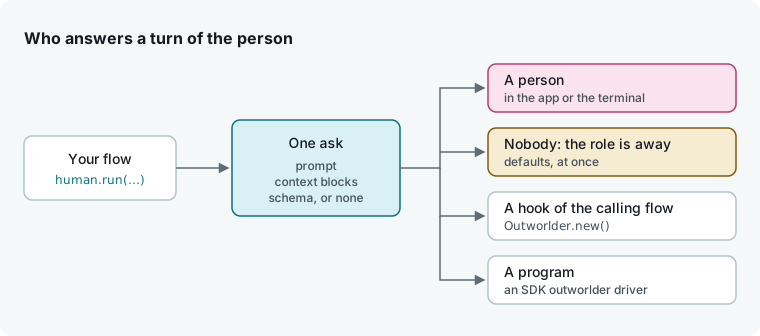
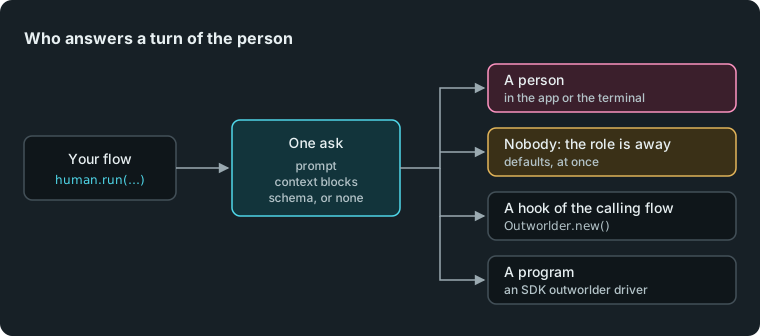
An Outworlder role represents the person running the flow. Your flow gives this role turns like any agent: each turn asks a question, and run returns the person's answer.
Declare the role
Type a role as Outworlder in the flow's AgentCollection. Humanize fills it automatically; naming it with -a is an error.
# .hmz/flows/approve/__init__.py
"""Approve: an agent does the task, and a person decides whether to keep it."""

from pydantic import BaseModel, Field

from hmz.flows import (
    Agent,
    AgentCollection,
    Diff,
    EnvCollection,
    FlowContext,
    FlowParams,
    LocalEnv,
    Markdown,
    Outworlder,
    ShellEnvMixin,
    Table,
    flow,
)


class Review(BaseModel):
    keep: bool = Field(False, description="Keep the change.")
    notes: str = Field("", description="What to change, if anything.")


class Agents(AgentCollection):
    coder: Agent
    human: Outworlder


class Workspace(LocalEnv, ShellEnvMixin): ...


class Envs(EnvCollection):
    workspace: Workspace


@flow(agents=Agents, envs=Envs, params=FlowParams)
async def approve(
    task: str, *, agents: Agents, envs: Envs, params: FlowParams, ctx: FlowContext
) -> bool:
    """An agent does the task, and a person decides whether to keep it."""
    coder, human = agents["coder"], agents["human"]
    workspace = envs["workspace"]
    work = await coder.spawn()
    asking = await human.spawn()
    said = await coder.run(task, session=work, env=workspace)
    await human.show(
        (Markdown(text="The coder is done. Running the checks."),), session=asking
    )
    _, patch, _ = await workspace.exec(["git", "diff"])
    code, _, _ = await workspace.exec(["python", "-m", "compileall", "-q", "."])
    review = await human.run(
        "Keep this change?",
        session=asking,
        output_schema=Review,
        context=(
            Markdown(title="What the coder says", text=said),
            Diff(patch=patch),
            Table(
                title="Checks",
                columns=("check", "result"),
                rows=(("compiles", "yes" if code == 0 else "no"),),
            ),
        ),
    )
    if review.keep:
        title = await human.run("What should the commit say?", session=asking)
        await coder.run(f"Commit the change as: {title or task}", session=work, env=workspace)
    else:
        await coder.run(f"Undo the change. {review.notes}", session=work, env=workspace)
    return review.keep
You can declare multiple Outworlder roles, such as author and approver. Each role is asked, claimed, and set away by its own name.
Ask a question
Call spawn to open a session, then call run to ask a question. A session groups its questions into one conversation.
| Call | The person gets | run returns |
|---|---|---|
await human.run("What should the commit say?", session=asking) | A box to type in | The text, a str |
await human.run("Keep this change?", session=asking, output_schema=Review) | One form with every field of Review | A Review |
Humanize presents a schema as a single form, never one field at a time. Field types, defaults, and descriptions determine the form controls; see Typed answers.
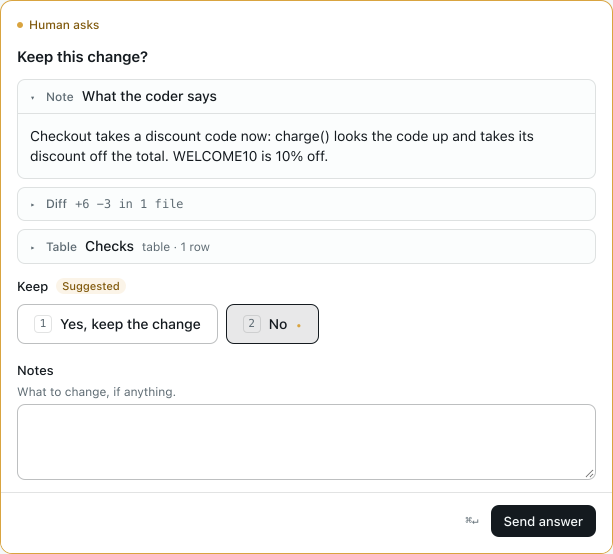
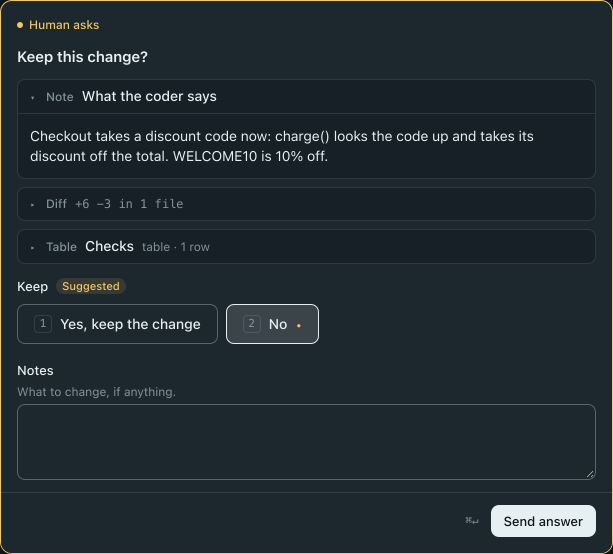
The daemon validates answers against the model. Invalid answers are rejected with field errors, keeping the question open until the answer fits. While a question waits, the epic status is waiting.
Pass spawn(face=...) to replace the standard form with a custom HTML page; see Faces.
Show context and messages
Pass a sequence of blocks to context in run to display them in order beneath the prompt. Context blocks work with both text questions and forms.
| Block | Fields | Drawn as |
|---|---|---|
Markdown | text | Formatted text |
Code | text, language="" | Highlighted source |
Diff | patch | A unified diff, file by file; it may span files |
Table | columns, rows | A table; a row that is not as wide as columns raises ValueError |
Image | data, mime, alt="" | A picture; at most 4 MiB, and mime must start with image/, else ValueError |
Json | value | A tree that folds |
Chart | spec | A Vega-Lite chart; put its data inline in data.values |
Every block accepts title="". All fields are keyword-only.
Call show with the same blocks to send a message without asking a question:
await human.show((Markdown(text="The coder is done. Running the checks."),), session=asking)show records the blocks in the epic history and returns immediately without waiting.


Click the person in the app's graph to view messages sent with show.
See the question
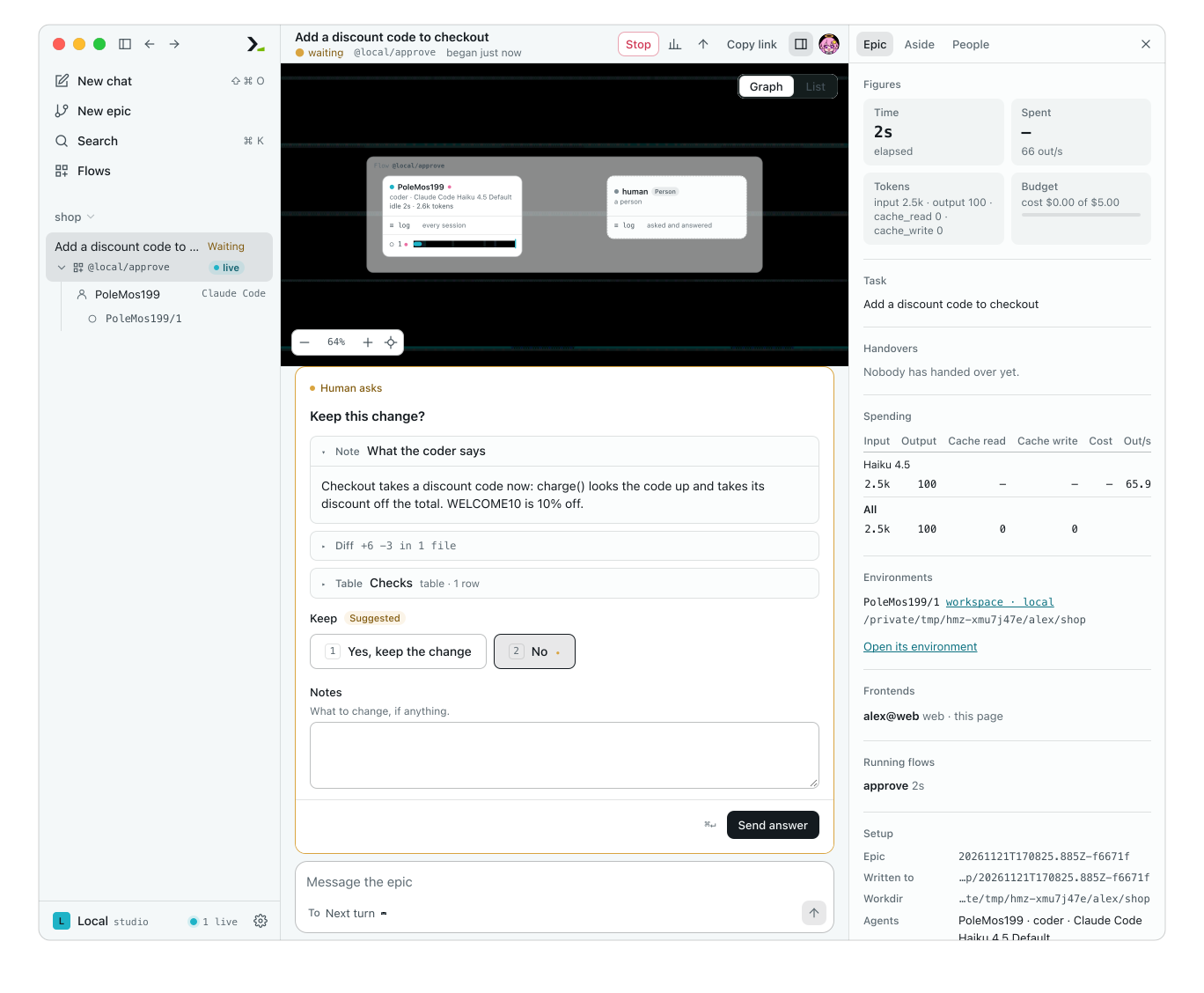
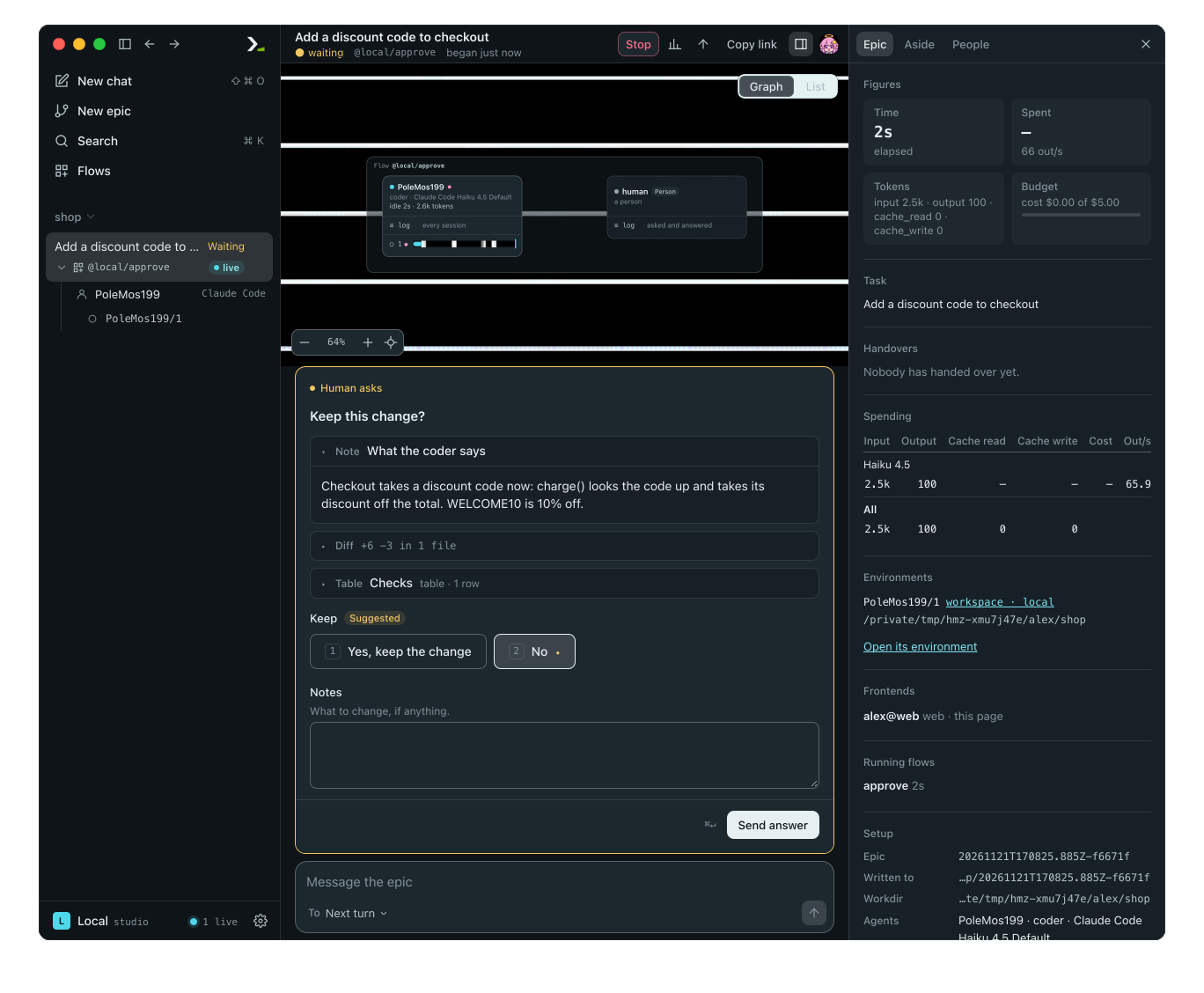
Start the flow in the app or hmz to see questions appear as the flow runs. See Answer a flow's questions for how to respond.
In the app
In the terminal
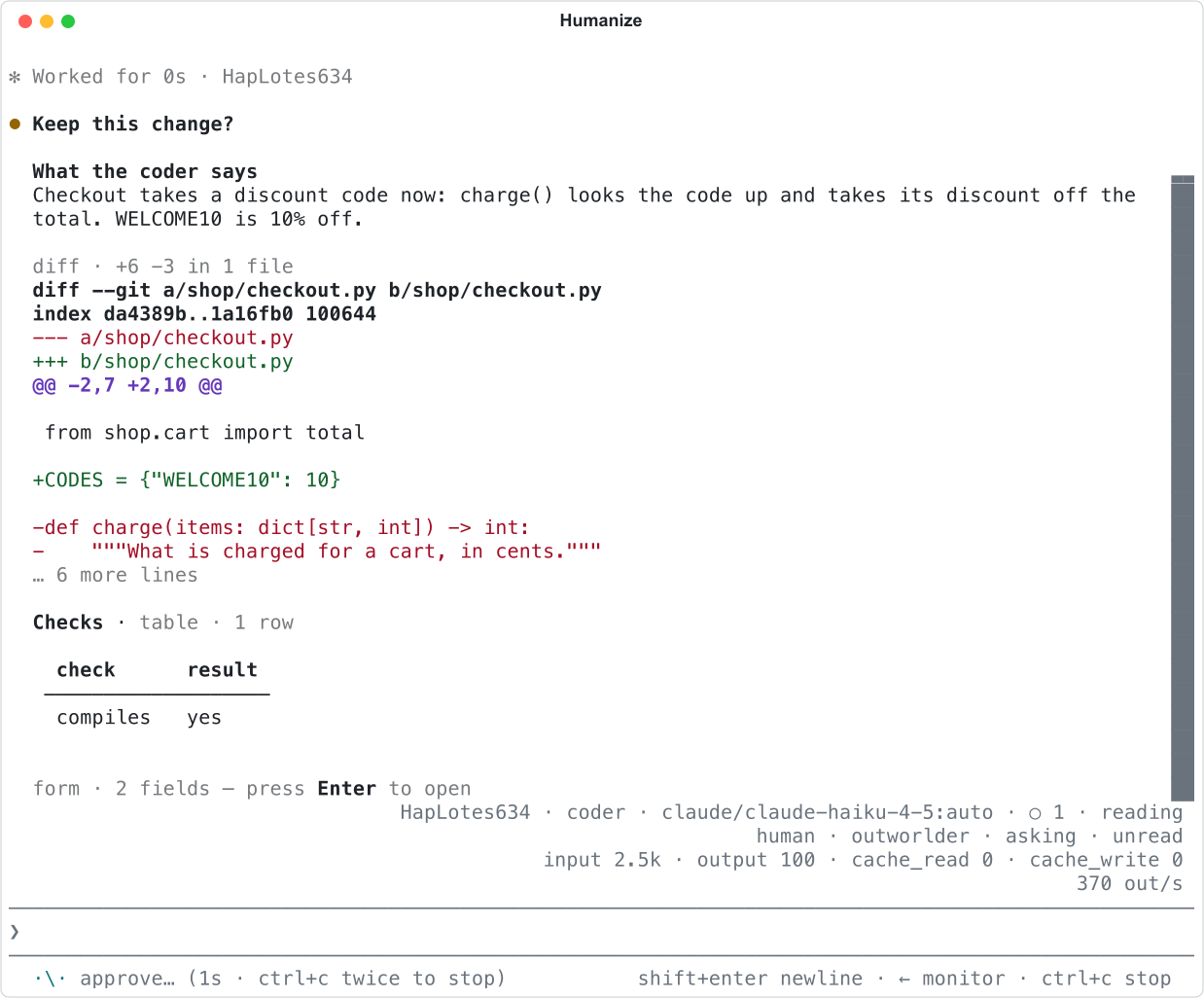
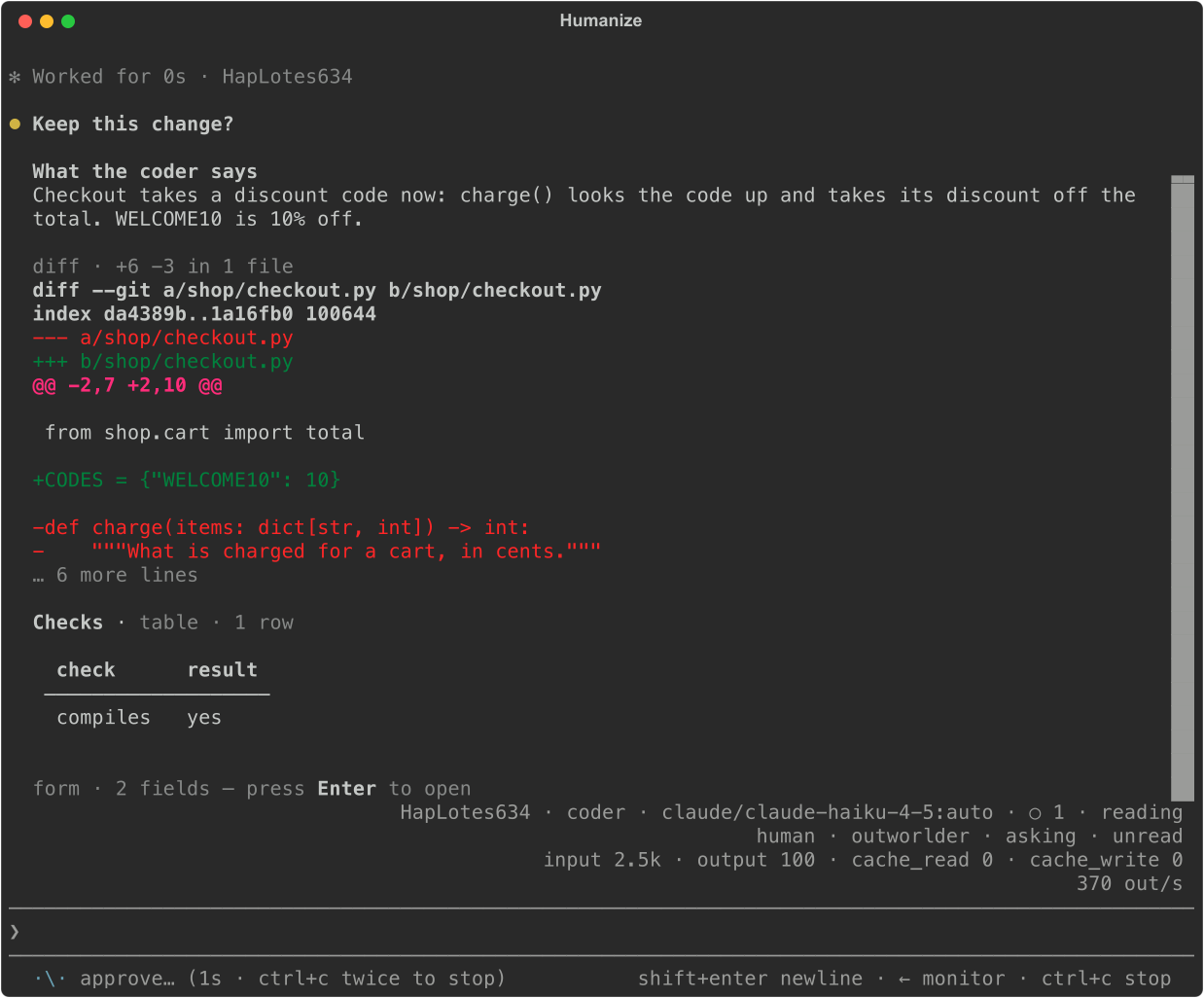
Handle nobody being there
Check human.away to see if no person is present to answer. This state can change during a run. A role is away when the epic runs via hmz exec, when the person enables /afk in the terminal or clicks Away on the People tab, or when the run starts from the SDK without an outworlder driver or from run_fake without outworlder.
When the role is away, run returns immediately:
| Asked for | run |
|---|---|
| Text | Returns "" |
| A model whose every field has a default | Returns the model built from its defaults |
| A model with a field that has no default, or whose defaults fail its own validators | Raises OutworlderAway |
While the role is away, show does nothing. If the person goes away while a question is open, Humanize withdraws the question and resolves run using the table above.
Give every field a safe default for unattended runs. In approve, keep defaults to False, so an unattended run undoes the change:
hmz exec -f approve -a coder=claude/claude-haiku-4-5 -p budget.duration=10m "Add a discount code"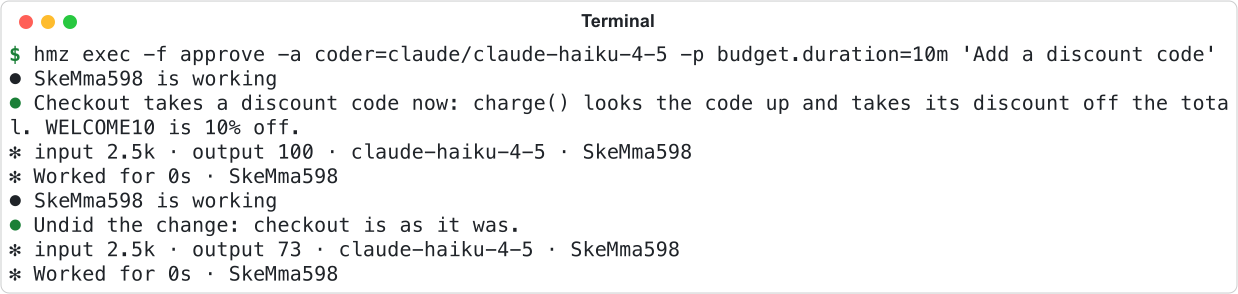
To handle away states yourself, check human.away before asking or catch OutworlderAway.
Claims
A person can claim a role so only their window or terminal can answer it. Claims are invisible to the flow. Any attached interface can answer an unclaimed role, and the first answer wins.
Answer from another flow
When your flow calls another flow, you control who fills the callee's Outworlder role:
| The caller passes | The callee's questions go to |
|---|---|
| Nothing for that role | The epic's own person |
| Its own outworlder | The same person |
Outworlder.new() | A hook of the caller |
Call Outworlder.new() to create an outworlder that the caller answers, then attach a hook with on_outworlder_run. Every run calls the hook. Until you attach a hook, the outworlder is away.
The hook receives OutworlderRunHookParams:
| Field | Holds |
|---|---|
prompt | What was asked |
output_schema | The model to answer with, or None for text |
context | The blocks passed with the question |
face | The face the session was spawned with, or None |
Like every hook, it also gets ctx and session. Return OutworlderRunHookResult(output=...) with text or a model instance. An invalid output raises OutputSchemaError in the callee.
This flow calls approve and uses a second agent to answer the form:
# .hmz/flows/judged/__init__.py
"""Judged: run approve, with an agent answering in the person's place."""

from hmz.flows import (
    Agent,
    AgentCollection,
    Diff,
    EnvCollection,
    FlowContext,
    FlowParams,
    LocalEnv,
    Outworlder,
    OutworlderRunHookParams,
    OutworlderRunHookResult,
    ShellEnvMixin,
    flow,
    load,
)

approve = load("approve")


class Agents(AgentCollection):
    coder: Agent
    judge: Agent


class Workspace(LocalEnv, ShellEnvMixin): ...


class Envs(EnvCollection):
    workspace: Workspace


@flow(agents=Agents, envs=Envs, params=FlowParams)
async def judged(
    task: str, *, agents: Agents, envs: Envs, params: FlowParams, ctx: FlowContext
) -> bool:
    """Run approve, with an agent answering in the person's place."""
    judge = agents["judge"]
    judging = await judge.spawn()

    async def answer(asked: OutworlderRunHookParams) -> OutworlderRunHookResult:
        if asked.output_schema is None:
            return OutworlderRunHookResult(output="")
        patch = "".join(b.patch for b in asked.context if isinstance(b, Diff))
        verdict = await judge.run(
            f"{asked.prompt}\n\n{patch}",
            session=judging,
            env=envs["workspace"],
            output_schema=asked.output_schema,
        )
        return OutworlderRunHookResult(output=verdict)

    stand_in = Outworlder.new()
    stand_in.on_outworlder_run(answer)
    return await approve(
        task,
        agents={"coder": agents["coder"], "human": stand_in},
        envs=envs,
        params=FlowParams(),
)hmz exec -f judged -a coder=claude/claude-haiku-4-5 -a judge=claude/claude-haiku-4-5 \
-p budget.duration=10m "Add a discount code"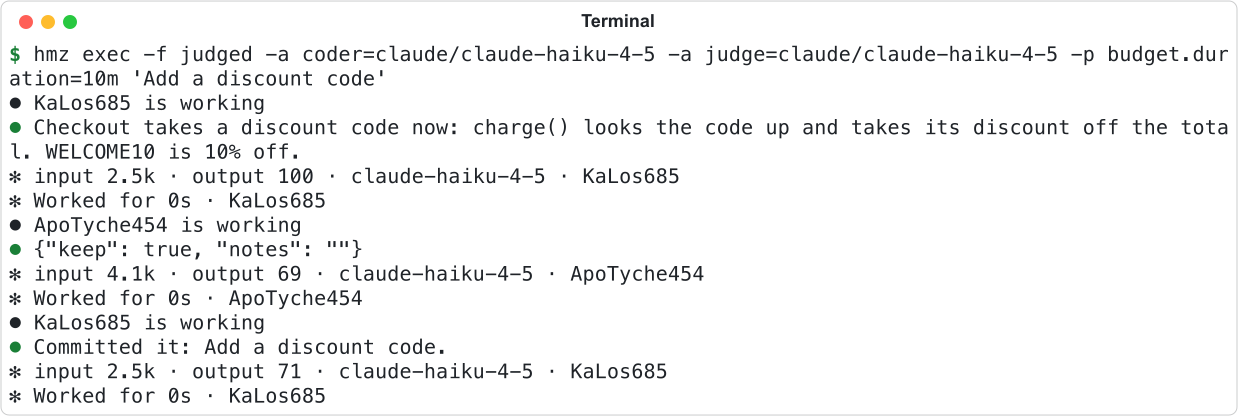
Even under hmz exec, where the epic's person is away, the judge answers the form. See Call another flow for load and flow calling.
Test and drive from code
In tests, script the person's responses with FakeOutworlder (from hmz.sdk import fakes): fakes.run_fake("approve", ..., outworlder=fakes.FakeOutworlder(reply=[{"keep": True}, "Add discount codes"])). See Test a flow.
Pass an outworlder driver to Hmz().run(..., outworlder=...) to receive each question as an Ask and return the answer from Python. See The Python SDK. Both receive the same prompt, context, and schema as a person.
Good to know
- An outworlder is distinct from steering: steering injects text into an agent's turn, while an outworlder takes its own turns.
runacceptsenvand ignores it. Callingforkon an outworlder raisesUnsupportedOperation, and callingderivewith skills raisesCapabilityNotGranted. Callingshowwith another agent's session raisesSessionError. Agent hooks such ason_stopcan be attached to an outworlder but are never called.on_outworlder_runworks only on anOutworlder.new()instance; calling it on the epic's own outworlder raisesCapabilityNotGranted.showdoes nothing on anOutworlder.new()instance.- A caller can pass an outworlder to a callee role typed as a plain
Agent, but roles with a mixin or harness reject it withCapabilityMissing. An agent passed for anOutworlderrole is rejected the same way. - The context of one
runorshowmay come to at most 16 MiB as JSON, elseValueError. Text passed ascontextin place of a sequence of blocks raisesTypeError. - In the terminal, image and chart blocks render as a single line linking to the web page.