Call another flow
Use load(ref) to find another flow, then await it to run it as a step inside your epic and get its return value.
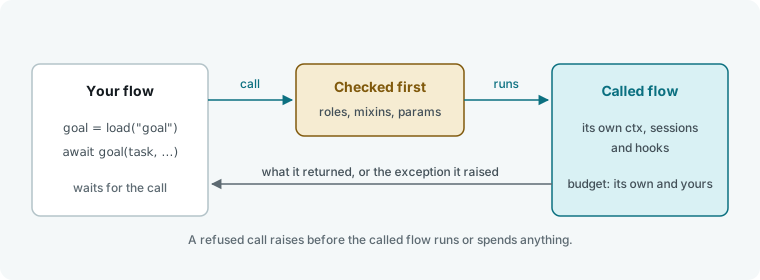
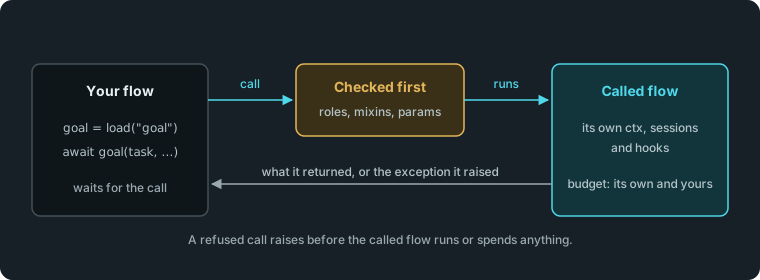
Load a flow and call it
Save this flow as .hmz/flows/shipped/__init__.py. It calls goal from the official flowverse (see Find and install flows) and review, a hidden flow in the same file:
from hmz.flows import (
    Agent,
    AgentCollection,
    Budget,
    EnvCollection,
    FlowContext,
    FlowParams,
    GoalCommandAgentMixin,
    LocalEnv,
    flow,
    load,
)


class Coder(Agent, GoalCommandAgentMixin): ...


class Agents(AgentCollection):
    coder: Coder


class Reviewers(AgentCollection):
    reviewer: Agent


class Envs(EnvCollection):
    workspace: LocalEnv


class Focus(FlowParams):
    focus: str = "bugs"


@flow(agents=Reviewers, envs=Envs, params=Focus, name="review", hidden=True)
async def review(
    task: str, *, agents: Reviewers, envs: Envs, params: Focus, ctx: FlowContext
) -> str:
    """Read the change and say what is wrong with it."""
    reviewer = agents["reviewer"]
    session = await reviewer.spawn()
    return await reviewer.run(
        f"Review the change for {params.focus}: {task}",
        session=session,
        env=envs["workspace"],
    )


@flow(agents=Agents, envs=Envs, params=FlowParams)
async def shipped(
    task: str, *, agents: Agents, envs: Envs, params: FlowParams, ctx: FlowContext
) -> str:
    """The task as a goal, then a review of the change."""
    goal = load("goal")
    await goal(
        task,
        agents={"worker": agents["coder"]},
        envs={},
        params=goal.expected_params(),
    )
    review = load(":review")
    return await review(
        task,
        agents={"reviewer": agents["coder"]},
        envs=envs,
        params=review.expected_params(focus="security"),
        budget=Budget(output_tokens=2000),
    )
Run it from the command line:
hmz exec -f @local/shipped -a coder=claude/claude-haiku-4-5 -p budget.output_tokens=20000 "Add a discount code to checkout"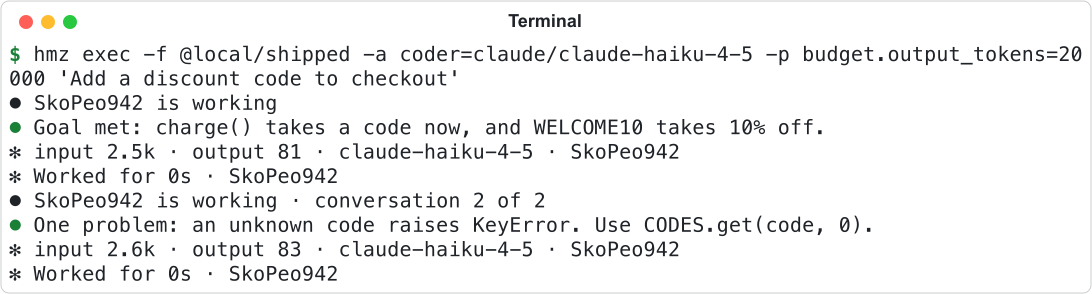
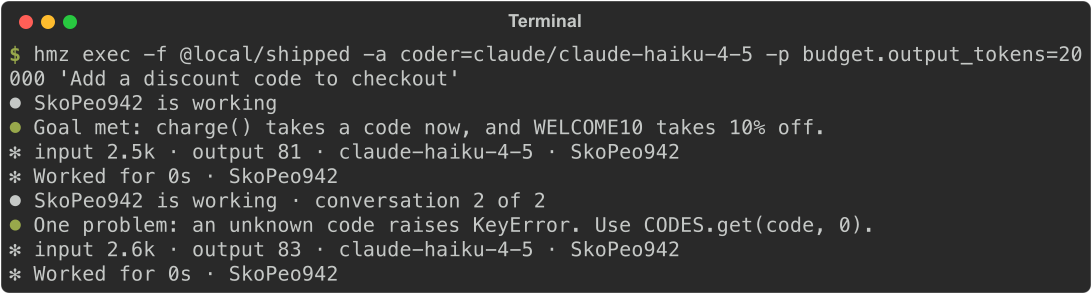
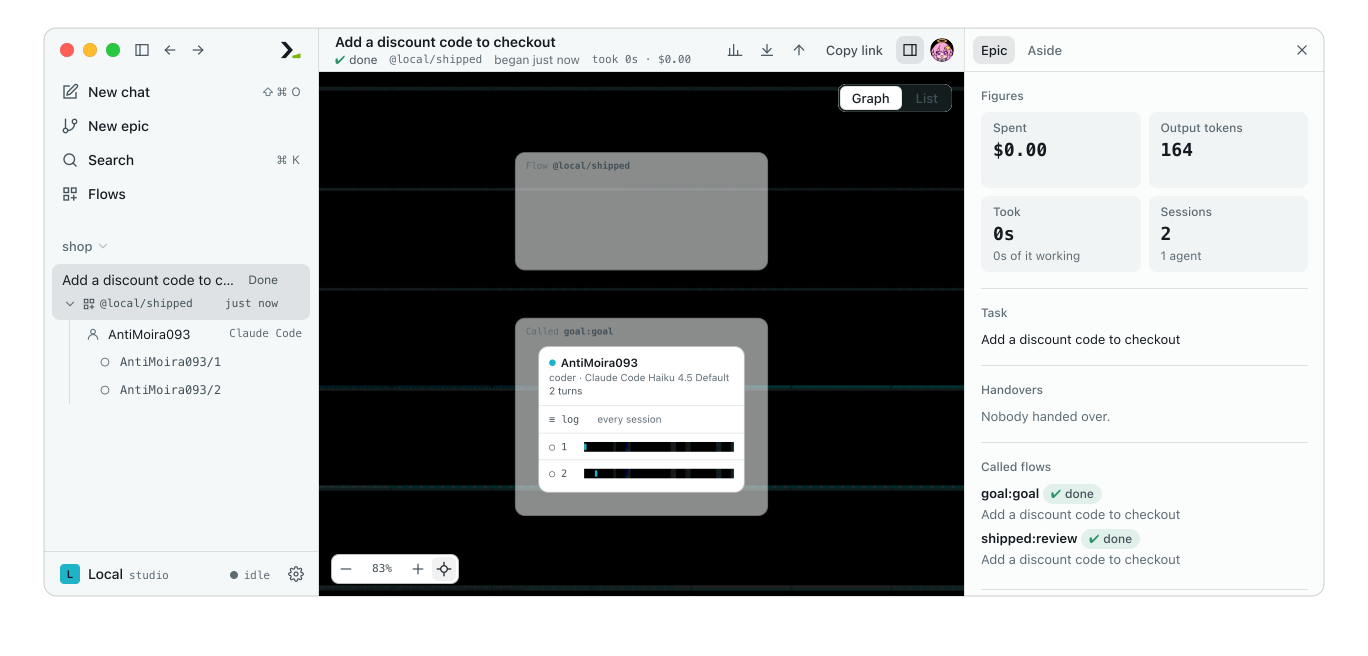
The first turn runs inside goal, the second inside review.
Pass these arguments when calling a flow:
| Argument | What to pass |
|---|---|
task | The task text for the called flow. |
agents | A mapping from the called flow's role names to your agents. |
envs | A mapping from the called flow's role names to your environments. |
params | An instance of the called flow's params class, or a mapping of values. |
budget | Optional. A Budget for this call alone. |
The called flow runs with its own ctx, sessions, and hooks, and cannot use a session you opened. If it raises an exception, you receive that exception unwrapped with its original class.
Read a flow object's attributes to inspect its declaration: description, expected_agents, expected_envs, expected_params, and resumable.
If a flow is defined in the same file, it is already a flow object. You can await review(...) directly without calling load.
Name the flow
Pass a flow ref to load. hmz exec -f accepts the same forms, except :review.
| Ref | What it names |
|---|---|
:review | The flow called review in the same module as the code calling load. |
goal | A flow by name. |
humanize1:gen-plan | The flow called gen-plan in the humanize1 module. |
alice/kernel | A flow the official flowverse lists under a user. |
@local/shipped | A flow of one flowverse only: @local, @user or @<flowverse>. |
./flows/mine, /abs/path, ~/flows/mine | A path. The first that exists of <path>/__init__.py, <path> and <path>.py is used. A relative path starts from the workspace directory. |
git+https://github.com/humanfia/humanize1-flow@v0.1.0#humanize1:rlcr | A repository, at the revision after @, in the directory after #. :<name> picks a flow there, with or without #<subdir>. |
Humanize resolves a flow name beside the calling flow first: among the flows in the same directory as the calling flow, or among flows from the same flowverse if it was installed from one. Next, it checks @local, @user, official, and other flowverses alphabetically.
A ref without :<name> selects the flow named after the directory or file, or else the only non-hidden flow.
Use a git+ ref to run a flow without installing it. Supported URL schemes are https, http, ssh, file, and git. Omitting @<rev> uses the default branch, and omitting #<subdir> uses the repository's root. A flow that is one file is named by the file, as in #tools/review.py. load does not fetch the repository; Humanize clones it when you first call the flow or read a property like expected_params.
load raises these exceptions:
| Exception | When |
|---|---|
FlowRefError | The text is not a ref, or :<name> is used where no flow is asking. |
FlowNotFound | The ref names no flow. For a git+ ref, this is raised when the repository is first fetched, if it cannot be. |
FlowLoadConflict | Two flow directories that import under the same module name are loaded in one epic. |
FlowDefinitionError | The named flow is written wrong, or importing it fails. |
Pass agents and environments
Map the called flow's role names to your agents and environments. In the example above, your coder fills the worker role in goal and the reviewer role in review.
Every agent or environment you pass must meet the called role's declarations. Humanize checks requirements before the called flow starts, so a failed check runs and spends nothing.
| The called role declares | Raised if what you pass falls short |
|---|---|
| A required role | MissingRole |
A mixin, such as GoalCommandAgentMixin | CapabilityMissing |
| A permission | PermissionTooNarrow |
One harness, such as ClaudeCodeAgent | HarnessMismatch |
| CPUs, memory or GPUs | ResourceUnmet |
A LocalEnv | CapabilityMissing, if the environment is not on this machine |
All of these exceptions inherit from RequirementError. Passing an object that is not an agent or environment of the current epic raises RequirementError directly.
Your agent can only pass on capabilities that your own role declares. Because goal requires GoalCommandAgentMixin, Coder must declare it too. If coder is a plain Agent, Humanize refuses the call:


The called flow receives only what its own role declares: its mixins, permission, skills, tools, and command lines. It never receives extra capabilities held by your flow.
Names in a mapping that the called flow does not declare are ignored. You can omit roles that the run provides automatically. An omitted LocalEnv role receives the epic's directory, which lets envs={} work for goal. An omitted Outworlder role receives the epic's person. To answer for the person from your flow instead, see The person as an agent.
Pass params
Call expected_params on the loaded flow to build its params instance:
params=review.expected_params(focus="security")Calling review.expected_params() with no arguments uses the defaults. You can also pass a plain mapping like {"focus": "security"}, which Humanize validates against the params class. Invalid values raise ParamsError before the called flow starts. See Params.
Give the call a budget
Pass budget=Budget(...) to cap what a single call can spend. Without budget=, the called flow uses your remaining budget. With budget=, both limits apply, and everything the called flow spends counts against your flow and the epic.
If the call exhausts its own budget, it raises BudgetExceeded, which you can catch to continue your flow. The budget argument must be a Budget or None, or the call raises TypeError. See Budgets in a flow.
In the app
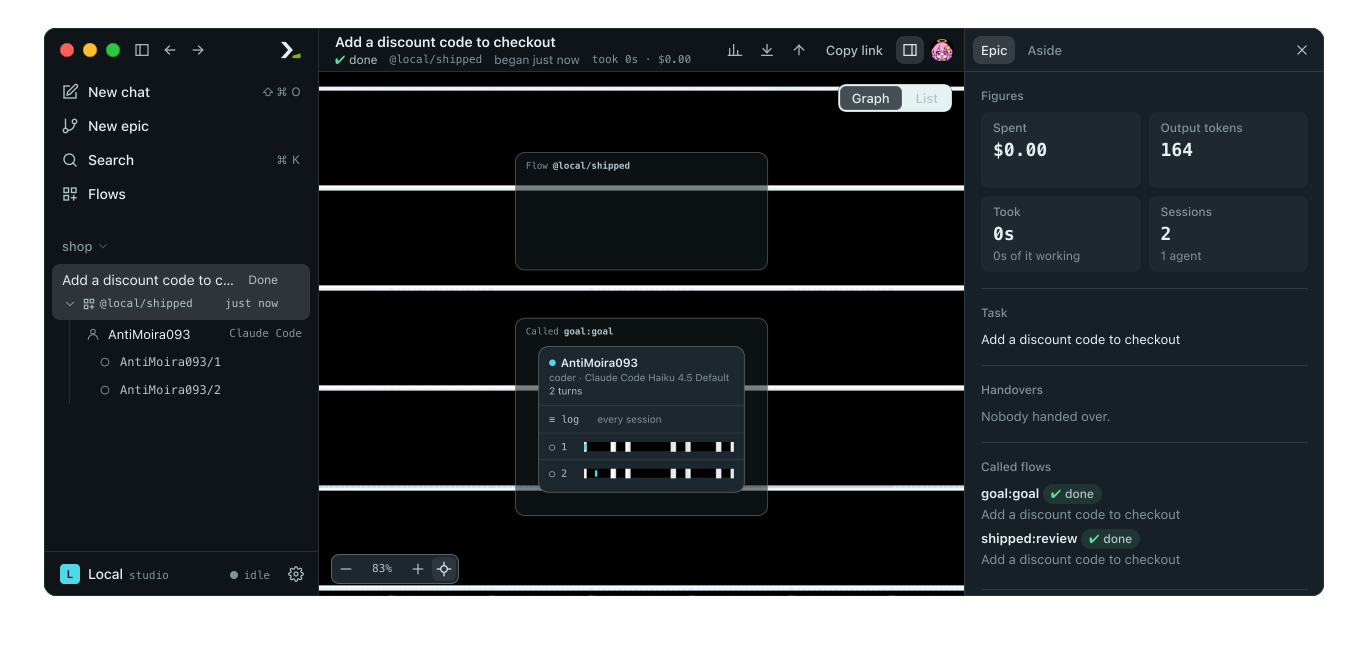
Open the epic and look under Called flows in the Epic panel to see each call's task and state. On the graph, each agent is drawn in the flow that opened its first session: a called flow's box is labelled Called with the flow's ref.
Good to know
- Run several flow calls at once with
asyncio.gather(see Concurrent turns). - A flow can call itself. Calls nest at most 64 flows deep, counting the flow the epic started with; one level deeper raises
FlowDepthExceeded, which is a subclass ofRecursionError. - Awaiting a flow outside an epic raises
FlowRuntimeError. Calling a flow after your own call or the epic has finished raisesFlowCancelled. - Within one epic, loading the same ref from the same module returns the same flow object, and a
git+URL at a given revision is fetched at most once. - When you resume an epic, a called flow resumes if called with the same task, agents, environments, and params (see Resumable flows).
- In tests, called flows run against the same fakes as the caller (see Test a flow).