Params
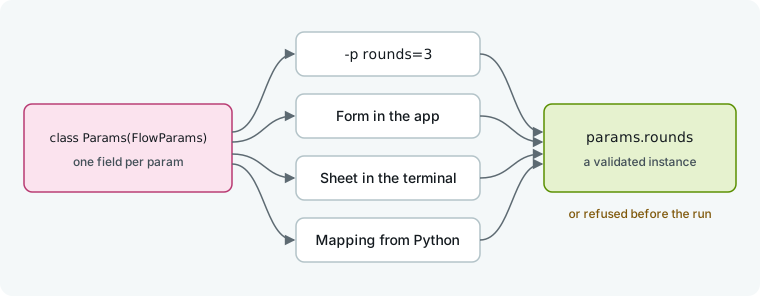
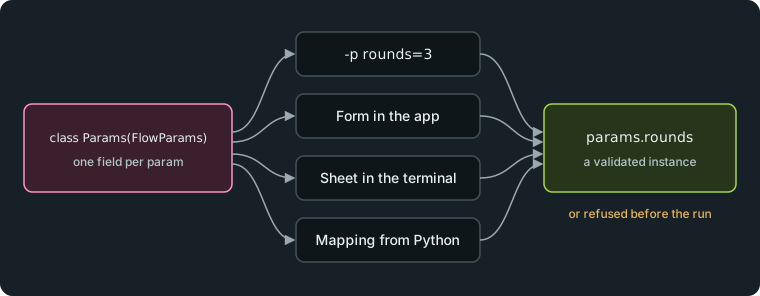
Params are the settings the caller can change when running a flow, such as the number of rounds, the mode, or whether to commit. Declare them once as a pydantic model. Humanize prompts for them on every interface and passes a validated instance to your flow.
Declare the params
Subclass FlowParams, add one field per param, and pass the class to @flow(params=...). If a flow takes no params, pass FlowParams itself.
# .hmz/flows/polish/__init__.py
from typing import Literal

from pydantic import Field, model_validator

from hmz.flows import (
    Agent,
    AgentCollection,
    EnvCollection,
    FlowContext,
    FlowParams,
    LocalEnv,
    flow,
)

REVIEW = {"section": "Review"}
AFTER = {"section": "After"}


class Agents(AgentCollection):
    coder: Agent


class Envs(EnvCollection):
    workspace: LocalEnv


class Params(FlowParams):
    rounds: int = Field(
        2, ge=1, le=5, description="Review rounds after the work.",
        json_schema_extra=REVIEW,
    )
    focus: Literal["correctness", "style", "tests"] = Field(
        "correctness", description="What each round looks for.",
        json_schema_extra=REVIEW,
    )
    commit: bool = Field(
        False, description="Commit when done", json_schema_extra=AFTER
    )
    message: str = Field(
        "", title="Commit message", description="Empty for the agent's own.",
        json_schema_extra=AFTER,
    )

    @model_validator(mode="after")
    def _message_needs_commit(self) -> "Params":
        if self.message and not self.commit:
            raise ValueError("a message needs commit=true")
        return self


@flow(agents=Agents, envs=Envs, params=Params)
async def polish(
    task: str, *, agents: Agents, envs: Envs, params: Params, ctx: FlowContext
) -> None:
    """Do the task, then review it for one thing."""
    coder, workspace = agents["coder"], envs["workspace"]
    session = await coder.spawn()
    await coder.run(task, session=session, env=workspace)
    for _ in range(params.rounds):
        await coder.run(
            f"Review your change for {params.focus} only. Fix what you find.",
            session=session,
            env=workspace,
        )
    if params.commit:
        how = f"the message {params.message!r}" if params.message else "your own message"
        await coder.run(f"Commit your work with {how}.", session=session, env=workspace)
Inside the flow, params is an instance of your class, never None. Unset fields hold their defaults.
All standard pydantic field features work. The interfaces also read these attributes:
| In the model | What it does |
|---|---|
| The field's type | How -p parses text, and which control the form draws. |
| The default | The value used when unset. A field with no default is required on every run. |
description | Help text shown with the param. |
title | Display name on the form and sheet. -p still uses the field key. |
ge, le and other bounds | Rejects out-of-range values. |
Literal[...] | Restricts input to fixed choices. |
@model_validator | Rejects invalid combinations and shows the ValueError message to the user. |
json_schema_extra={"section": "..."} | Groups params under a heading on the terminal sheet. |
Unknown keys are rejected. You cannot name a param budget; @flow raises FlowDefinitionError.
In the app
Pick a flow on the New epic page. Its params appear under Parameters, pre-filled with their defaults.
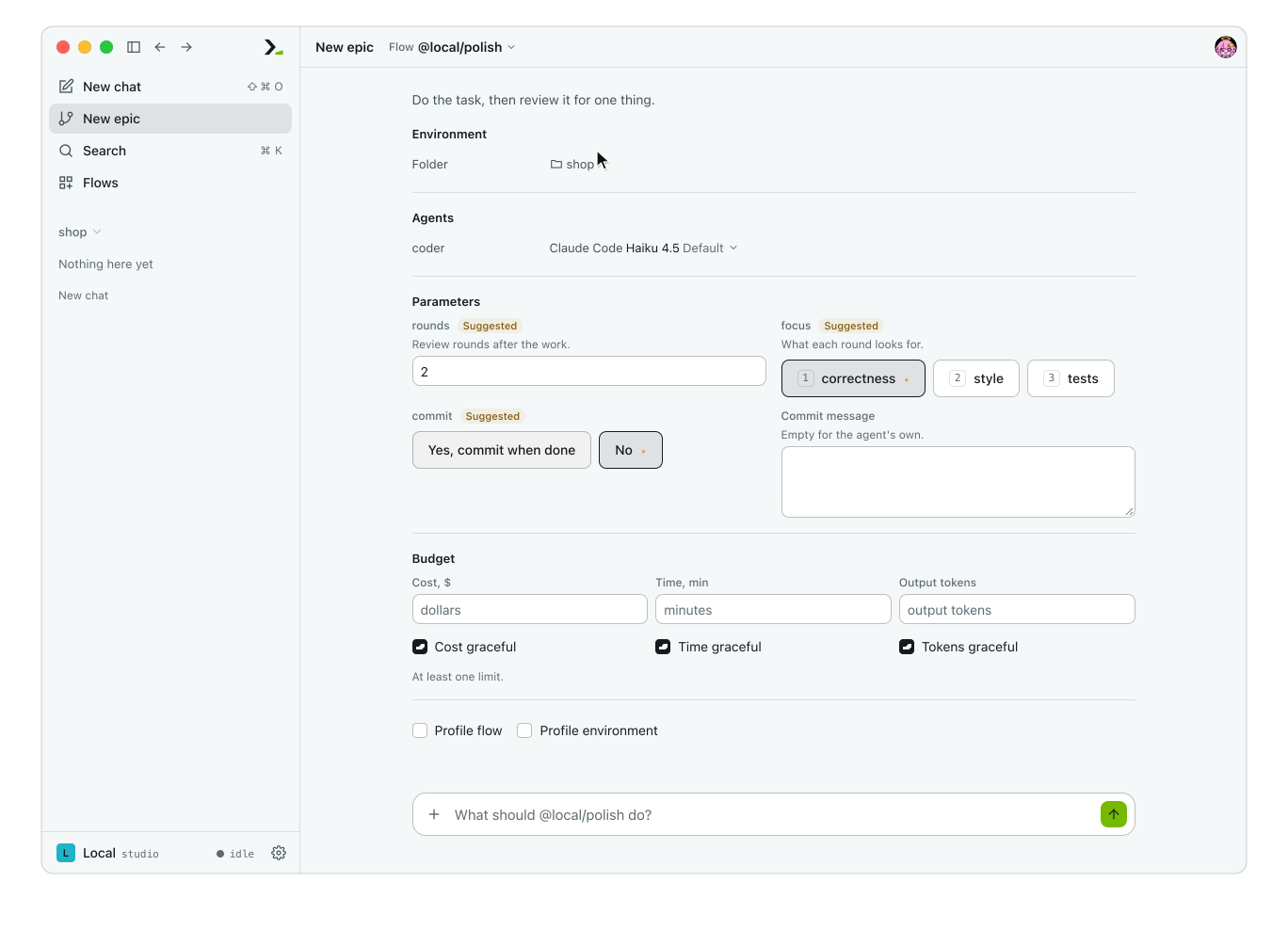
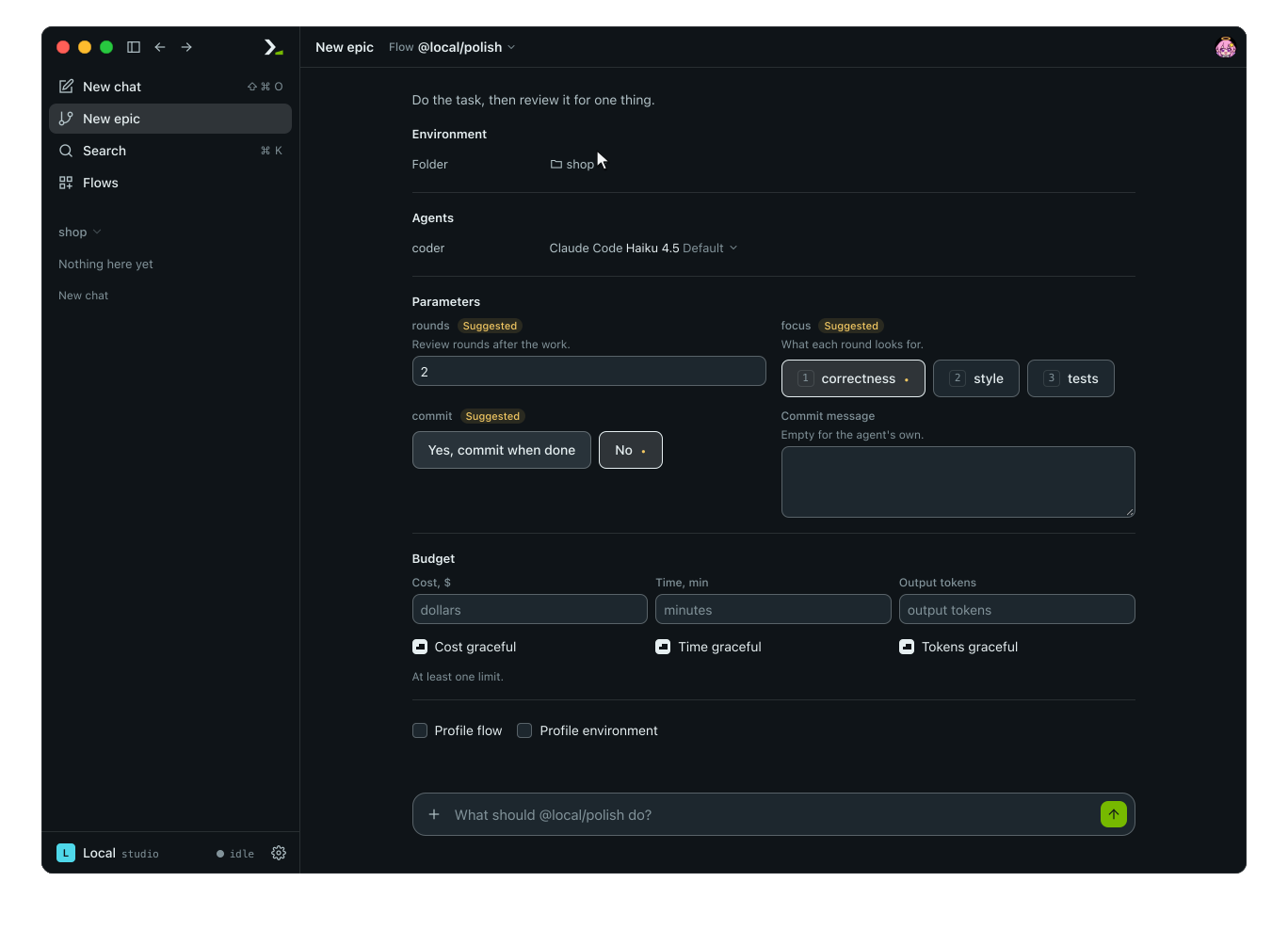
Picking the flow shows its params. If the model rejects a value when you start the epic, the error appears above the task box and nothing runs.
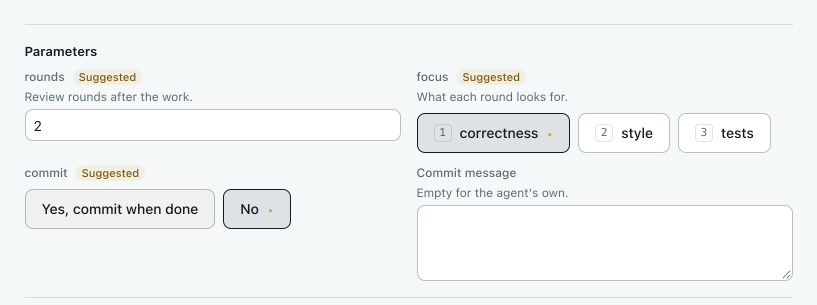
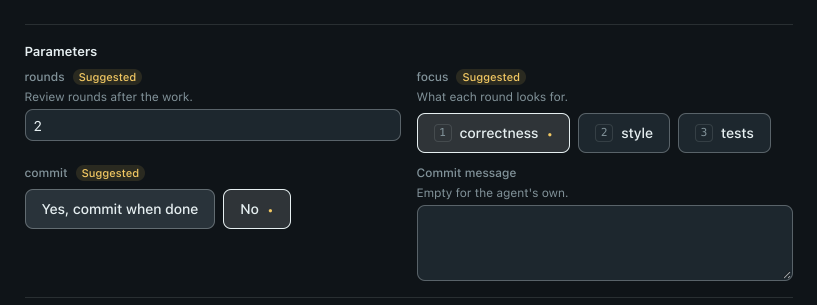
Params use the same controls as Typed answers: int renders a number box, Literal a button row (a list when it has more than five choices), bool two buttons with the affirmative label drawn from a short description, and str a text box. Required params appear first. A param still at a non-empty default is tagged Suggested, and a dot marks the default choice.
The flow's page under Flows lists each param by its title, or its key when it has none, with its description.
In the terminal
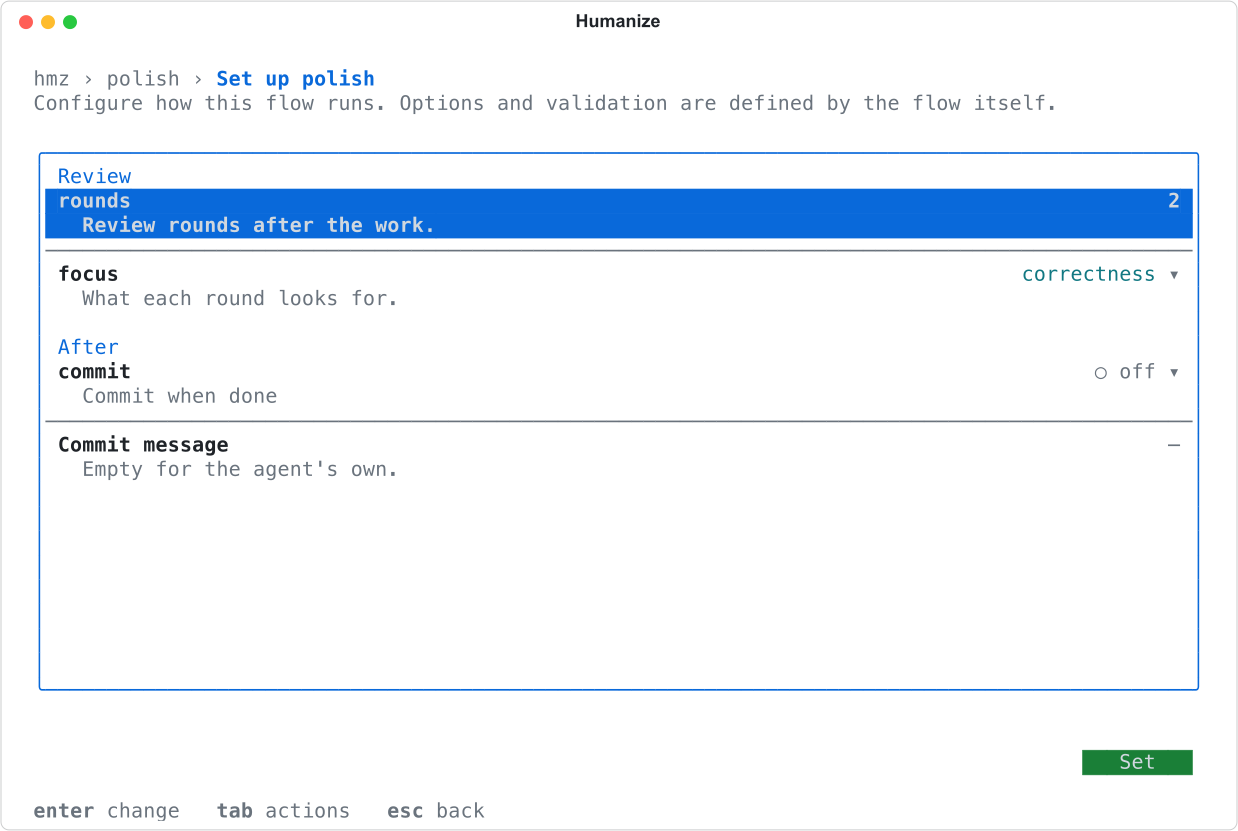
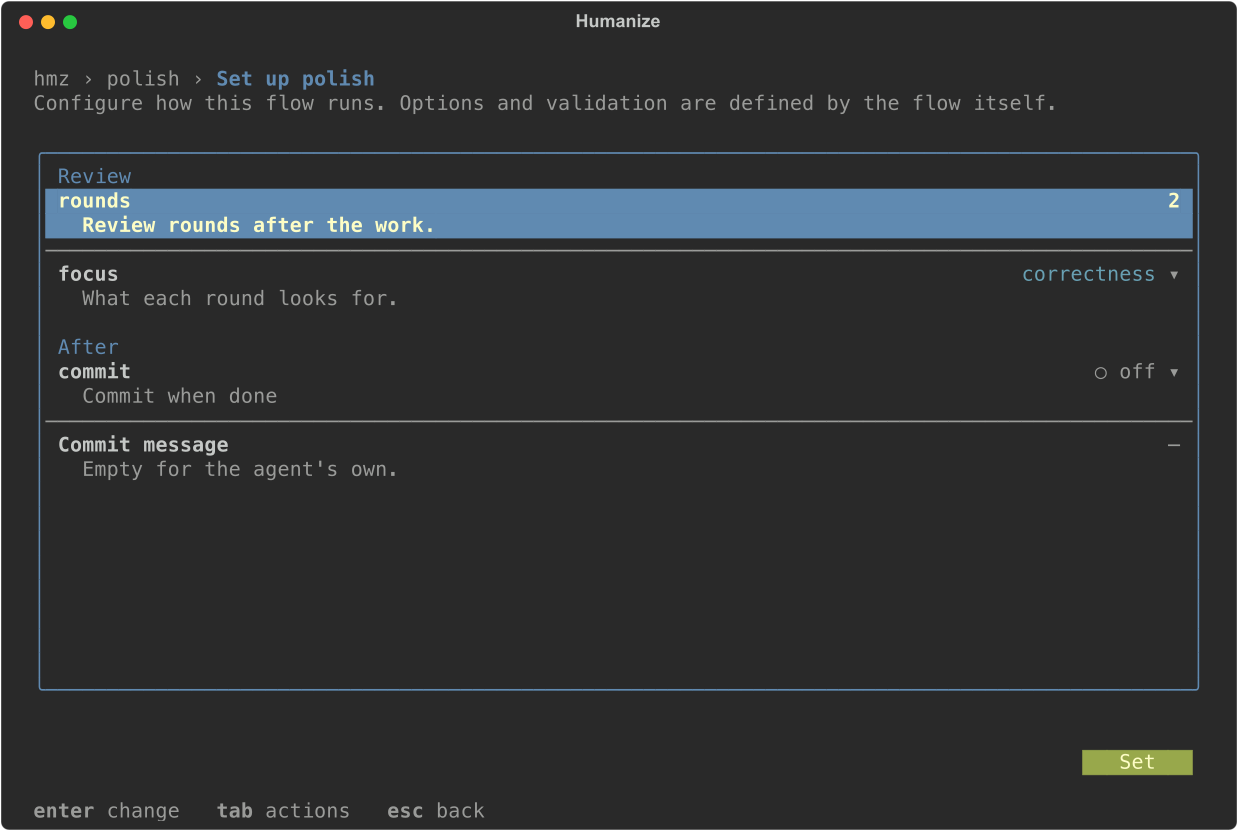
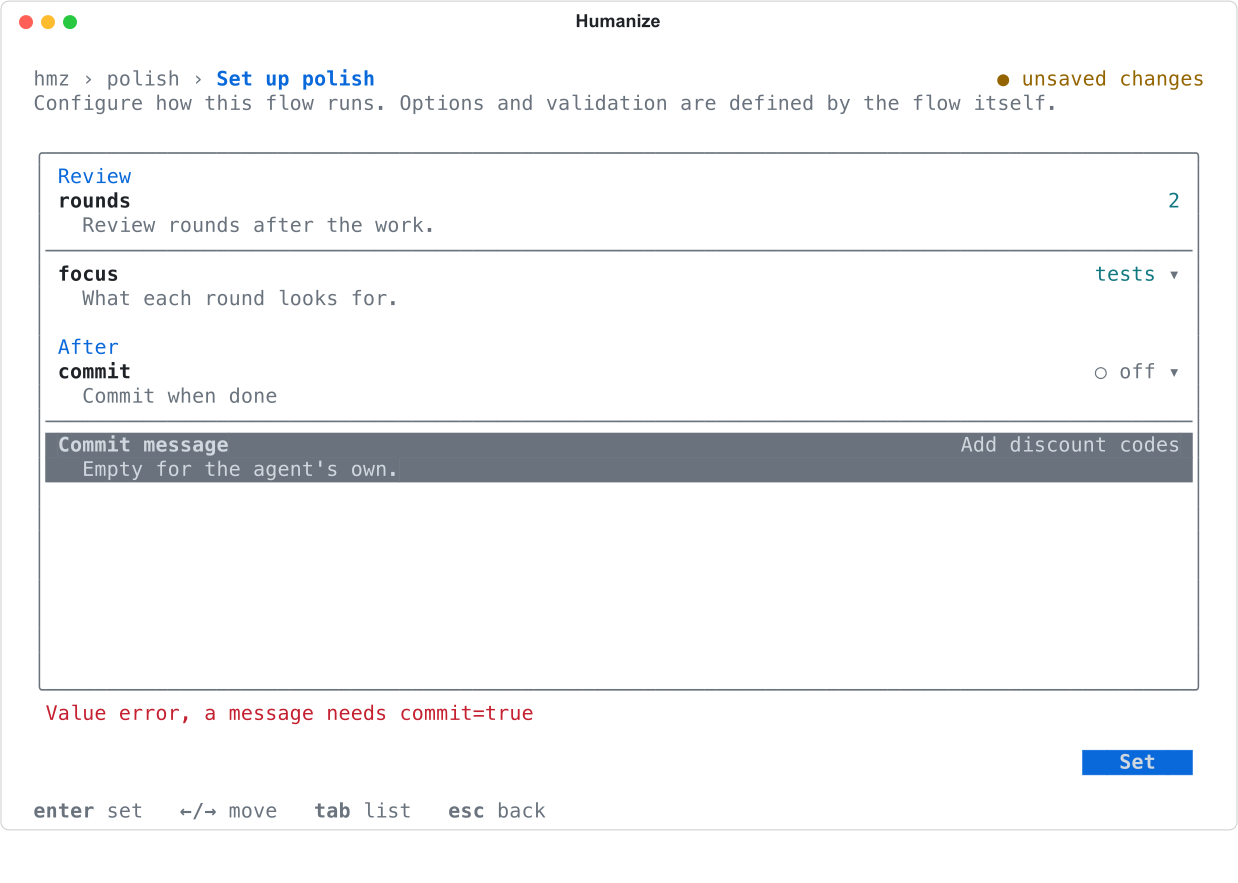
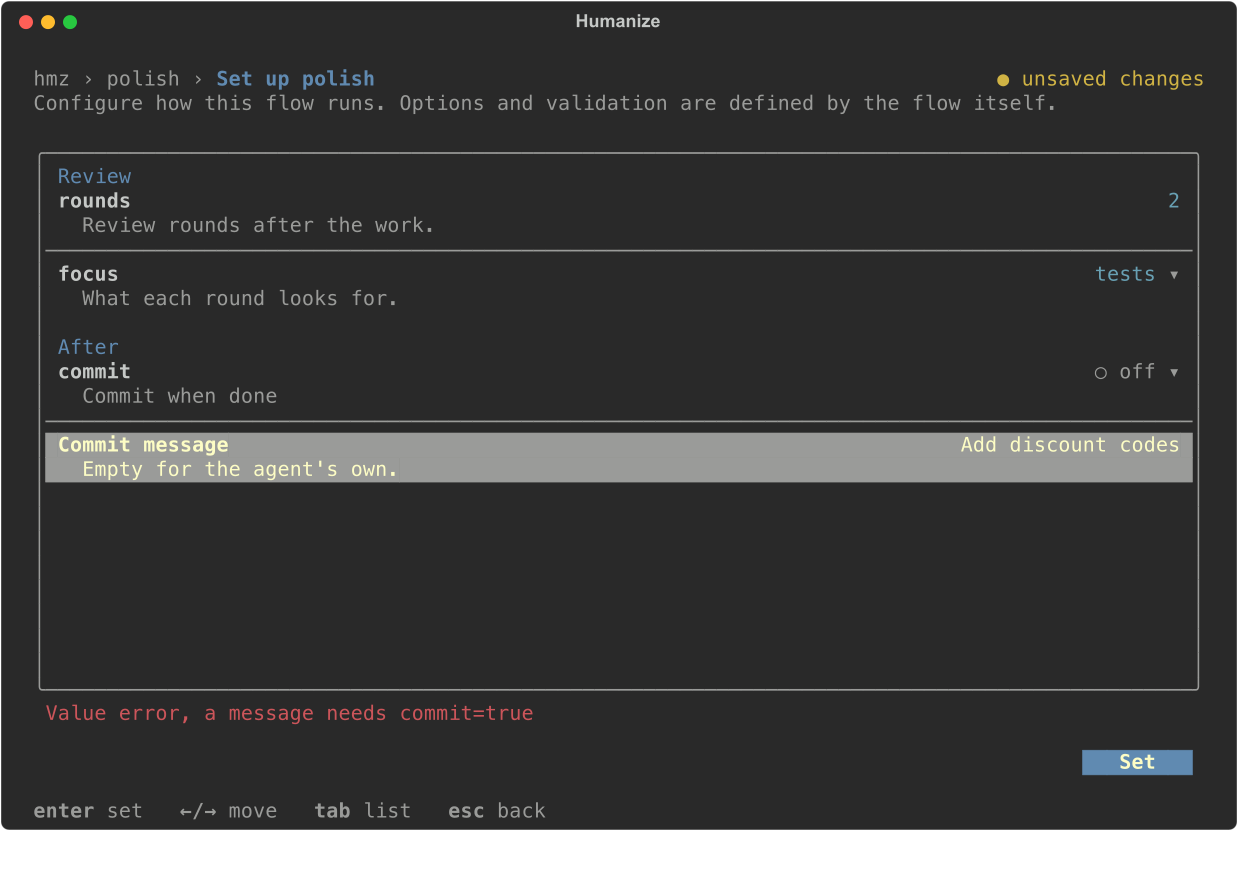
Select the flow in the /flow menu. If the flow has params, the Set up polish sheet opens before role assignment. You can reopen it from the params row on the flow's page.
| Field type | On the sheet |
|---|---|
bool | A switch: press enter to pick on or off. |
Literal[...] | Press enter to open a list of choices. |
| Anything else | Press enter and type the value. Parsed as the field type, then as JSON. |
Choose Set to validate the model. If validation fails, the error appears in red below the list and the sheet stays open.
From the command line
Pass -p key=value to hmz exec.
hmz exec -f polish -a coder=claude/claude-haiku-4-5 -p budget.duration=10m \
    -p rounds=1,focus=tests -p commit=true "Add a discount code to checkout"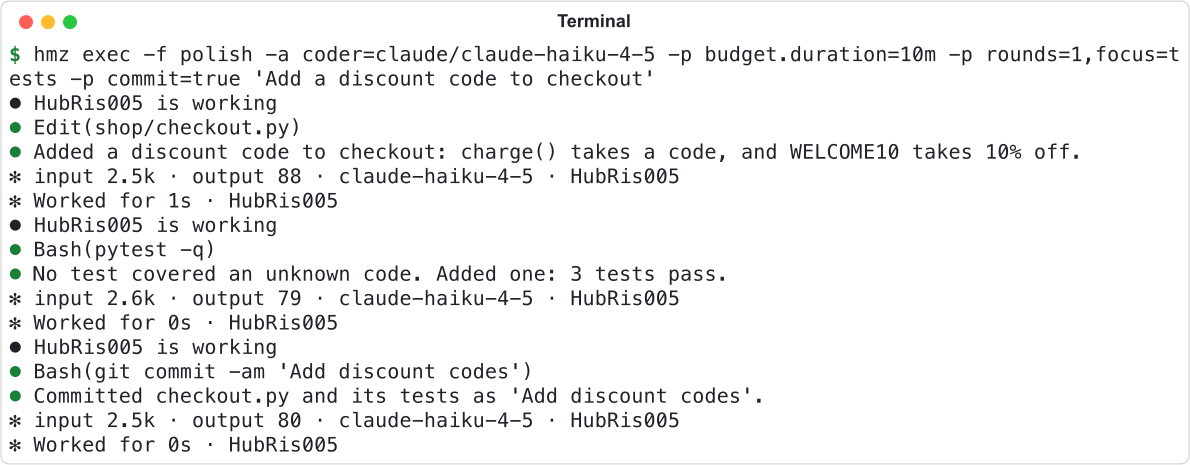
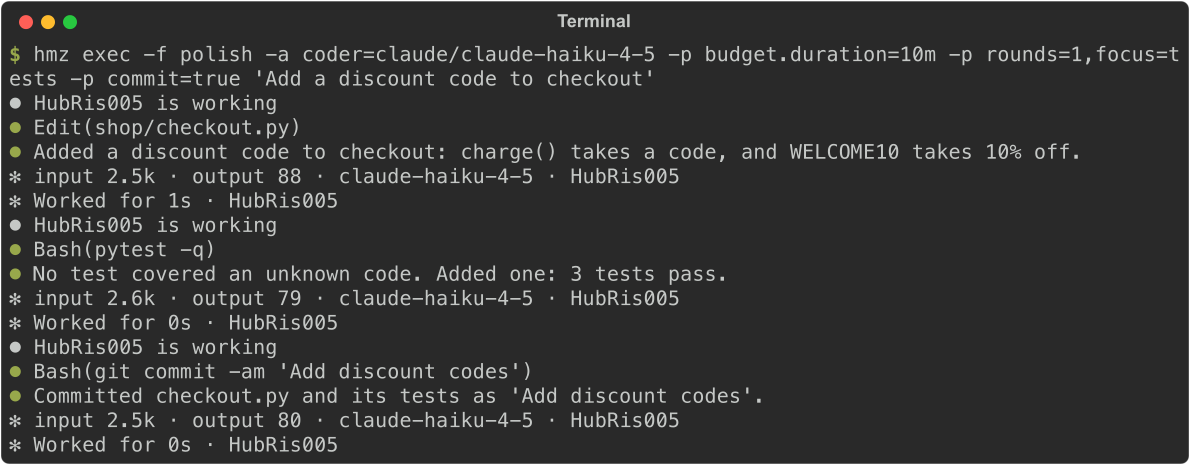
You can repeat -p or separate multiple pairs with commas. A comma starts a new param only when followed by key=, so -p message=fix a, b and c stays a single param. Humanize parses each value as the field's type (such as 1 as int for rounds and true as bool for commit), falling back to JSON for values like -p 'tags=["cart","checkout"]'. Duplicate keys are rejected. -p budget.<limit>= sets the run's budget, not a flow param; see Budgets in a flow.
If validation fails, hmz exec prints the pydantic error and exits before starting any agent.




From Python
Pass a mapping (parsed like -p) or a model instance to the SDK. Invalid params raise Refused.
from hmz.sdk import Hmz

Hmz().run(
    "polish",
    "Add a discount code to checkout",
    agents={"coder": "claude/claude-haiku-4-5"},
    params={"rounds": 3, "focus": "tests"},
    budget={"cost": 1},
).run()
When a flow calls another flow, construct the callee's params with expected_params:
polish = load("polish")
await polish(task, agents=agents, envs=envs, params=polish.expected_params(rounds=3))
In tests, pass the same mapping to run_fake. Invalid params raise ParamsError. See Test a flow.
# .hmz/tests/test_polish.py
import pytest

from hmz.flows import ParamsError
from hmz.sdk import fakes


async def test_rounds_and_focus_reach_the_prompts() -> None:
    coder = fakes.FakeAgentDriver()
    await fakes.run_fake(
        "polish", "add a discount code", agents={"coder": coder},
        params={"rounds": 1, "focus": "tests"},
    )
    assert coder.prompts == [
        "add a discount code",
        "Review your change for tests only. Fix what you find.",
    ]


async def test_a_message_without_commit_is_refused() -> None:
    coder = fakes.FakeAgentDriver()
    with pytest.raises(ParamsError, match="a message needs commit=true"):
        await fakes.run_fake(
            "polish", "x", agents={"coder": coder}, params={"message": "hi"}
        )
    assert coder.prompts == []
Good to know
- Validation runs before the flow starts, so a rejected run spawns no agents.
- Check multi-field rules in a validator rather than the flow body so failures happen before agents start.
ParamsErroris a subclass ofValueError.- Give every field a default unless the flow cannot run without it.
- Renaming a field breaks existing command lines because the old name is rejected as an unknown key.
- The app and terminal remember the last values set for each flow; see Start an epic.
- When serialised, infinite or NaN
floatvalues become"Infinity","-Infinity", or"NaN".