Environment roles
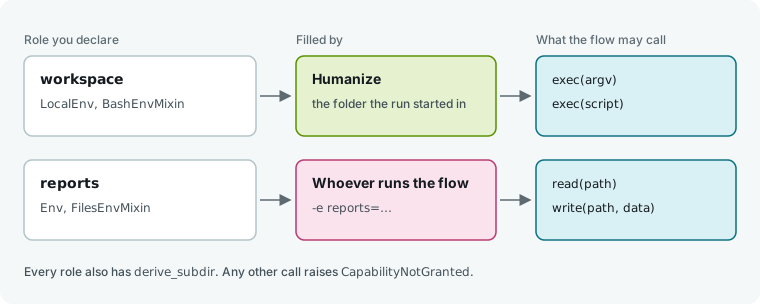
An environment is a working directory on a machine. A flow declares one role for each directory it needs, and uses mixins to declare what the flow itself will do there.
Declare the roles
Subclass EnvCollection with one key per role. Type each role as Env or LocalEnv, and add mixins for the methods the flow calls on it.
# .hmz/flows/tested/__init__.py
from hmz.flows import (
    Agent,
    AgentCollection,
    BashEnvMixin,
    Env,
    EnvCollection,
    FilesEnvMixin,
    FlowContext,
    FlowParams,
    LocalEnv,
    flow,
)


class Workspace(LocalEnv, BashEnvMixin):
    """The folder the run started in. The flow runs commands in it."""


class Reports(Env, FilesEnvMixin):
    """Where the test report is kept. The flow writes files in it."""


class Agents(AgentCollection):
    coder: Agent


class Envs(EnvCollection):
    workspace: Workspace  # filled by Humanize
    reports: Reports  # filled by whoever runs the flow


@flow(agents=Agents, envs=Envs, params=FlowParams)
async def tested(
    task: str, *, agents: Agents, envs: Envs, params: FlowParams, ctx: FlowContext
) -> str:
    """A coder does the task in the package; the flow runs the tests and files the report."""
    coder, workspace, reports = agents["coder"], envs["workspace"], envs["reports"]
    package = await workspace.derive_subdir(subdir="shop")
    session = await coder.spawn()
    await coder.run(task, session=session, env=package)
    code, out, err = await workspace.exec(["python3", "-m", "pytest", "-q"], timeout=600)
    await reports.write("tests/latest.txt", (out + err).encode())
return "tests pass" if code == 0 else "tests fail"| Role type | Who fills it |
|---|---|
LocalEnv | Humanize, with the workspace the run started in. You cannot set it with -e. |
Env | The user running the flow. It can be on this machine, an ssh host, a container or a Slurm job. |
NotRequired[...] | The user running the flow, or nobody. Read it with envs.get("role"), which returns None when omitted. |
Pass env= to a turn to set where the agent works. Mixins apply only to methods the flow calls directly. An agent does not need mixins to work in an environment.
Properties on every environment
Every environment provides these properties and methods without a mixin.
| Name | What it is |
|---|---|
env.role | The role name, such as "workspace". |
env.backend | An EnvBackendKind: local, ssh, docker, swarm, apple-container or slurm. |
env.provider | The ssh host or saved runtime name. "" on this machine. |
env.workdir | The working directory for commands and relative paths, as a PurePosixPath. |
env.available | Whether the machine was reachable and the workdir existed when last checked. |
await env.derive_subdir(subdir=...) | Returns a new environment on the same machine, in a subdirectory of this one. |
Work in a subdirectory
Call derive_subdir to get an environment rooted in a subdirectory of the parent. Humanize creates the directory if it is missing. The new environment keeps its parent's role and mixins.
package = await workspace.derive_subdir(subdir="shop")
await coder.run(task, session=session, env=package)
subdir must be a relative path inside the workdir. An absolute path, or one that climbs out of the workdir with .., raises ValueError. A directory that cannot be created raises EnvError.
Run a command
Add ShellEnvMixin to get exec. It runs a program in the workdir, waits for it to finish, and returns its exit status, stdout and stderr.
code, out, err = await workspace.exec(["python3", "-m", "pytest", "-q"], timeout=600)Pass the program and its arguments as a list to run without a shell. timeout is in seconds; 0 (the default) means no limit. If a command exceeds its timeout, Humanize kills it and raises EnvCommandTimeout. A command that cannot start raises EnvError. A non-zero exit status does not raise an error; check code instead.
Add BashEnvMixin (which includes ShellEnvMixin) to pass a shell string to exec, which runs as bash -c:
code, out, err = await workspace.exec("python3 -m pytest -q 2>&1 | tail -1")Passing a string to a role that only declares ShellEnvMixin raises CapabilityNotGranted.
Read and write files
Add FilesEnvMixin to get read and write. Paths can be relative to the workdir or absolute.
await reports.write("tests/latest.txt", (out + err).encode())
data = await reports.read("tests/latest.txt")
read returns the file's bytes. write replaces the file and creates any missing parent directories. A missing file raises EnvFileNotFound. Insufficient permissions raise EnvPermissionDenied.
Other mixins
| Mixin | What it adds | Page |
|---|---|---|
GitWorktreeEnvMixin | derive_worktree: another worktree of the repository. | Worktrees, clones and scratch |
TemporaryClonedDirEnvMixin | A throwaway copy of the workdir. | Worktrees, clones and scratch |
ScratchDirEnvMixin | An empty directory beside the workdir. | Worktrees, clones and scratch |
GitEnvMixin | Snapshots, and rewinding to one. | Worktrees, clones and scratch |
CPUEnvMixin, MemoryEnvMixin, GPUEnvMixin, ImageEnvMixin | Hardware and image requirements for the machine. | Machines and moving sessions |
Fill roles when running a flow
The person running the flow sets the location for each Env role. LocalEnv roles are set automatically. For the user guide, see Environments.
In the app
On the New epic page, find Environment and set the Backend and Directory for each Env role. A backend other than this machine also has a Runtime to pick.


While the epic runs, open the Epic panel and click Open its 3 environments under Environments (the number is how many the epic holds). The Environments view lists each environment by role. Directories created with derive_subdir appear nested under their parent environment.
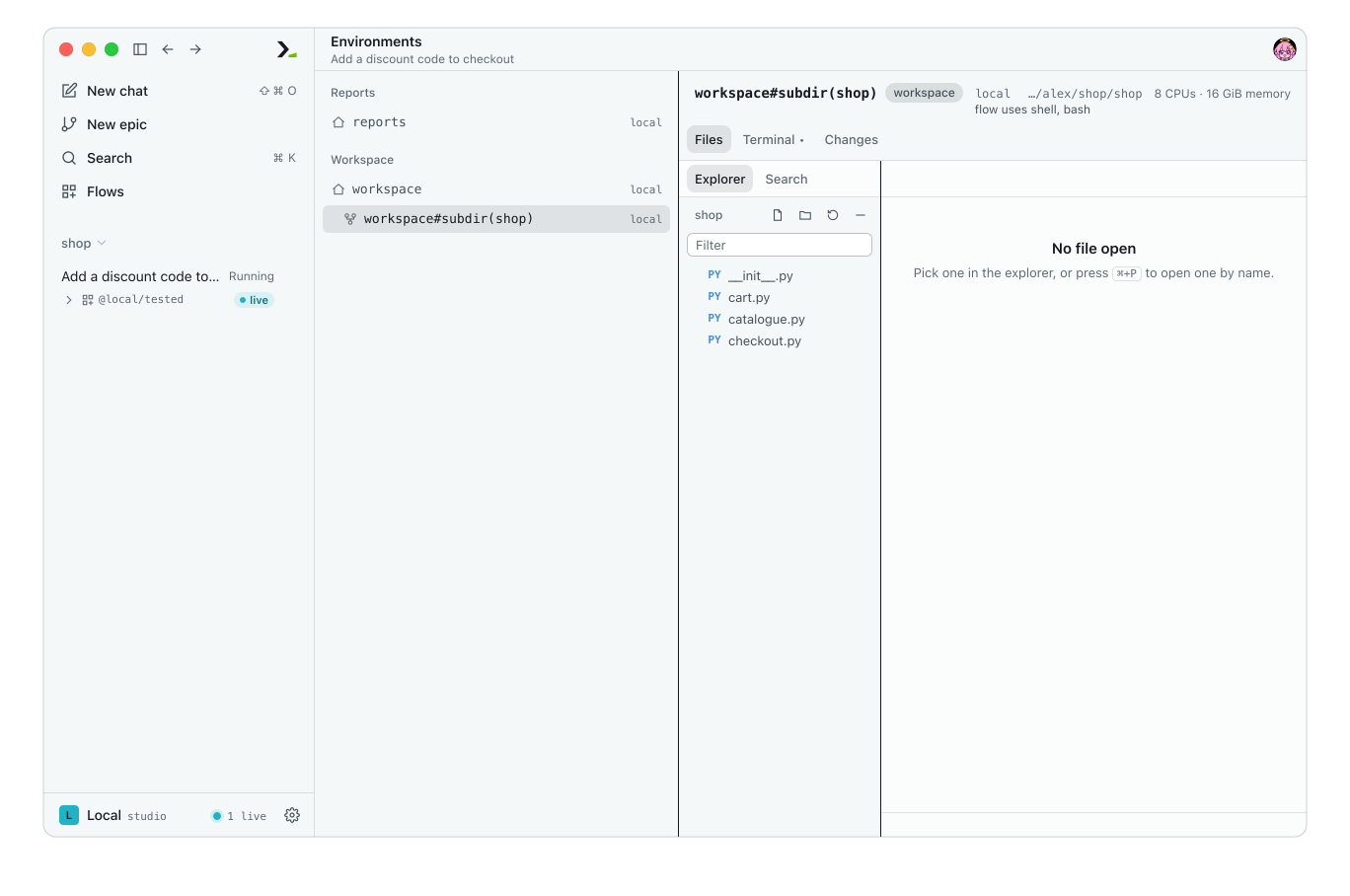
workspace#subdir(shop) is the directory the flow derived from workspace.
In the terminal
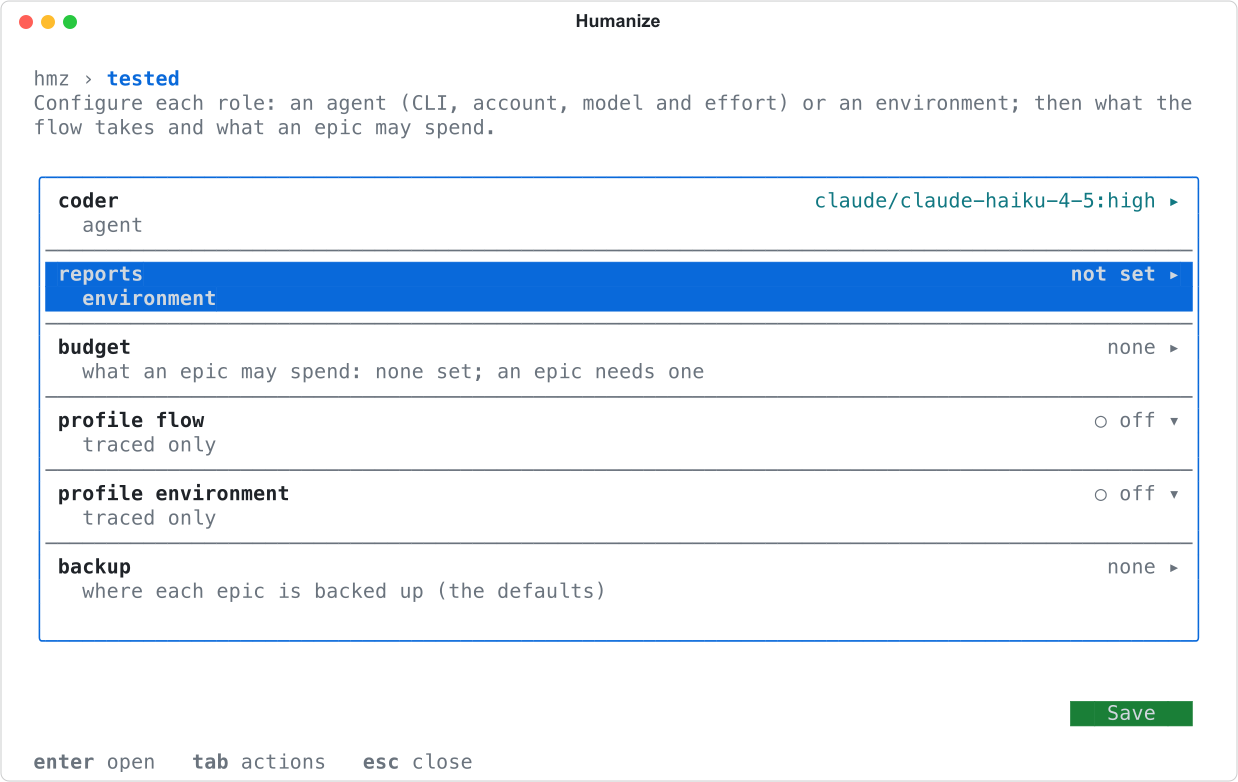
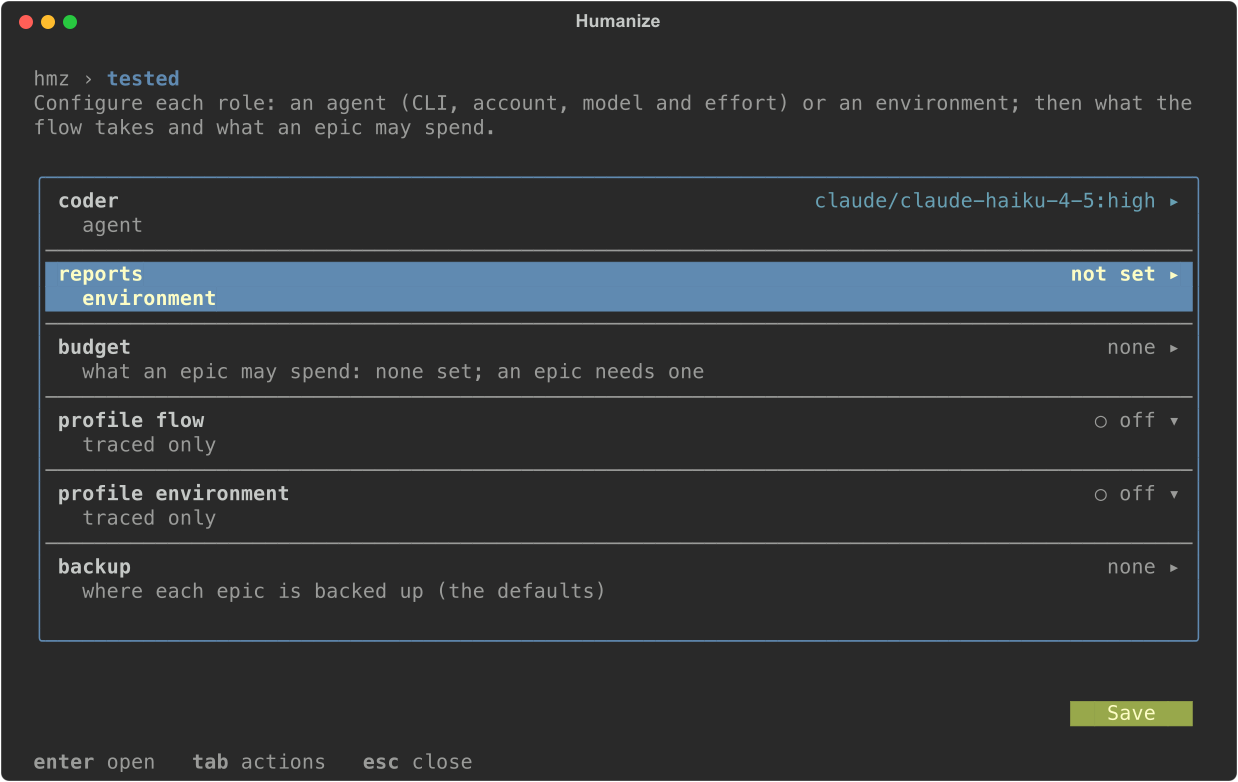
In hmz, run /flow tested. The configuration sheet shows one row per agent role and per Env role; open reports to set its location.
From the command line
Pass -e ROLE=BACKEND[@PROVIDER][/WORKDIR] to hmz exec for each Env role. If you omit a required role, the run fails before starting.
hmz exec -f tested -a coder=claude/claude-haiku-4-5 \
    -p budget.output_tokens=20000 "Add a discount code to checkout"

Provide the reports directory to run the flow:
hmz exec -f tested -a coder=claude/claude-haiku-4-5 -e reports=local/~/reports \
    -p budget.output_tokens=20000 "Add a discount code to checkout"

The flow runs the tests in the workspace and writes the output to reports:


From Python
Pass the same role strings to Hmz().run(...): envs={"reports": "local/~/reports"}. See The Python SDK. In tests, pass a FakeEnvDriver per role to run_fake in envs=, and the one for a LocalEnv role as local=. See Test a flow.
Pre-run checks
Humanize connects to every environment and verifies it before calling the flow function. The first failed check stops the run.
- Every required
Envrole is filled, and noLocalEnvrole is set by the user. - Each machine is reachable and its workdir exists. Otherwise, Humanize raises
EnvConnectionErrororEnvUnavailable. - Each machine supports every mixin its role declares.
BashEnvMixinrequiresbashon the machine's PATH.GitEnvMixinandGitWorktreeEnvMixinrequiregit. The other mixins on this page are always supported; hardware mixins are checked against the machine too, see Machines and moving sessions.
If a machine lacks support for a mixin, the run fails with CapabilityMissing. Here is the same command on a machine without bash:


Good to know
- A flow can only call methods from mixins the role declares. Calling a method from an undeclared mixin raises
CapabilityNotGranted, even if the machine supports it. - Humanize never deletes directories created by
derive_subdir. execruns commands with an empty stdin and decodes output as UTF-8.- Each command runs in its own process group. A timeout, a cancelled flow or the environment closing kills the whole group.
EnvCommandTimeoutincludesstdoutandstderrwith the output written before the command was killed.- Every environment error subclasses
EnvError. See Context, errors and cleanup. - A turn without
env=runs in the epic's workspace.