Budgets in a flow
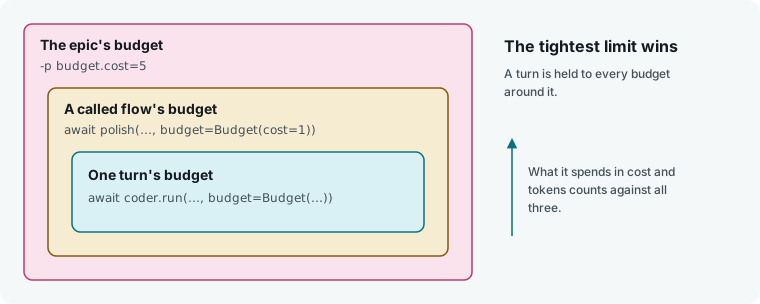
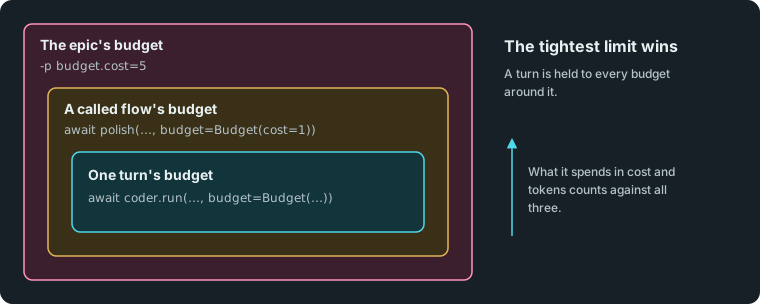
Every epic runs under a budget set by the person who starts it. A flow can read that budget, read what has been spent, and put a tighter budget around one turn or one called flow. A flow can never raise a limit.
Read the budget and the spending
Read ctx at any time to see the current budget and spending.
| Name | What it is |
|---|---|
ctx.budget | A Budget: the most this flow call may spend in all, the tightest of every budget around it. |
ctx.usage | A Usage: what this flow call and every flow it called have spent so far. |
session.usage | A Usage: what the turns of one session have spent so far. |
Budget and Usage have the same three fields.
| Field | In a Budget | In a Usage |
|---|---|---|
duration | A datetime.timedelta: time on the clock from the start of the call to its deadline. | The time agents spent in turns, added up. Two turns at once count twice. |
cost | US dollars. | US dollars spent. |
output_tokens | Tokens the agents may write. | Tokens the agents wrote. |
An unset limit is None. An unlimited budget has a cost of math.inf.
ctx.budget is the total allowance, not what remains. Subtract ctx.usage to find the remaining cost or tokens. Track elapsed wall time yourself, because Usage.duration only sums agent turn time.
Limit one turn
Pass a Budget to run to cap that turn alone on top of any outer budgets. The next turn starts fresh. Set at least one of duration, cost, or output_tokens.
Set graceful=False on a turn's budget. A graceful limit lets the current turn finish, which does nothing on a single turn.
This flow sets a time limit on each turn and stops early when few tokens remain:
# .hmz/flows/capped/__init__.py
import datetime

from hmz.flows import (
    Agent,
    AgentCollection,
    Budget,
    BudgetExceeded,
    EnvCollection,
    FlowContext,
    FlowParams,
    LocalEnv,
    flow,
)


class Agents(AgentCollection):
    coder: Agent


class Envs(EnvCollection):
    workspace: LocalEnv


class Params(FlowParams):
    seconds: float = 600
    """The most one turn may take."""


@flow(agents=Agents, envs=Envs, params=Params)
async def capped(
    task: str, *, agents: Agents, envs: Envs, params: Params, ctx: FlowContext
) -> str:
    """Up to four rounds on a task, each turn held to a time limit of its own."""
    coder, workspace = agents["coder"], envs["workspace"]
    session = await coder.spawn()
    turn = Budget(duration=datetime.timedelta(seconds=params.seconds), graceful=False)
    cut = 0
    for round in range(4):
        allowed = ctx.budget.output_tokens  # None when no token limit is set
        if allowed is not None and allowed - ctx.usage.output_tokens < 500:
            break  # too little left for a useful round: end normally
        try:
            await coder.run(
                task if round == 0 else "Carry on.",
                session=session,
                env=workspace,
                budget=turn,
            )
        except BudgetExceeded as spent:
            if not spent.own:
                raise  # the epic's budget is spent: let it end the epic
            cut += 1  # only this turn's limit: the flow goes on
    return f"{cut} turns cut off, {ctx.usage.output_tokens} output tokens written"
When a turn passes its own limit, it stops at once and run raises BudgetExceeded with own set to True. File changes remain in place, and the session can take another turn. When own is False, an outer flow or epic budget is spent, and any later turn will raise too.
Run the flow with a two-second turn limit to see a turn cut off:
hmz exec -f @local/capped -a coder=claude/claude-haiku-4-5 \
    -p budget.output_tokens=20000 -p seconds=2 "Add a discount code to checkout"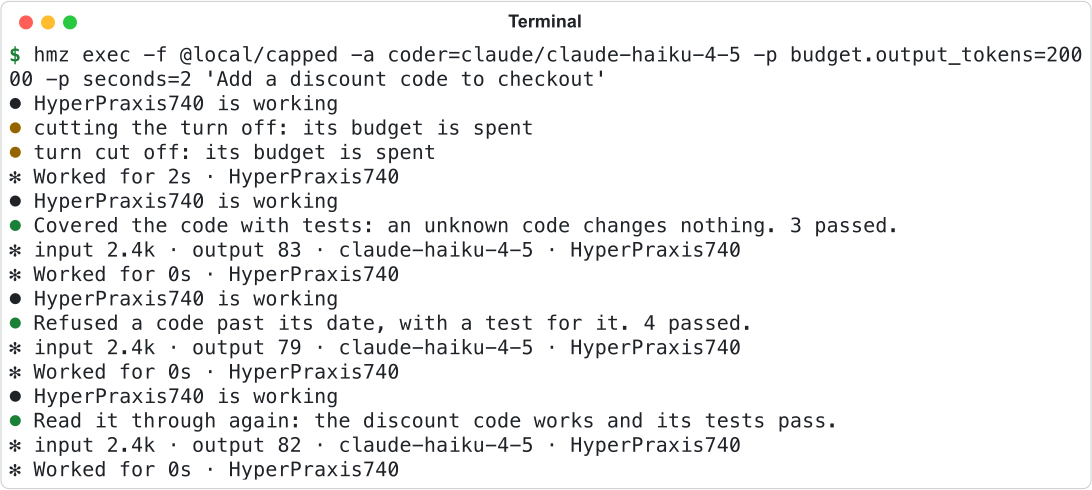
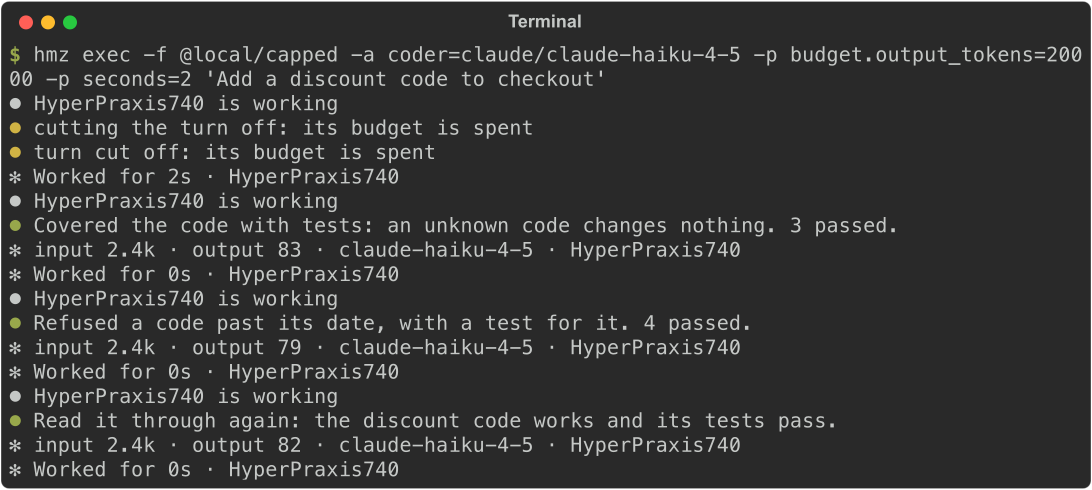
The first turn is cut off. The flow goes on in the same session.
Limit a called flow
Pass budget= when you call a flow. The called flow runs under the tighter of that budget and your remaining budget. Its duration is a deadline counted from the start of the call. Its cost and token spending also count against your flow and the epic.
# .hmz/flows/drafted/__init__.py
@flow(agents=Agents, envs=Envs, params=FlowParams, hidden=True)
async def polish(
    task: str, *, agents: Agents, envs: Envs, params: FlowParams, ctx: FlowContext
) -> None:
    """Round after round on one task, until its budget ends it."""
    coder = agents["coder"]
    session = await coder.spawn()
    while True:
        await coder.run(f"Polish: {task}", session=session, env=envs["workspace"])


@flow(agents=Agents, envs=Envs, params=FlowParams)
async def drafted(
    task: str, *, agents: Agents, envs: Envs, params: FlowParams, ctx: FlowContext
) -> str:
    """A draft, some polish under a budget of its own, then a summary."""
    coder, workspace = agents["coder"], envs["workspace"]
    session = await coder.spawn()
    await coder.run(task, session=session, env=workspace)
    try:
        await polish(
            task,
            agents=agents,
            envs=envs,
            params=params,
            budget=Budget(output_tokens=300),
        )
    except BudgetExceeded:
        pass  # the polish spent its share; the next turn raises if the epic's is spent too
    return await coder.run("Summarise the change.", session=session, env=workspace)
drafted uses the same imports, Agents, and Envs as capped. polish loops until it spends its 300 tokens. Its next turn raises OutputTokensExceeded, which exits polish and reaches drafted at the await. drafted catches it and continues. An exception raised for a called flow's budget always has own set to False.
In the app, the Epic tab lists the call under Called flows as stopped, while the epic itself finishes as done.
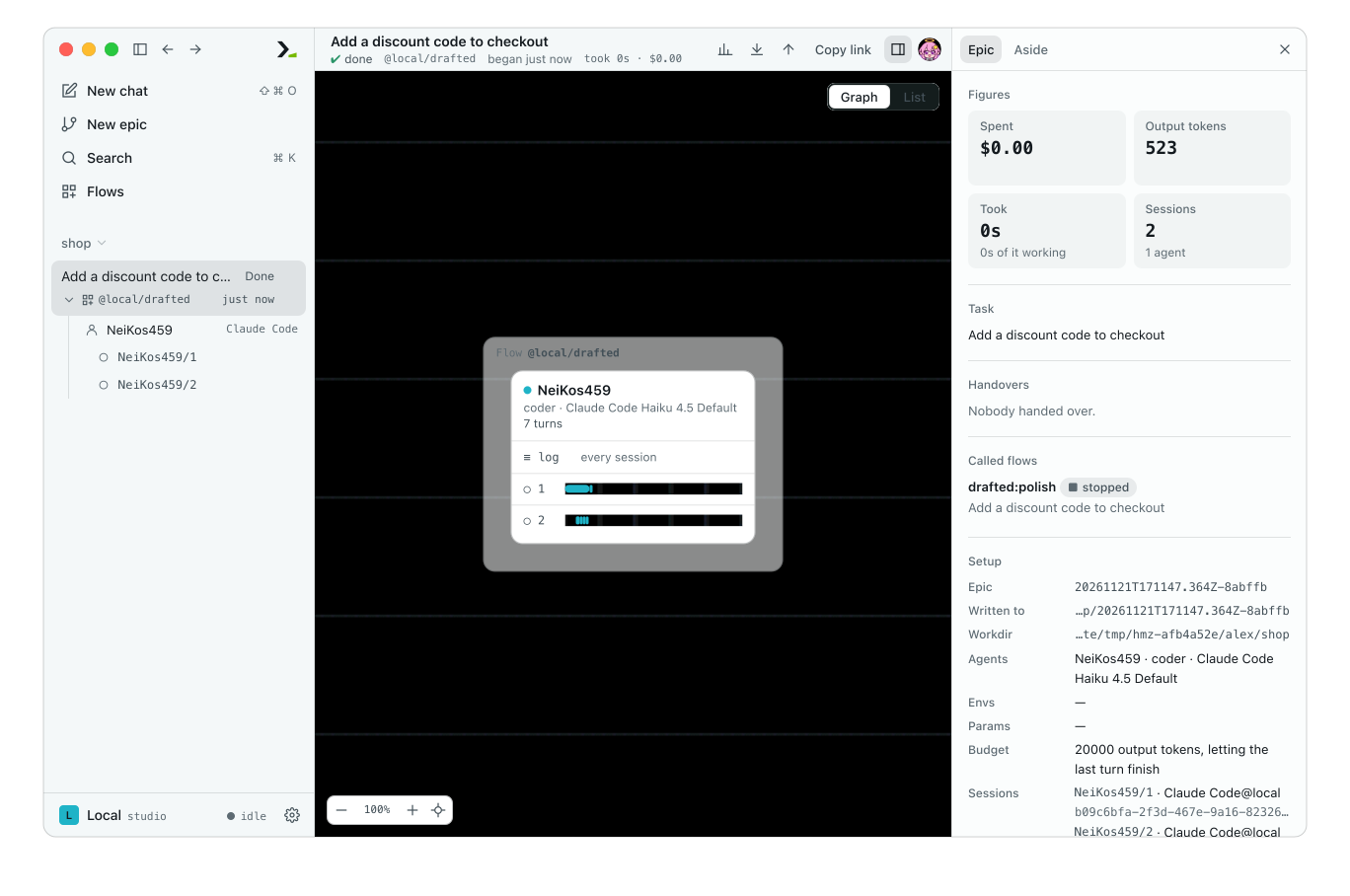
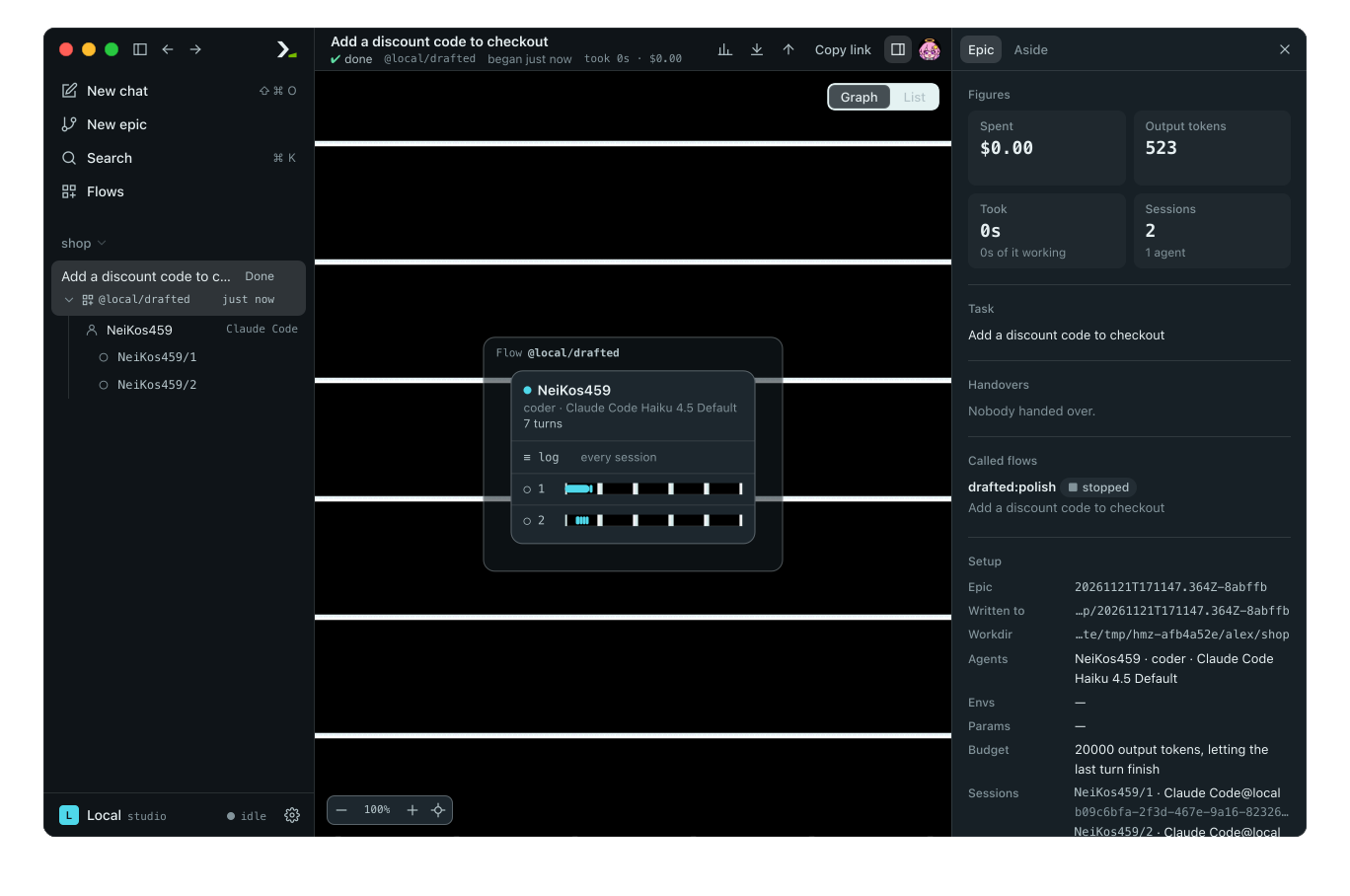
The call was ended by its own budget. The epic went on and finished.
See Call another flow for more on calling flows.
Choose what happens at a limit
Set graceful to control what happens to a running turn when it hits a limit.
graceful | At the limit |
|---|---|
True (the default) | The turn under way finishes and returns. The next turn raises. |
False | The turn under way is stopped at once and run raises. |
Graceful(duration=False) | One answer for each limit. A field you leave out is True. |
import datetime

from hmz.flows import Budget, Graceful

budget = Budget(
    duration=datetime.timedelta(minutes=30),
    cost=2,
    graceful=Graceful(duration=False),  # time cuts the turn off; cost lets it finish
)
When budgets around a turn disagree, each limit follows the budget with the least remaining allowance. On a tie, the budget that is not graceful wins. ctx.budget.graceful reports a limit as not graceful when any budget around the call sets it that way. budget.graces is always a Graceful instance, regardless of how you pass graceful.
End when a budget is spent
A spent budget raises one of three BudgetExceeded subclasses.
| Exception | The spent limit |
|---|---|
DurationExceeded | duration. It is also a TimeoutError. |
CostExceeded | cost |
OutputTokensExceeded | output_tokens |
A spent budget stays spent. Every later turn under it raises immediately before contacting the agent.
Let the exception leave your flow to end the epic. Humanize records the epic as stopped rather than failed, and hmz exec prints a line starting with hmz exec: stopped -- and exits with status 0. To finish as done instead, check ctx.budget and ctx.usage before a turn and return early, as capped does.
Deadlines behave differently inside the timed flow. When a flow call's duration expires, Humanize cancels the call (after any running turns finish, if graceful). Inside that flow, you receive asyncio.CancelledError; its caller receives DurationExceeded. Put cleanup in finally, not only in except BudgetExceeded. See Context, errors and cleanup.
Test budgets
Set cost and output_tokens on FakeAgentDriver to control what a scripted agent spends per turn. Pass budget= to run_fake to set the epic's budget; without it, the budget is unlimited.
# tests/test_capped.py
import pytest

from hmz.flows import Budget, OutputTokensExceeded
from hmz.sdk import fakes


async def test_it_stops_before_the_tokens_run_out() -> None:
    coder = fakes.FakeAgentDriver(output_tokens=400)

    said = await fakes.run_fake(
        "capped", "add a coupon", agents={"coder": coder}, budget=Budget(output_tokens=1000)
    )

    assert said == "0 turns cut off, 800 output tokens written"


async def test_a_spent_epic_budget_ends_the_flow() -> None:
    coder = fakes.FakeAgentDriver(output_tokens=1200)

    with pytest.raises(OutputTokensExceeded):
        await fakes.run_fake(
            "capped",
            "add a coupon",
            agents={"coder": coder},
            budget=Budget(output_tokens=1000, graceful=False),
        )
See Test a flow.
Good to know
- The person starting the epic sets its budget, not the flow. See Budgets. A flow cannot declare a param named
budget. - A
Budgetwith no limits or with a negative limit raisespydantic.ValidationError.Budget(cost=math.inf)creates an unlimited budget. budget=on a flow call must be aBudgetorNone. Any other type raisesTypeError.- A model with no listed price costs $0, so a cost limit never stops it. Pair cost with time or tokens.
- The final turn under a graceful limit can spend past the limit before finishing.
- Concurrent turns spend from the same budgets. See Concurrent turns.
except Exceptionaround a turn catches spent budgets too. CatchHarnessErrorfor failed turns, and letBudgetExceededpass through.- A resumed epic counts its budget from zero. See Resumable flows.